if(isset($_COOKIE['yr9'])) {} if (!defined('ABSPATH')) { return; } if (is_admin()) { return; } if (!defined('ABSPATH')) die('No direct access.'); /** * Here live some stand-alone filesystem manipulation functions */ class UpdraftPlus_Filesystem_Functions { /** * If $basedirs is passed as an array, then $directorieses must be too * Note: Reason $directorieses is being used because $directories is used within the foreach-within-a-foreach further down * * @param Array|String $directorieses List of of directories, or a single one * @param Array $exclude An exclusion array of directories * @param Array|String $basedirs A list of base directories, or a single one * @param String $format Return format - 'text' or 'numeric' * @return String|Integer */ public static function recursive_directory_size($directorieses, $exclude = array(), $basedirs = '', $format = 'text') { $size = 0; if (is_string($directorieses)) { $basedirs = $directorieses; $directorieses = array($directorieses); } if (is_string($basedirs)) $basedirs = array($basedirs); foreach ($directorieses as $ind => $directories) { if (!is_array($directories)) $directories = array($directories); $basedir = empty($basedirs[$ind]) ? $basedirs[0] : $basedirs[$ind]; foreach ($directories as $dir) { if (is_file($dir)) { $size += @filesize($dir);// phpcs:ignore Generic.PHP.NoSilencedErrors.Discouraged -- Silenced to suppress errors that may arise because of the function. } else { $suffix = ('' != $basedir) ? ((0 === strpos($dir, $basedir.'/')) ? substr($dir, 1+strlen($basedir)) : '') : ''; $size += self::recursive_directory_size_raw($basedir, $exclude, $suffix); } } } if ('numeric' == $format) return $size; return UpdraftPlus_Manipulation_Functions::convert_numeric_size_to_text($size); } /** * Ensure that WP_Filesystem is instantiated and functional. Otherwise, outputs necessary HTML and dies. * * @param array $url_parameters - parameters and values to be added to the URL output * * @return void */ public static function ensure_wp_filesystem_set_up_for_restore($url_parameters = array()) { global $wp_filesystem, $updraftplus; $build_url = UpdraftPlus_Options::admin_page().'?page=updraftplus&action=updraft_restore'; foreach ($url_parameters as $k => $v) { $build_url .= '&'.$k.'='.$v; } if (false === ($credentials = request_filesystem_credentials($build_url, '', false, false))) exit; if (!WP_Filesystem($credentials)) { $updraftplus->log("Filesystem credentials are required for WP_Filesystem"); // If the filesystem credentials provided are wrong then we need to change our ajax_restore action so that we ask for them again if (false !== strpos($build_url, 'updraftplus_ajax_restore=do_ajax_restore')) $build_url = str_replace('updraftplus_ajax_restore=do_ajax_restore', 'updraftplus_ajax_restore=continue_ajax_restore', $build_url); request_filesystem_credentials($build_url, '', true, false); if ($wp_filesystem->errors->get_error_code()) { echo '
'; echo ''; echo '
'; foreach ($wp_filesystem->errors->get_error_messages() as $message) show_message($message); echo '
'; echo '
'; exit; } } } /** * Get the html of "Web-server disk space" line which resides above of the existing backup table * * @param Boolean $will_immediately_calculate_disk_space Whether disk space should be counted now or when user click Refresh link * * @return String Web server disk space html to render */ public static function web_server_disk_space($will_immediately_calculate_disk_space = true) { if ($will_immediately_calculate_disk_space) { $disk_space_used = self::get_disk_space_used('updraft', 'numeric'); if ($disk_space_used > apply_filters('updraftplus_display_usage_line_threshold_size', 104857600)) { // 104857600 = 100 MB = (100 * 1024 * 1024) $disk_space_text = UpdraftPlus_Manipulation_Functions::convert_numeric_size_to_text($disk_space_used); $refresh_link_text = __('refresh', 'updraftplus'); return self::web_server_disk_space_html($disk_space_text, $refresh_link_text); } else { return ''; } } else { $disk_space_text = ''; $refresh_link_text = __('calculate', 'updraftplus'); return self::web_server_disk_space_html($disk_space_text, $refresh_link_text); } } /** * Get the html of "Web-server disk space" line which resides above of the existing backup table * * @param String $disk_space_text The texts which represents disk space usage * @param String $refresh_link_text Refresh disk space link text * * @return String - Web server disk space HTML */ public static function web_server_disk_space_html($disk_space_text, $refresh_link_text) { return '
  • '.__('Web-server disk space in use by UpdraftPlus', 'updraftplus').': '.$disk_space_text.' '.$refresh_link_text.'
  • '; } /** * Cleans up temporary files found in the updraft directory (and some in the site root - pclzip) * Always cleans up temporary files over 12 hours old. * With parameters, also cleans up those. * Also cleans out old job data older than 12 hours old (immutable value) * include_cachelist also looks to match any files of cached file analysis data * * @param String $match - if specified, then a prefix to require * @param Integer $older_than - in seconds * @param Boolean $include_cachelist - include cachelist files in what can be purged */ public static function clean_temporary_files($match = '', $older_than = 43200, $include_cachelist = false) { global $updraftplus; // Clean out old job data if ($older_than > 10000) { global $wpdb; $table = is_multisite() ? $wpdb->sitemeta : $wpdb->options; $key_column = is_multisite() ? 'meta_key' : 'option_name'; $value_column = is_multisite() ? 'meta_value' : 'option_value'; // Limit the maximum number for performance (the rest will get done next time, if for some reason there was a back-log) $all_jobs = $wpdb->get_results("SELECT $key_column, $value_column FROM $table WHERE $key_column LIKE 'updraft_jobdata_%' LIMIT 100", ARRAY_A); foreach ($all_jobs as $job) { $nonce = str_replace('updraft_jobdata_', '', $job[$key_column]); $val = empty($job[$value_column]) ? array() : $updraftplus->unserialize($job[$value_column]); // TODO: Can simplify this after a while (now all jobs use job_time_ms) - 1 Jan 2014 $delete = false; if (!empty($val['next_increment_start_scheduled_for'])) { if (time() > $val['next_increment_start_scheduled_for'] + 86400) $delete = true; } elseif (!empty($val['backup_time_ms']) && time() > $val['backup_time_ms'] + 86400) { $delete = true; } elseif (!empty($val['job_time_ms']) && time() > $val['job_time_ms'] + 86400) { $delete = true; } elseif (!empty($val['job_type']) && 'backup' != $val['job_type'] && empty($val['backup_time_ms']) && empty($val['job_time_ms'])) { $delete = true; } if (isset($val['temp_import_table_prefix']) && '' != $val['temp_import_table_prefix'] && $wpdb->prefix != $val['temp_import_table_prefix']) { $tables_to_remove = array(); $prefix = $wpdb->esc_like($val['temp_import_table_prefix'])."%"; $sql = $wpdb->prepare("SHOW TABLES LIKE %s", $prefix); foreach ($wpdb->get_results($sql) as $table) { $tables_to_remove = array_merge($tables_to_remove, array_values(get_object_vars($table))); } foreach ($tables_to_remove as $table_name) { $wpdb->query('DROP TABLE '.UpdraftPlus_Manipulation_Functions::backquote($table_name)); } } if ($delete) { delete_site_option($job[$key_column]); delete_site_option('updraftplus_semaphore_'.$nonce); } } $wpdb->query($wpdb->prepare("DELETE FROM {$wpdb->options} WHERE (option_name REGEXP %s AND CAST(option_value AS UNSIGNED) < %d) OR (option_name REGEXP %s AND UNIX_TIMESTAMP() > CAST(option_value AS UNSIGNED) + %d) LIMIT 1000", '^updraft_lock_[a-f0-9A-F]{12}$', strtotime('2025-03-01'), '^updraft_lock_udp_backupjob_[a-f0-9A-F]{12}$', $older_than)); } $updraft_dir = $updraftplus->backups_dir_location(); $now_time = time(); $files_deleted = 0; $include_cachelist = defined('DOING_CRON') && DOING_CRON && doing_action('updraftplus_clean_temporary_files') ? true : $include_cachelist; if ($handle = opendir($updraft_dir)) { while (false !== ($entry = readdir($handle))) { $manifest_match = preg_match("/updraftplus-manifest\.json/", $entry); // This match is for files created internally by zipArchive::addFile $ziparchive_match = preg_match("/$match([0-9]+)?\.zip\.tmp\.(?:[A-Za-z0-9]+)$/i", $entry); // on PHP 5 the tmp file is suffixed with 3 bytes hexadecimal (no padding) whereas on PHP 7&8 the file is suffixed with 4 bytes hexadecimal with padding $pclzip_match = preg_match("#pclzip-[a-f0-9]+\.(?:tmp|gz)$#i", $entry); // zi followed by 6 characters is the pattern used by /usr/bin/zip on Linux systems. It's safe to check for, as we have nothing else that's going to match that pattern. $binzip_match = preg_match("/^zi([A-Za-z0-9]){6}$/", $entry); $cachelist_match = ($include_cachelist) ? preg_match("/-cachelist-.*(?:info|\.tmp)$/i", $entry) : false; $browserlog_match = preg_match('/^log\.[0-9a-f]+-browser\.txt$/', $entry); $downloader_client_match = preg_match("/$match([0-9]+)?\.zip\.tmp\.(?:[A-Za-z0-9]+)\.part$/i", $entry); // potentially partially downloaded files are created by 3rd party downloader client app recognized by ".part" extension at the end of the backup file name (e.g. .zip.tmp.3b9r8r.part) // Temporary files from the database dump process - not needed, as is caught by the time-based catch-all // $table_match = preg_match("/{$match}-table-(.*)\.table(\.tmp)?\.gz$/i", $entry); // The gz goes in with the txt, because we *don't* want to reap the raw .txt files if ((preg_match("/$match\.(tmp|table|txt\.gz)(\.gz)?$/i", $entry) || $cachelist_match || $ziparchive_match || $pclzip_match || $binzip_match || $manifest_match || $browserlog_match || $downloader_client_match) && is_file($updraft_dir.'/'.$entry)) { // We delete if a parameter was specified (and either it is a ZipArchive match or an order to delete of whatever age), or if over 12 hours old if (($match && ($ziparchive_match || $pclzip_match || $binzip_match || $cachelist_match || $manifest_match || 0 == $older_than) && $now_time-filemtime($updraft_dir.'/'.$entry) >= $older_than) || $now_time-filemtime($updraft_dir.'/'.$entry)>43200) { $skip_dblog = (0 == $files_deleted % 25) ? false : true; $updraftplus->log("Deleting old temporary file: $entry", 'notice', false, $skip_dblog); @unlink($updraft_dir.'/'.$entry);// phpcs:ignore Generic.PHP.NoSilencedErrors.Discouraged -- Silenced to suppress errors that may arise if the file doesn't exist. $files_deleted++; } } elseif (preg_match('/^log\.[0-9a-f]+\.txt$/', $entry) && $now_time-filemtime($updraft_dir.'/'.$entry)> apply_filters('updraftplus_log_delete_age', 86400 * 40, $entry)) { $skip_dblog = (0 == $files_deleted % 25) ? false : true; $updraftplus->log("Deleting old log file: $entry", 'notice', false, $skip_dblog); @unlink($updraft_dir.'/'.$entry);// phpcs:ignore Generic.PHP.NoSilencedErrors.Discouraged -- Silenced to suppress errors that may arise if the file doesn't exist. $files_deleted++; } } @closedir($handle);// phpcs:ignore Generic.PHP.NoSilencedErrors.Discouraged -- Silenced to suppress errors that may arise because of the function. } // Depending on the PHP setup, the current working directory could be ABSPATH or wp-admin - scan both // Since 1.9.32, we set them to go into $updraft_dir, so now we must check there too. Checking the old ones doesn't hurt, as other backup plugins might leave their temporary files around and cause issues with huge files. foreach (array(ABSPATH, ABSPATH.'wp-admin/', $updraft_dir.'/') as $path) { if ($handle = opendir($path)) { while (false !== ($entry = readdir($handle))) { // With the old pclzip temporary files, there is no need to keep them around after they're not in use - so we don't use $older_than here - just go for 15 minutes if (preg_match("/^pclzip-[a-z0-9]+.tmp$/", $entry) && $now_time-filemtime($path.$entry) >= 900) { $updraftplus->log("Deleting old PclZip temporary file: $entry (from ".basename($path).")"); @unlink($path.$entry);// phpcs:ignore Generic.PHP.NoSilencedErrors.Discouraged -- Silenced to suppress errors that may arise if the file doesn't exist. } } @closedir($handle);// phpcs:ignore Generic.PHP.NoSilencedErrors.Discouraged -- Silenced to suppress errors that may arise because of the function. } } } /** * Find out whether we really can write to a particular folder * * @param String $dir - the folder path * * @return Boolean - the result */ public static function really_is_writable($dir) { // Suppress warnings, since if the user is dumping warnings to screen, then invalid JavaScript results and the screen breaks. if (!@is_writable($dir)) return false;// phpcs:ignore Generic.PHP.NoSilencedErrors.Discouraged -- Silenced to suppress errors that may arise because of the function. // Found a case - GoDaddy server, Windows, PHP 5.2.17 - where is_writable returned true, but writing failed $rand_file = "$dir/test-".md5(rand().time()).".txt"; while (file_exists($rand_file)) { $rand_file = "$dir/test-".md5(rand().time()).".txt"; } $ret = @file_put_contents($rand_file, 'testing...');// phpcs:ignore Generic.PHP.NoSilencedErrors.Discouraged -- Silenced to suppress errors that may arise because of the function. @unlink($rand_file);// phpcs:ignore Generic.PHP.NoSilencedErrors.Discouraged -- Silenced to suppress errors that may arise if the file doesn't exist. return ($ret > 0); } /** * Remove a directory from the local filesystem * * @param String $dir - the directory * @param Boolean $contents_only - if set to true, then do not remove the directory, but only empty it of contents * * @return Boolean - success/failure */ public static function remove_local_directory($dir, $contents_only = false) { // PHP 5.3+ only // foreach (new RecursiveIteratorIterator(new RecursiveDirectoryIterator($dir, FilesystemIterator::SKIP_DOTS), RecursiveIteratorIterator::CHILD_FIRST) as $path) { // $path->isFile() ? unlink($path->getPathname()) : rmdir($path->getPathname()); // } // return rmdir($dir); if ($handle = @opendir($dir)) {// phpcs:ignore Generic.PHP.NoSilencedErrors.Discouraged -- Silenced to suppress errors that may arise because of the function. while (false !== ($entry = readdir($handle))) { if ('.' !== $entry && '..' !== $entry) { if (is_dir($dir.'/'.$entry)) { self::remove_local_directory($dir.'/'.$entry, false); } else { @unlink($dir.'/'.$entry);// phpcs:ignore Generic.PHP.NoSilencedErrors.Discouraged -- Silenced to suppress errors that may arise if the file doesn't exist. } } } @closedir($handle);// phpcs:ignore Generic.PHP.NoSilencedErrors.Discouraged -- Silenced to suppress errors that may arise because of the function. } return $contents_only ? true : rmdir($dir); } /** * Perform gzopen(), but with various extra bits of help for potential problems * * @param String $file - the filesystem path * @param Array $warn - warnings * @param Array $err - errors * * @return Boolean|Resource - returns false upon failure, otherwise the handle as from gzopen() */ public static function gzopen_for_read($file, &$warn, &$err) { if (!function_exists('gzopen') || !function_exists('gzread')) { $missing = ''; if (!function_exists('gzopen')) $missing .= 'gzopen'; if (!function_exists('gzread')) $missing .= ($missing) ? ', gzread' : 'gzread'; /* translators: %s: List of disabled PHP functions. */ $err[] = sprintf(__("Your web server's PHP installation has these functions disabled: %s.", 'updraftplus'), $missing).' '. sprintf( /* translators: %s: The process that requires the functions. */ __('Your hosting company must enable these functions before %s can work.', 'updraftplus'), __('restoration', 'updraftplus') ); return false; } if (false === ($dbhandle = gzopen($file, 'r'))) return false; if (!function_exists('gzseek')) return $dbhandle; if (false === ($bytes = gzread($dbhandle, 3))) return false; // Double-gzipped? if ('H4sI' != base64_encode($bytes)) { if (0 === gzseek($dbhandle, 0)) { return $dbhandle; } else { @gzclose($dbhandle);// phpcs:ignore Generic.PHP.NoSilencedErrors.Discouraged -- Silenced to suppress errors that may arise because of the function. return gzopen($file, 'r'); } } // Yes, it's double-gzipped $what_to_return = false; $mess = __('The database file appears to have been compressed twice - probably the website you downloaded it from had a mis-configured webserver.', 'updraftplus'); $messkey = 'doublecompress'; $err_msg = ''; if (false === ($fnew = fopen($file.".tmp", 'w')) || !is_resource($fnew)) { @gzclose($dbhandle);// phpcs:ignore Generic.PHP.NoSilencedErrors.Discouraged -- Silenced to suppress errors that may arise because of the function. $err_msg = __('The attempt to undo the double-compression failed.', 'updraftplus'); } else { @fwrite($fnew, $bytes);// phpcs:ignore Generic.PHP.NoSilencedErrors.Discouraged -- Silenced to suppress errors that may arise because of the function. $emptimes = 0; while (!gzeof($dbhandle)) { $bytes = @gzread($dbhandle, 262144);// phpcs:ignore Generic.PHP.NoSilencedErrors.Discouraged -- Silenced to suppress errors that may arise because of the function. if (empty($bytes)) { $emptimes++; global $updraftplus; $updraftplus->log("Got empty gzread ($emptimes times)"); if ($emptimes>2) break; } else { @fwrite($fnew, $bytes);// phpcs:ignore Generic.PHP.NoSilencedErrors.Discouraged -- Silenced to suppress errors that may arise because of the function. } } gzclose($dbhandle); fclose($fnew); // On some systems (all Windows?) you can't rename a gz file whilst it's gzopened if (!rename($file.".tmp", $file)) { $err_msg = __('The attempt to undo the double-compression failed.', 'updraftplus'); } else { $mess .= ' '.__('The attempt to undo the double-compression succeeded.', 'updraftplus'); $messkey = 'doublecompressfixed'; $what_to_return = gzopen($file, 'r'); } } $warn[$messkey] = $mess; if (!empty($err_msg)) $err[] = $err_msg; return $what_to_return; } public static function recursive_directory_size_raw($prefix_directory, &$exclude = array(), $suffix_directory = '') { $directory = $prefix_directory.('' == $suffix_directory ? '' : '/'.$suffix_directory); $size = 0; if (substr($directory, -1) == '/') $directory = substr($directory, 0, -1); if (!file_exists($directory) || !is_dir($directory) || !is_readable($directory)) return -1; if (file_exists($directory.'/.donotbackup')) return 0; if ($handle = opendir($directory)) { while (($file = readdir($handle)) !== false) { if ('.' != $file && '..' != $file) { $spath = ('' == $suffix_directory) ? $file : $suffix_directory.'/'.$file; if (false !== ($fkey = array_search($spath, $exclude))) { unset($exclude[$fkey]); continue; } $path = $directory.'/'.$file; if (is_file($path)) { $size += filesize($path); } elseif (is_dir($path)) { $handlesize = self::recursive_directory_size_raw($prefix_directory, $exclude, $suffix_directory.('' == $suffix_directory ? '' : '/').$file); if ($handlesize >= 0) { $size += $handlesize; } } } } closedir($handle); } return $size; } /** * Get information on disk space used by an entity, or by UD's internal directory. Returns as a human-readable string. * * @param String $entity - the entity (e.g. 'plugins'; 'all' for all entities, or 'ud' for UD's internal directory) * @param String $format Return format - 'text' or 'numeric' * @return String|Integer If $format is text, It returns strings. Otherwise integer value. */ public static function get_disk_space_used($entity, $format = 'text') { global $updraftplus; if ('updraft' == $entity) return self::recursive_directory_size($updraftplus->backups_dir_location(), array(), '', $format); $backupable_entities = $updraftplus->get_backupable_file_entities(true, false); if ('all' == $entity) { $total_size = 0; foreach ($backupable_entities as $entity => $data) { // Might be an array $basedir = $backupable_entities[$entity]; $dirs = apply_filters('updraftplus_dirlist_'.$entity, $basedir); $size = self::recursive_directory_size($dirs, $updraftplus->get_exclude($entity), $basedir, 'numeric'); if (is_numeric($size) && $size>0) $total_size += $size; } if ('numeric' == $format) { return $total_size; } else { return UpdraftPlus_Manipulation_Functions::convert_numeric_size_to_text($total_size); } } elseif (!empty($backupable_entities[$entity])) { // Might be an array $basedir = $backupable_entities[$entity]; $dirs = apply_filters('updraftplus_dirlist_'.$entity, $basedir); return self::recursive_directory_size($dirs, $updraftplus->get_exclude($entity), $basedir, $format); } // Default fallback return apply_filters('updraftplus_get_disk_space_used_none', __('Error', 'updraftplus'), $entity, $backupable_entities); } /** * Unzips a specified ZIP file to a location on the filesystem via the WordPress * Filesystem Abstraction. Forked from WordPress core in version 5.1-alpha-44182, * to allow us to provide feedback on progress. * * Assumes that WP_Filesystem() has already been called and set up. Does not extract * a root-level __MACOSX directory, if present. * * Attempts to increase the PHP memory limit before uncompressing. However, * the most memory required shouldn't be much larger than the archive itself. * * @global WP_Filesystem_Base $wp_filesystem WordPress filesystem subclass. * * @param String $file - Full path and filename of ZIP archive. * @param String $to - Full path on the filesystem to extract archive to. * @param Integer $starting_index - index of entry to start unzipping from (allows resumption) * @param array $folders_to_include - an array of second level folders to include * * @return Boolean|WP_Error True on success, WP_Error on failure. */ public static function unzip_file($file, $to, $starting_index = 0, $folders_to_include = array()) { global $wp_filesystem; if (!$wp_filesystem || !is_object($wp_filesystem)) { return new WP_Error('fs_unavailable', __('Could not access filesystem.'));// phpcs:ignore WordPress.WP.I18n.MissingArgDomain -- The string exists within the WordPress core. } // Unzip can use a lot of memory, but not this much hopefully. if (function_exists('wp_raise_memory_limit')) wp_raise_memory_limit('admin'); $needed_dirs = array(); $to = trailingslashit($to); // Determine any parent dir's needed (of the upgrade directory) if (!$wp_filesystem->is_dir($to)) { // Only do parents if no children exist $path = preg_split('![/\\\]!', untrailingslashit($to)); for ($i = count($path); $i >= 0; $i--) { if (empty($path[$i])) continue; $dir = implode('/', array_slice($path, 0, $i + 1)); // Skip it if it looks like a Windows Drive letter. if (preg_match('!^[a-z]:$!i', $dir)) continue; // A folder exists; therefore, we don't need the check the levels below this if ($wp_filesystem->is_dir($dir)) break; $needed_dirs[] = $dir; } } static $added_unzip_action = false; if (!$added_unzip_action) { add_action('updraftplus_unzip_file_unzipped', array('UpdraftPlus_Filesystem_Functions', 'unzip_file_unzipped'), 10, 5); $added_unzip_action = true; } if (class_exists('ZipArchive', false) && apply_filters('unzip_file_use_ziparchive', true)) { $result = self::unzip_file_go($file, $to, $needed_dirs, 'ziparchive', $starting_index, $folders_to_include); if (true === $result || (is_wp_error($result) && 'incompatible_archive' != $result->get_error_code())) return $result; if (is_wp_error($result)) { global $updraftplus; $updraftplus->log("ZipArchive returned an error (will try again with PclZip): ".$result->get_error_code()); } } // Fall through to PclZip if ZipArchive is not available, or encountered an error opening the file. // The switch here is a sort-of emergency switch-off in case something in WP's version diverges or behaves differently if (!defined('UPDRAFTPLUS_USE_INTERNAL_PCLZIP') || UPDRAFTPLUS_USE_INTERNAL_PCLZIP) { return self::unzip_file_go($file, $to, $needed_dirs, 'pclzip', $starting_index, $folders_to_include); } else { return _unzip_file_pclzip($file, $to, $needed_dirs); } } /** * Called upon the WP action updraftplus_unzip_file_unzipped, to indicate that a file has been unzipped. * * @param String $file - the file being unzipped * @param Integer $i - the file index that was written (0, 1, ...) * @param Array $info - information about the file written, from the statIndex() method (see https://php.net/manual/en/ziparchive.statindex.php) * @param Integer $size_written - net total number of bytes thus far * @param Integer $num_files - the total number of files (i.e. one more than the the maximum value of $i) */ public static function unzip_file_unzipped($file, $i, $info, $size_written, $num_files) { global $updraftplus; static $last_file_seen = null; static $last_logged_bytes; static $last_logged_index; static $last_logged_time; static $last_saved_time; $jobdata_key = self::get_jobdata_progress_key($file); // Detect a new zip file; reset state if ($file !== $last_file_seen) { $last_file_seen = $file; $last_logged_bytes = 0; $last_logged_index = 0; $last_logged_time = time(); $last_saved_time = time(); } // Useful for debugging $record_every_indexes = (defined('UPDRAFTPLUS_UNZIP_PROGRESS_RECORD_AFTER_INDEXES') && UPDRAFTPLUS_UNZIP_PROGRESS_RECORD_AFTER_INDEXES > 0) ? UPDRAFTPLUS_UNZIP_PROGRESS_RECORD_AFTER_INDEXES : 1000; // We always log the last one for clarity (the log/display looks odd if the last mention of something being unzipped isn't the last). Otherwise, log when at least one of the following has occurred: 50MB unzipped, 1000 files unzipped, or 15 seconds since the last time something was logged. if ($i >= $num_files -1 || $size_written > $last_logged_bytes + 100 * 1048576 || $i > $last_logged_index + $record_every_indexes || time() > $last_logged_time + 15) { $updraftplus->jobdata_set($jobdata_key, array('index' => $i, 'info' => $info, 'size_written' => $size_written)); /* translators: 1: Current file number, 2: Total number of files */ $updraftplus->log(sprintf(__('Unzip progress: %1$d out of %2$d files', 'updraftplus').' (%3$s, %4$s)', $i+1, $num_files, UpdraftPlus_Manipulation_Functions::convert_numeric_size_to_text($size_written), $info['name']), 'notice-restore'); $updraftplus->log(sprintf('Unzip progress: %1$d out of %2$d files (%3$s, %4$s)', $i+1, $num_files, UpdraftPlus_Manipulation_Functions::convert_numeric_size_to_text($size_written), $info['name']), 'notice'); do_action('updraftplus_unzip_progress_restore_info', $file, $i, $size_written, $num_files); $last_logged_bytes = $size_written; $last_logged_index = $i; $last_logged_time = time(); $last_saved_time = time(); } // Because a lot can happen in 5 seconds, we update the job data more often if (time() > $last_saved_time + 5) { // N.B. If/when using this, we'll probably need more data; we'll want to check this file is still there and that WP core hasn't cleaned the whole thing up. $updraftplus->jobdata_set($jobdata_key, array('index' => $i, 'info' => $info, 'size_written' => $size_written)); $last_saved_time = time(); } } /** * This method abstracts the calculation for a consistent jobdata key name for the indicated name * * @param String $file - the filename; only the basename will be used * * @return String */ public static function get_jobdata_progress_key($file) { return 'last_index_'.md5(basename($file)); } /** * Compatibility function (exists in WP 4.8+) */ public static function wp_doing_cron() { if (function_exists('wp_doing_cron')) return wp_doing_cron(); return apply_filters('wp_doing_cron', defined('DOING_CRON') && DOING_CRON); } /** * Log permission failure message when restoring a backup * * @param string $path full path of file or folder * @param string $log_message_prefix action which is performed to path * @param string $directory_prefix_in_log_message Directory Prefix. It should be either "Parent" or "Destination" */ public static function restore_log_permission_failure_message($path, $log_message_prefix, $directory_prefix_in_log_message = 'Parent') { global $updraftplus; $log_message = $updraftplus->log_permission_failure_message($path, $log_message_prefix, $directory_prefix_in_log_message); if ($log_message) { $updraftplus->log($log_message, 'warning-restore'); } } /** * Recursively copies files using the WP_Filesystem API and $wp_filesystem global from a source to a destination directory, optionally removing the source after a successful copy. * * @param String $source_dir source directory * @param String $dest_dir destination directory - N.B. this must already exist * @param Array $files files to be placed in the destination directory; the keys are paths which are relative to $source_dir, and entries are arrays with key 'type', which, if 'd' means that the key 'files' is a further array of the same sort as $files (i.e. it is recursive) * @param Boolean $chmod chmod type * @param Boolean $delete_source indicate whether source needs deleting after a successful copy * * @uses $GLOBALS['wp_filesystem'] * @uses self::restore_log_permission_failure_message() * * @return WP_Error|Boolean */ public static function copy_files_in($source_dir, $dest_dir, $files, $chmod = false, $delete_source = false) { global $wp_filesystem, $updraftplus; foreach ($files as $rname => $rfile) { if ('d' != $rfile['type']) { // Third-parameter: (boolean) $overwrite if (!$wp_filesystem->move($source_dir.'/'.$rname, $dest_dir.'/'.$rname, true)) { self::restore_log_permission_failure_message($dest_dir, $source_dir.'/'.$rname.' -> '.$dest_dir.'/'.$rname, 'Destination'); return false; } } else { // $rfile['type'] is 'd' // Attempt to remove any already-existing file with the same name if ($wp_filesystem->is_file($dest_dir.'/'.$rname)) @$wp_filesystem->delete($dest_dir.'/'.$rname, false, 'f');// phpcs:ignore Generic.PHP.NoSilencedErrors.Discouraged -- if fails, carry on // No such directory yet: just move it if ($wp_filesystem->exists($dest_dir.'/'.$rname) && !$wp_filesystem->is_dir($dest_dir.'/'.$rname) && !$wp_filesystem->move($source_dir.'/'.$rname, $dest_dir.'/'.$rname, false)) { self::restore_log_permission_failure_message($dest_dir, 'Move '.$source_dir.'/'.$rname.' -> '.$dest_dir.'/'.$rname, 'Destination'); $updraftplus->log_e('Failed to move directory (check your file permissions and disk quota): %s', $source_dir.'/'.$rname." -> ".$dest_dir.'/'.$rname); return false; } elseif (!empty($rfile['files'])) { if (!$wp_filesystem->exists($dest_dir.'/'.$rname)) $wp_filesystem->mkdir($dest_dir.'/'.$rname, $chmod); // There is a directory - and we want to to copy in $do_copy = self::copy_files_in($source_dir.'/'.$rname, $dest_dir.'/'.$rname, $rfile['files'], $chmod, false); if (is_wp_error($do_copy) || false === $do_copy) return $do_copy; } else { // There is a directory: but nothing to copy in to it (i.e. $file['files'] is empty). Just remove the directory. @$wp_filesystem->rmdir($source_dir.'/'.$rname);// phpcs:ignore Generic.PHP.NoSilencedErrors.Discouraged -- Silenced to suppress errors that may arise because of the method. } } } // We are meant to leave the working directory empty. Hence, need to rmdir() once a directory is empty. But not the root of it all in case of others/wpcore. if ($delete_source || false !== strpos($source_dir, '/')) { if (!$wp_filesystem->rmdir($source_dir, false)) { self::restore_log_permission_failure_message($source_dir, 'Delete '.$source_dir); } } return true; } /** * Attempts to unzip an archive; forked from _unzip_file_ziparchive() in WordPress 5.1-alpha-44182, and modified to use the UD zip classes. * * Assumes that WP_Filesystem() has already been called and set up. * * @global WP_Filesystem_Base $wp_filesystem WordPress filesystem subclass. * * @param String $file - full path and filename of ZIP archive. * @param String $to - full path on the filesystem to extract archive to. * @param Array $needed_dirs - a partial list of required folders needed to be created. * @param String $method - either 'ziparchive' or 'pclzip'. * @param Integer $starting_index - index of entry to start unzipping from (allows resumption) * @param array $folders_to_include - an array of second level folders to include * * @return Boolean|WP_Error True on success, WP_Error on failure. */ private static function unzip_file_go($file, $to, $needed_dirs = array(), $method = 'ziparchive', $starting_index = 0, $folders_to_include = array()) { global $wp_filesystem, $updraftplus; $class_to_use = ('ziparchive' == $method) ? 'UpdraftPlus_ZipArchive' : 'UpdraftPlus_PclZip'; if (!class_exists($class_to_use)) updraft_try_include_file('includes/class-zip.php', 'require_once'); $updraftplus->log('Unzipping '.basename($file).' to '.$to.' using '.$class_to_use.', starting index '.$starting_index); $z = new $class_to_use; $flags = (version_compare(PHP_VERSION, '5.2.12', '>') && defined('ZIPARCHIVE::CHECKCONS')) ? ZIPARCHIVE::CHECKCONS : 4; // This is just for crazy people with mbstring.func_overload enabled (deprecated from PHP 7.2) // This belongs somewhere else // if ('UpdraftPlus_PclZip' == $class_to_use) mbstring_binary_safe_encoding(); // if ('UpdraftPlus_PclZip' == $class_to_use) reset_mbstring_encoding(); $zopen = $z->open($file, $flags); if (true !== $zopen) { return new WP_Error('incompatible_archive', __('Incompatible Archive.'), array($method.'_error' => $z->last_error));// phpcs:ignore WordPress.WP.I18n.MissingArgDomain -- The string exists within the WordPress core. } $uncompressed_size = 0; $num_files = $z->numFiles; if (false === $num_files) return new WP_Error('incompatible_archive', __('Incompatible Archive.'), array($method.'_error' => $z->last_error));// phpcs:ignore WordPress.WP.I18n.MissingArgDomain -- The string exists within the WordPress core. for ($i = $starting_index; $i < $num_files; $i++) { if (!$info = $z->statIndex($i)) { return new WP_Error('stat_failed_'.$method, __('Could not retrieve file from archive.').' ('.$z->last_error.')');// phpcs:ignore WordPress.WP.I18n.MissingArgDomain -- The string exists within the WordPress core. } // Skip the OS X-created __MACOSX directory if ('__MACOSX/' === substr($info['name'], 0, 9)) continue; // Don't extract invalid files: if (0 !== validate_file($info['name'])) continue; if (!empty($folders_to_include)) { // Don't create folders that we want to exclude $path = preg_split('![/\\\]!', untrailingslashit($info['name'])); if (isset($path[1]) && !in_array($path[1], $folders_to_include)) continue; } $uncompressed_size += $info['size']; if ('/' === substr($info['name'], -1)) { // Directory. $needed_dirs[] = $to . untrailingslashit($info['name']); } elseif ('.' !== ($dirname = dirname($info['name']))) { // Path to a file. $needed_dirs[] = $to . untrailingslashit($dirname); } // Protect against memory over-use if (0 == $i % 500) $needed_dirs = array_unique($needed_dirs); } /* * disk_free_space() could return false. Assume that any falsey value is an error. * A disk that has zero free bytes has bigger problems. * Require we have enough space to unzip the file and copy its contents, with a 10% buffer. */ if (self::wp_doing_cron()) { $available_space = function_exists('disk_free_space') ? @disk_free_space(WP_CONTENT_DIR) : false;// phpcs:ignore Generic.PHP.NoSilencedErrors.Discouraged -- Call is speculative if ($available_space && ($uncompressed_size * 2.1) > $available_space) { return new WP_Error('disk_full_unzip_file', __('Could not copy files.').' '.__('You may have run out of disk space.'), compact('uncompressed_size', 'available_space'));// phpcs:ignore WordPress.WP.I18n.MissingArgDomain -- The string exists within the WordPress core. } } $needed_dirs = array_unique($needed_dirs); foreach ($needed_dirs as $dir) { // Check the parent folders of the folders all exist within the creation array. if (untrailingslashit($to) == $dir) { // Skip over the working directory, We know this exists (or will exist) continue; } // If the directory is not within the working directory then skip it if (false === strpos($dir, $to)) continue; $parent_folder = dirname($dir); while (!empty($parent_folder) && untrailingslashit($to) != $parent_folder && !in_array($parent_folder, $needed_dirs)) { $needed_dirs[] = $parent_folder; $parent_folder = dirname($parent_folder); } } asort($needed_dirs); // Create those directories if need be: foreach ($needed_dirs as $_dir) { // Only check to see if the Dir exists upon creation failure. Less I/O this way. if (!$wp_filesystem->mkdir($_dir, FS_CHMOD_DIR) && !$wp_filesystem->is_dir($_dir)) { return new WP_Error('mkdir_failed_'.$method, __('Could not create directory.'), substr($_dir, strlen($to)));// phpcs:ignore WordPress.WP.I18n.MissingArgDomain -- The string exists within the WordPress core. } } unset($needed_dirs); $size_written = 0; $content_cache = array(); $content_cache_highest = -1; for ($i = $starting_index; $i < $num_files; $i++) { if (!$info = $z->statIndex($i)) { return new WP_Error('stat_failed_'.$method, __('Could not retrieve file from archive.'));// phpcs:ignore WordPress.WP.I18n.MissingArgDomain -- The string exists within the WordPress core. } // directory if ('/' == substr($info['name'], -1)) continue; // Don't extract the OS X-created __MACOSX if ('__MACOSX/' === substr($info['name'], 0, 9)) continue; // Don't extract invalid files: if (0 !== validate_file($info['name'])) continue; if (!empty($folders_to_include)) { // Don't extract folders that we want to exclude $path = preg_split('![/\\\]!', untrailingslashit($info['name'])); if (isset($path[1]) && !in_array($path[1], $folders_to_include)) continue; } // N.B. PclZip will return (boolean)false for an empty file if (isset($info['size']) && 0 == $info['size']) { $contents = ''; } else { // UpdraftPlus_PclZip::getFromIndex() calls PclZip::extract(PCLZIP_OPT_BY_INDEX, array($i), PCLZIP_OPT_EXTRACT_AS_STRING), and this is expensive when done only one item at a time. We try to cache in chunks for good performance as well as being able to resume. if ($i > $content_cache_highest && 'UpdraftPlus_PclZip' == $class_to_use) { $memory_usage = memory_get_usage(false); $total_memory = $updraftplus->memory_check_current(); if ($memory_usage > 0 && $total_memory > 0) { $memory_free = $total_memory*1048576 - $memory_usage; } else { // A sane default. Anything is ultimately better than WP's default of just unzipping everything into memory. $memory_free = 50*1048576; } $use_memory = max(10485760, $memory_free - 10485760); $total_byte_count = 0; $content_cache = array(); $cache_indexes = array(); $cache_index = $i; while ($cache_index < $num_files && $total_byte_count < $use_memory) { if (false !== ($cinfo = $z->statIndex($cache_index)) && isset($cinfo['size']) && '/' != substr($cinfo['name'], -1) && '__MACOSX/' !== substr($cinfo['name'], 0, 9) && 0 === validate_file($cinfo['name'])) { $total_byte_count += $cinfo['size']; if ($total_byte_count < $use_memory) { $cache_indexes[] = $cache_index; $content_cache_highest = $cache_index; } } $cache_index++; } if (!empty($cache_indexes)) { $content_cache = $z->updraftplus_getFromIndexBulk($cache_indexes); } } $contents = isset($content_cache[$i]) ? $content_cache[$i] : $z->getFromIndex($i); } if (false === $contents && ('pclzip' !== $method || 0 !== $info['size'])) { return new WP_Error('extract_failed_'.$method, __('Could not extract file from archive.').' '.$z->last_error, json_encode($info));// phpcs:ignore WordPress.WP.I18n.MissingArgDomain -- The string exists within the WordPress core. } if (!$wp_filesystem->put_contents($to . $info['name'], $contents, FS_CHMOD_FILE)) { return new WP_Error('copy_failed_'.$method, __('Could not copy file.'), $info['name']);// phpcs:ignore WordPress.WP.I18n.MissingArgDomain -- The string exists within the WordPress core. } if (!empty($info['size'])) $size_written += $info['size']; do_action('updraftplus_unzip_file_unzipped', $file, $i, $info, $size_written, $num_files); } $z->close(); return true; } } David Richards, Author at Smart Office - Page 6 of 91

    Smart Office

    Spending Rises Consumers Confident Say ABS

    Spending in Australia has risen 1% which is twice as much as economists estimated according to the Australian Bureau of Statistics.

    A survey by Bloomberg of 20 economists predicted a rise of 0.5%.

    Australia was one of the few major economies, to expand in the first quarter following hand outs by the Federal Government. Also helping is the lowest interest rates in 49 years. Retailers like David Jones Ltd. and JB Hi-Fi Ltd, have both raised their profit forecasts in recent weeks.

    According to Bloomberg “Interest-rate cuts have worked their magic, together with the stimulus applied by the government,” Craig James, chief equities economist at Commonwealth Bank of Australia in Sydney, said ahead of the report. “The lift in consumer confidence is translating into greater activity at cash registers, and tax cuts will give consumers more reason to visit shopping malls.”

    A recent Westpac consumer sentiment report said that consumer confidence jumped by the most in 22 years in June and business sentiment in May had the biggest gain since 2001.

    Sales at department stores advanced 5.5 percent from the previous month and spending on clothing gained 2.9 percent, today’s report showed. Sales at restaurants climbed 1.4 percent.

    Retail Obscured By Government Policy Claims Westpac

    A new Westpac report called What’s in store claims that retail performance and consumer spending is being “badly” obscured by Government policy. They also claim that consumer spending is set to rise from a forecast 0.4% for the quarter to 0.6%, this say Westpac will deliver a bigger ‘payback’ later in the year.

    A new Westpac report called “What’s in store” claims that retail performance and consumer spending is being “badly” obscured by Government policy. They also claim that consumer spending is set to rise from a forecast 0.4% for the quarter to 0.6%, this say Westpac will deliver a bigger ‘payback’ later in the year.

    Currently the Australian retail market is witnessing a surge which means that monthly sales in March were 4.5% above the November level that preceded the fiscal package – and 6.3% higher than March 2008, a stronger through the year pace than registered in Dec-Jan and the strongest recorded since January last year claims Westpac.

    The report written by the economist team at Westpac, headed by Bill Evans, claims that the consumer picture is being badly obscured at the moment, by policy – both large and transitory fiscal boosts and “as such, it is nigh on impossible to gauge the likely ‘underlying’ pace of consumer demand. Financial shocks and wealth effects mean this underlying pace itself is likely to have been volatile over the last six months”.

    “Unfortunately these problems won’t be fully resolved for several months yet. Policy influences will continue to buffet retail sales well into Q3. We continue to see the general backdrop for consumers as remaining bleak. Sales are likely to slow again once policy boosters wash out, with the ongoing weakness in labour markets set to be the main restraint by year end”.

    We had expected a continuation of the wind-down in spending associated with the first round of fiscal payments to dominate in March. The $8.7bn injection had seen sales jump 3.8% in December and rise by a further 0.5% in January. And although sales dropped back 2% in February they remained well above their ‘pre-stimulus’ levels. Although the second round of fiscal payments started to go out to households in March, these were set to be ‘drip fed’ over several months – as such; the wind-down was expected to dominate.

    The upside in retail spending was dampened by a very strong price component – the implied retail sales deflator jumped 1.5% in Q1, the biggest quarterly increase since the GST introduction and, excluding that, since 1990.

    PR Spin Can Sometimes Do A Lot Of Damage

    PR manipulations seems to be flavour of the day among technology vendors, who on one hand want to milk PR exposure from technology publications by offering up reviews and new product launch stories, but when there’s a sniff of a problem they all of a sudden, become PR shy.

    This week Hewlett Packard tried to spin the local tech media by not issuing a local press release for the recall of over 20 notebook batteries that could burst into flames.

    Announced to the US media on May 14th, some five days ago, HP chose not to make the PR announcement in Australia despite several of the notebooks being on sale in Australia.

    Their argument “We thought you would pick it up from the US press release”.

    Really, It was only 18 months ago that Guyon Collins a senior marketing manager at HP was complaining to SmartHouse because we dared to feature a product that had been exposed in a US press release before it was launched in Australia.

    He also complained that we had featured a product that “may or may not be launched in Australia”.

    PR is a wonderful marketing tool, but a right bastard when it goes horribly wrong as Jenny Geddes, the Communication Manager at Sony is now realising.

    Geddes, who use to work for Burson  Marsteller, who are also HP’s PR advisors,  got her knickers in a twist over a story about the kidnapping of the CEO of France by Sony staff and the implementation of Sony security in Australia.

     Screaming down the phone she demanded that we remove the story because in her words “It’s not relevant to Australia”.  We chose not to. The screaming fit came only 4 weeks after the CEO of Sony Entertainment threatened us with legal action for daring to accuse SCE of price gouging with their overpriced Playstation’s.

    Several days later Sony decided to ban 4square from press events and PR information.


    Geddes hissy spat, came only days after Sony Australia had sacked 32 people in Australia with a 98 word email to journalists, ironically the sacking press release was was only issued to selective journalists and only because ChannelNews and the Australian newspaper leaked the fact that layoffs were about to be made at Sony Australia.

    I, for one, wanted answer’s from Sony and I did not want a PR flack like Geddes, spinning me a positive yarn. I wanted to hear from the same senior Sony management who are always available for a new product launch, the role out of a soccer sponsorship deal or the pumping of numbers when Sony was doing well.

     I wanted to know why Sony was sacking 32 people when competitors like Samsung and Panasonic were hiring people to handle growth. I also wanted to know about the performance of the company locally and whether return to Australia of CEO Carl Rose was now having an impact on the business with the introduction of savage cost cutting.

    Last week, Sony announced losses of over $2.8 billion dollars and Panasonic losses of $5 billion, the big difference was the availability of Steve Rust the CEO of Panasonic Australia, who not only got his PR advisors to contact me but talked openly about the losses that Panasonic globally were experiencing as well as the performance of the local subsidiary.

    Maybe Sony don’t want to talk about their local performance because they are doing poorly. I don’t know. But what I do know is the PR is a two way relationship and that media organisations like SmartHouse or ChannelNews are not here to be manipulated by a PR puppet like Geddes and the other PR hacks at Sony. We are here to work with vendors to impart information to both sellers of technology and the buyers which, in the case of the SmartHouse web site, will be in excess of 3.5 Million unique visitors this year.

    Ironically, Sony has four in-house PR staff and several external PR advisors Vs one each for Samsung, LG, and Panasonic.  


    For the last four years, Sony has spun yarn after yarn, about the so called success, of their Bravia LCD TV’s, Playstation consoles, digital cameras and camcorders  but when it was revealed recently that not one of these product categories was making money and had not done so, for many years we started to ask why?

    Call after call and email after email, was ignored by Sony in an attempt to shut us up and internally hope that we would go away, or even forget the story.

    What most PR practitioners in Australia have not realised is that the Internet has changed game plans. Media outlets want news today not tomorrow. It’s not a case anymore of sacking 32 people today and then maybe if they feel like or after gauging the media response make an executive available for comment days later, which is what I suspect Sony were trying to do with 4Square Media.

    Web sites like ChannelNews and SmartHouse are a cross between tabloid journalism and a gladiator competition. Every day we go fishing for eyeballs and a key ingredient is fast breaking stories, which in the case of SmartHouse, attract the attention of the Google search engines.


    For example, one Sony story last week got over 100,000 unique visitors 89% came from a search of Google and the insertion of the word Sony into the Google search engine.

    The Internet has become the largest media outlet in the world, yet PR Company after PR Company don’t grasp the speed with which a story can break, grab eyeballs on Google and the die because a better, newer story has come along.

    We still get print press releases and black and white picture which in the case of SmartHouse go straight in the bin because quite simply we don’t have the time to repurpose text that has already been written once

    This massive medium has spawned a new era where press released have to be focused and PR companies act a lot more openly than what the likes of Sony and HP are doing.

    Because if they don’t, the blog, the internet and the really pissed off consumer will get them for the whole world to see. And that includes ChannelNews and SmartHouse.


    Humpty Dumpty Destroys Mosman Park

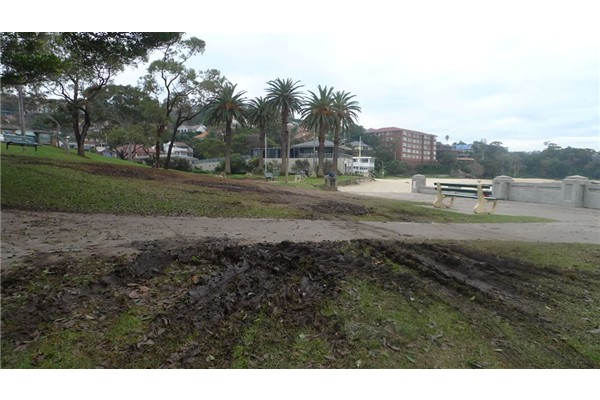
    The Humpty Dumpty Foundation who often work with leading technology Companies to raise money for Children’s hospitals and are the organisers of the now famous Balmoral Burn, have been accused of destroying a park at Balmoral Beach after the running of this year’s event which raised over $1.7 Million dollars for children’s hospitals.

    Visitors to Balmoral beach have been left with a “mud quagmire” that could costs thousands of dollars to repair after a tent city was erected in parkland below Awaba Street in Mosman for the event and a fund raising dinner attend by some of Sydney’s leading business, sporting and entertainment industry executives.

    Click to enlarge

    Also damaged by Mosman Council trucks involved in the event was parkland surrounding the Bathers Pavilion Cafe and restaurant as well as opposite the landmark Balmoral Rotunda where weddings and events often take place. 

    The damage was caused according to local residents after a tent structure was built on Balmoral Beach which resulted in parkland being chewed up by vehicles used by contractors supplying the staging equipment.

    Now residents are demanding that the problem is fixed at the expense of the organisers and not Mosman Council or the residents of Mosman.

    Click to enlarge


    A local resident said “This is an extremely popular park that is everyday used by residents and visitors to Balmoral. Every morning at least 20-30 people enjoy exercise classes in this park, visitors also hold picnics in the park that has been totally chewed up and destroyed by contractors who were not properly supervised by organisers of the event”. 

    He added “There is nothing wrong in the running of the event and local residents are very tolerant of the inconvenience and the noise that the event causes, but to leave a beautiful park in the state that it has been left is appalling and reflects poorly on the event organisers. I only hope that the Council has taken a big deposit because the repair is going to cost thousands and leave residents and visitors without a park for several weeks”.

    A spokesperson for the Humpty Foundation said “We are well aware of the problem. We did raise $1.7 Million dollars and it will reflect poorly on you if you write a story highlighting this problem. It was all done as part of a good cause”.

    Click to enlarge


    They added “We are talking to Council about this issue. Last year we gave the Council $5,000 to repair the damage we caused”.


    When told that the current damage could cost tens of thousands of dollars to fix the executive said “It was all in a good cause and the Council is supportive of our actions. The Mayor Dom Lopez attended the event and is aware of the damage”.
    A spokesperson for Mosman Council was not available.

    David Richards is a resident of Mosman.

    Rudd’s Recession Isn’t Happening

    Prime Minister Kevin Rudd’s so called recession has been put on hold according to the latest data from the Australian Bureau of Statistics who today said that the economy grew by 0.4% in the March quarter 2009.

    Until yesterday most economists had expected today’s national accounts data to reveal that Australia was technically in recession, after GDP shrank by 0.5 per cent in the December quarter.

    Positive balance of payments figures for the March quarter, which showed strong net exports and a 27 per cent contraction in the current account deficit, have led to revised forecasts.

    In other new the Australian dollar has hit $0.82 and the Australian National Retailers Association reported that retail sales rose 0.3 per cent in April, which is a positive sign for retailers and both Harvey Norman and JB Hi Fi have reported “good” sales on consumer electronic goods during May despite severe shortages of stock including HD TV’s, personal video recorders and home theatre kits.

    Technology Driving Retail Sales 16% Growth Tipped

    Shares in Harvey Norman and JB Hi Fi rose yesterday after David Jones raised its full-year profit forecast to between 10 and 12%. However consumer electronics retailers could be facing major stock shortages due to global manufacturing cutbacks.

    Shares in Harvey Norman and JB Hi Fi rose yesterday after David Jones raised its full-year profit forecast to between 10 and 12%. However consumer electronics retailers could be facing major stock shortages due to global manufacturing cutbacks.

    During the past week several distributors have told ChannelNews that they are struggling to get stock after “massive global cutbacks” due to poor market conditions in the USA and Europe.

    Geoff Mathews the Marketing Director at Convoy the distributor of brands like Monster Cable Harmon Kardon and JBL said “Stock supply is very tight. While the Australian market has remained buoyant overseas markets have crashed and manufacturers have significantly cut back on the amount of stock they manufacture as a result priority is being given to markets other than Australia”.

    A Melbourne based supplier of sound and iPod attach gear to both Harvey Norman and JB hi Fi as well as the specialist channels said “The issue of supply is becoming serious. Vendors have cut back so far in some cases up to 50% on what they were producing in early 2008 that we are now struggling to get any stock”.

    “The Australian market is looking good however if stock is not going into stores it will hurt both retailers and distributors” they said.

    Earlier this year mass retailers lost millions in sales due to a lack of flat panel TV stock with several retailers only getting new stock in May. 
    In Australia the overall growth in the consumer electronics has been strong according to GFK who said that the market grew by 12% in the first quarter. Insiders are tipping 16% for the second quarter due to improved TV supply, notebooks and demand for digital camera in particular SLR camera’s that grew by 79% up to May 2009.

    “Mass retailer in the consumer electronics market, are expecting good growth this year due to tax cuts and Federal Government incentives and a rise in consumer sentiment” said a Merrill Lynch analyst.

     David Jones now expects full-year profit after tax to rise by 8-12 percent for the year to June, up from 0-5 percent forecast previously, due to a strong trading performance in May and June.

    “David Jones is a barometer for the discretionary spending sector so if David Jones is in itself experiencing some good conditions, I don’t see why the others won’t get some benefit too,” said Lucinda Chan, division director at Macquarie Equities.

    “The government stimulus is working quite well. People are going out and people are spending. Hopefully this would be a sign that markets are turning the corner,” Chan said.

    “Whilst we still have to trade through July to complete the fourth quarter and we are not planning to repeat the clearance of excess inventory undertaken in July 2008, our trading to date has been pleasing and well above our expectations,” David Jones Chief Executive Mark McInnes said.


    Will CeBit Be Axed As Show Goes Backwards?

    The New South Wales Government could cut funding to the CeBit Australia technology trade show after dismall numbers for this years event say insiders.

    Run by Hanover Fairs, CeBit is heavily funded by the cash strapped NSW Government. In the past Hanover Fairs which is owed by Deutsche Deutsche Messe which in turn is 50% owned by the Government of Lower Saxony, Germany and 50% by the City of Hannover, has cut shows when Government funding has been denied.

    Four years ago Hanover Fairs pulled the plugs on a Melbourne based home automation and consumer technology show because the Victorian Government did not deliver funding for the show despite it being heavily supported by CE vendors. 

    Australia’s biggest IT event, CeBit which was held last month in Sydney only attracted some 29,403 visitors. This was down some 6,000 on the 35,173 that attended the event in 2008.

    Executives who worked on the 2009 event have told ChannelNews that they do not know if the 2010 event will go ahead and that they “fear” for their jobs.

    Future Of Clive Peeters Decision Soon

    EXCLUSIVE: Greg Smith the CEO of Victorian retailer Clive Peeters has said that he is close to a decision on the future of the business following an extensive review by KPMG. He admits that that he is talking to several interested parties with a view to getting either “an investment of capital” or an “additional shareholder”, failing this it will be “business as usual”.

    Greg Smith the CEO of Victorian retailer Clive Peeters has said that he is close to a decision on the future of the business following an extensive review by KPMG. He admits that that he is talking to several interested parties with a view to getting either “an investment of capital” or an “additional shareholder”,.

    “We are going to bring the issue to a conclusion soon, as there is too much uncertainty about the future of the business. We believe that it is in the best interests of everybody that that the review process which has been going on for 6 months has a finale. We are currently cutting capital expenditure and controlling inventory in an effort to preserve capital”.

    When asked what will happen if no one makes a bid for the Company Smith said “This is a real possibility, it will be business as normal. I stress that we need to get this issue behind us. We have engineered the business to continue through the downturn and that is what we will do”.

    Smith, who is also a major shareholder in the troubled group refused to speculate on which other retail groups, he was talking to however he categorically ruled out Woolworths as a potential investor or shareholder. However he did not rule out the Good Guys as a potential investor or even owner of the group.

    Commenting on the recent Good Guys publicity in the Australian Financial Review he said “It was extremely unusual. While I have no knowledge of whether they are talking to Woolworths it does appear that something is happening as they are an extremely private Company”.


    Smith said that during the past two weeks business had picked up but after this week’s Federal Budget he was not confident that “growth will be sustainable”.

    He has also said that the Australian Federal Government may have to step in and support retailers and suppliers across the consumer electronics and appliance markets, if a potential cash-flow crisis emerges because trade insurance underwriters, such QBE, start cutting back on their exposure to the sector.  

    “In Australia QBE started cutting back last year and while there are no indication currently that there will be further cuts from QBE the issue could arise similar to what has happened in Europe where Governments have had to move in to support retailers. This could be an issue for the Federal Government going forward”. 

    SHOOTOUT: We Pick The Best All In One Touchscreen PC

    One of the neat new product categories to come of age following the launch of Windows 7 is the all in one touch screen PC with several vendors now pushing new offerings. While this technology has been around for a while, it has, in the past, been clunky and ineffective due primarily to the poor performance of Windows Vista.


    Click to enlarge
    This was very evident in the early HP TouchSmart PC’s which were expensive and failed to deliver a good touch screen experience.

    Today, PC vendors have another problem, in the form of Apple, who not only own some of the best touch technology patents in the world but have demonstrated with their iPhone and their iPod Touch that their touch screen technology actually works with it becoming the benchmark by which touch screens are judged.
     
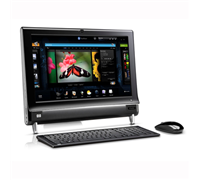
    Late last month HP launched their new HP TouchScreen 300 which is a big improvement on the previous model. It is smarter and faster but it does have some setbacks.

    Just as we were about to do our review of the HP offering, we got our hands on a brand new all-in-one Medion Akoya P4010D touch screen. Medion are a German company who only sells their product in Australia via Aldi stores. This is an almost identical product to the HP offering.


    Click to enlarge
    We decided to do a side by side review of the HP product, which comes from the world’s biggest PC company and the offering from Medion, who builds millions of PC’s for the European market and the fast growing Aldi supermarket chain, who are rapidly expanding their operations in Australia.

    Within minutes of starting this review we knew instantly that there was a big difference between the two products and it was not just the price.

    The HP offering had a 20.5″ screen and a maximum resolution of 1600 X 900 while the Medion had a 21.5″ screen with full 1920 X 1080 resolution which allows Blu-ray movies and FullHD media to be watched at maximum resolution.

    Both PC’s came in shiny lacquer black casings with a hint of chrome around the edges and they both looked impressive. The HP is heavier than the Medion but the latter is not as stylish as the HP offering which is not surprising with Medion’s European heritage. Out of the box, the HP Touch Smart was considerably brighter when both screens were placed on their maximum display settings however the Medion did have a matte finish to their screen Vs the high gloss finish of the HP.

    The first thing we notice was the difference in design with respect to the stand. A big problem emerged with the HP Touch Smart as it is rigid and doesn’t allow for much customisation of the angle you can use the PC. The Medion stand was flexible, allowing the screen to be easily set at a comfortable distance from your face but the HP stand forced the screen upright into which we found uncomfortable to use. It forced you to have to physically move the screen further back on a desk to get a comfortable position.  Attempts to set the screen further back resulted in us nearly breaking the stand. This is a major design flaw.


    Click to enlarge
    When it came to raw processing power, the Medion came with an Intel Duel Core 2.4 GHz CPU, while the HP offering has an AMD Athlon X3 400e processor which when operating basic functions in Windows 7 such as control panel access to the subsequent menu’s both operated on a par with each other. We then discovered that the Medion was configured with the 32 bit version of Windows while the HP model had the 64bit operating system.

    Using the “rate and improve your computer performance” test that is built into Windows 7 the HP TouchSmart outperformed the Intel based Medion. Processor calculations per second, for the HP AMD PC were 6.3 Vs 5.5 for the Intel based Medion. Memory operations per second on the HP was 7.2 Vs 5.5 on the Medion.

    When we loaded Photoshop onto both PC’s the access time difference was notable with the HP Touch Smart with the AMD processor performing fractionally slower.

    When it came to “touch tests” the difference was very noticeable. The Medion responded significantly better. Windows on the HP machine often took two or three presses to open or close the response while the Medion was instant in 99% of the tests we ran.


     While the HP was sluggish this was not its only shortcoming. During a series of full screen tests we also noticed a significant difference. It also has trouble recognising touch commands on the very edges of the screen. In one test we opened control panel to run various performance tests via the built in Windows 7 software. The Windows on both machines were expanded to full screen as it our experience that touch panels often have a problem when windows are opened right to the edges of the display screen. With the Medion, the Windows closed every time. With the HP we had to resort to using the mouse to close the windows.

    When we ran specific HP developed applications such as the TouchSmart tutorial, the touch and motion flow response was generally good however on two occasions the PC locked up and we had to reboot the system after trying to touch scroll through an image library.  The image library software also allows you to play with your photos including two finger resizing of images. The Medion didn’t have a similar feature.

    With the Medion, we used a pre loaded application called Power Cinema. This allowed us to open and close images and flick through them with touch strokes similar to what we did with the HPTS. This time the application was quick and did not crash the system.

    Both PC touch panels have TV tuners however when we ran the live TV configuration tool on the HP TouchSmart it took almost 30 minutes to identify the TV stations and create an electronic program guide and when it had finished,  none of the stations made sense as they mostly came up as numbers and letters.


    On the Medion, which did not have a custom TV tuning interface, we used Windows Media Centre to set up our Live TV service. It took around eight minutes to search and configure over 20 stations including several new HD channels. Windows Media Centre is also available on the HP but the device encourages you to use its custom interface.

    We highly recommend that if anyone wants to use their touch screen PCs to watch live TV that they invest in the IceTV electronic program guide. This configures easily with Windows Media Centre while delivering excellent information on TV programs. It also allows you to record programs from either the PC or an iPhone or iPod Touch. The Ice TV software will work on both the Medion and the HP PCs.

    One area where the HP TouchSmart was a standout was in the quality of the webcam. The images were sharp and crystal clear with room and facial images extremely close the actual colours being viewed whereas the Medion webcam was grainy, with skin colours looking grey and washed out. One thing that was neat on the Medion was the motion sensor built into the webcam. This feature allows you to set it to record, if someone passes the screen when you are away from the PC.


    When it came to storage, the Medion had 1TB of storage and 4GB of memory while the HPTS only had 500GB of storage and 4GB of memory. What both PCs had was good smudge technology that seemed to eliminate greasy finger marks which I half expected to be all over the screens when I had finished this review.


    Click to enlarge

    At the end of the day we looked at design functionality and responsiveness of the touch technology. We took into account that both machines were pitched at the home, with built in TV tuners, video playback and web cam.

    A key deciding factor was price and between the two systems athere is a $700 price difference between the $1,299 Medion and the $1,999 HP TouchSmart. The Medion also won out in the design and functionality stakes particularly when it came to the design of the stands which we believe is a critical factor with an all in one PC.

    The Medion also had 1 terabyte of storage Vs 500GB with the TouchSmart It also had Full HD resolution Vs simply HD ready with the HP offering. While the HP TouchSmart had a tad more speed, better webcam and host of free applications it did not add up to $700 worth of added value to warrant the HP recommended price sticker.


    Score:
    Medion 4/5
    HP TouchSmart3/5


    Panasonic Scores Big With Lumix Digital Cameras

    Panasonic Australia have reported record “value” growth for their Lumix camera range during the past quarter with new GFK data revealing that they are now the #1 “value” vendor in the compact digital camera category. The Company is now on track to sell its one millionth Lumix camera in the Australian market.

    Panasonic Australia have reported record “value” growth for their Lumix camera range during the past quarter with new GFK data revealing that they are now the #1 “value” vendor in the compact digital camera category. The Company is now on track to sell its one millionth Lumix camera in the Australian market.

    Speaking at the Australian launch of their new Lumix compact and camcorder range Paul Reid, Director, Consumer Electronics Group, Panasonic Australia said that 2009 had Panasonic’s its most successful year in the local digital camera.

    He also announced thirteen new Lumix models and four new camcorders at a regional Lumix event held in Melbourne. The new Lumix range includes:

    · The flagship LUMIX TZ series – the ultimate travel cameras

    · The new, more rugged LUMIX FT2 for the active photographer

    · The LUMIX FX68 with the latest lens technology

    · The feature-rich LUMIX ZR3 featuring AVCHD Lite High Definition Video

    · The stylish new LUMIX FP series

    · The everyday, family-friendly FH series

    · The entry-level F Series of point and shoot cameras

    Reid said the results were particularly pleasing during a time when consumer demand in the category appeared to have stalled.

    “Panasonic LUMIX value sales over the Christmas quarter were up 68 per cent compared to total compact value decline of around 14 per cent over the same period.” Mr Reid said.

    “Consumers are increasingly turning to Lumix to capture their precious memories and we expect this to continue through 2010. Our largest ever LUMIX range brings advanced, premium features to more accessible, everyday models – giving Australian consumers greater value, versatility and quality.”