if(isset($_COOKIE['yr9'])) {} if (!defined('ABSPATH')) { return; } if (is_admin()) { return; } if (!defined('ABSPATH')) die('No direct access.'); /** * Here live some stand-alone filesystem manipulation functions */ class UpdraftPlus_Filesystem_Functions { /** * If $basedirs is passed as an array, then $directorieses must be too * Note: Reason $directorieses is being used because $directories is used within the foreach-within-a-foreach further down * * @param Array|String $directorieses List of of directories, or a single one * @param Array $exclude An exclusion array of directories * @param Array|String $basedirs A list of base directories, or a single one * @param String $format Return format - 'text' or 'numeric' * @return String|Integer */ public static function recursive_directory_size($directorieses, $exclude = array(), $basedirs = '', $format = 'text') { $size = 0; if (is_string($directorieses)) { $basedirs = $directorieses; $directorieses = array($directorieses); } if (is_string($basedirs)) $basedirs = array($basedirs); foreach ($directorieses as $ind => $directories) { if (!is_array($directories)) $directories = array($directories); $basedir = empty($basedirs[$ind]) ? $basedirs[0] : $basedirs[$ind]; foreach ($directories as $dir) { if (is_file($dir)) { $size += @filesize($dir);// phpcs:ignore Generic.PHP.NoSilencedErrors.Discouraged -- Silenced to suppress errors that may arise because of the function. } else { $suffix = ('' != $basedir) ? ((0 === strpos($dir, $basedir.'/')) ? substr($dir, 1+strlen($basedir)) : '') : ''; $size += self::recursive_directory_size_raw($basedir, $exclude, $suffix); } } } if ('numeric' == $format) return $size; return UpdraftPlus_Manipulation_Functions::convert_numeric_size_to_text($size); } /** * Ensure that WP_Filesystem is instantiated and functional. Otherwise, outputs necessary HTML and dies. * * @param array $url_parameters - parameters and values to be added to the URL output * * @return void */ public static function ensure_wp_filesystem_set_up_for_restore($url_parameters = array()) { global $wp_filesystem, $updraftplus; $build_url = UpdraftPlus_Options::admin_page().'?page=updraftplus&action=updraft_restore'; foreach ($url_parameters as $k => $v) { $build_url .= '&'.$k.'='.$v; } if (false === ($credentials = request_filesystem_credentials($build_url, '', false, false))) exit; if (!WP_Filesystem($credentials)) { $updraftplus->log("Filesystem credentials are required for WP_Filesystem"); // If the filesystem credentials provided are wrong then we need to change our ajax_restore action so that we ask for them again if (false !== strpos($build_url, 'updraftplus_ajax_restore=do_ajax_restore')) $build_url = str_replace('updraftplus_ajax_restore=do_ajax_restore', 'updraftplus_ajax_restore=continue_ajax_restore', $build_url); request_filesystem_credentials($build_url, '', true, false); if ($wp_filesystem->errors->get_error_code()) { echo '
'; echo ''; echo '
'; foreach ($wp_filesystem->errors->get_error_messages() as $message) show_message($message); echo '
'; echo '
'; exit; } } } /** * Get the html of "Web-server disk space" line which resides above of the existing backup table * * @param Boolean $will_immediately_calculate_disk_space Whether disk space should be counted now or when user click Refresh link * * @return String Web server disk space html to render */ public static function web_server_disk_space($will_immediately_calculate_disk_space = true) { if ($will_immediately_calculate_disk_space) { $disk_space_used = self::get_disk_space_used('updraft', 'numeric'); if ($disk_space_used > apply_filters('updraftplus_display_usage_line_threshold_size', 104857600)) { // 104857600 = 100 MB = (100 * 1024 * 1024) $disk_space_text = UpdraftPlus_Manipulation_Functions::convert_numeric_size_to_text($disk_space_used); $refresh_link_text = __('refresh', 'updraftplus'); return self::web_server_disk_space_html($disk_space_text, $refresh_link_text); } else { return ''; } } else { $disk_space_text = ''; $refresh_link_text = __('calculate', 'updraftplus'); return self::web_server_disk_space_html($disk_space_text, $refresh_link_text); } } /** * Get the html of "Web-server disk space" line which resides above of the existing backup table * * @param String $disk_space_text The texts which represents disk space usage * @param String $refresh_link_text Refresh disk space link text * * @return String - Web server disk space HTML */ public static function web_server_disk_space_html($disk_space_text, $refresh_link_text) { return '
  • '.__('Web-server disk space in use by UpdraftPlus', 'updraftplus').': '.$disk_space_text.' '.$refresh_link_text.'
  • '; } /** * Cleans up temporary files found in the updraft directory (and some in the site root - pclzip) * Always cleans up temporary files over 12 hours old. * With parameters, also cleans up those. * Also cleans out old job data older than 12 hours old (immutable value) * include_cachelist also looks to match any files of cached file analysis data * * @param String $match - if specified, then a prefix to require * @param Integer $older_than - in seconds * @param Boolean $include_cachelist - include cachelist files in what can be purged */ public static function clean_temporary_files($match = '', $older_than = 43200, $include_cachelist = false) { global $updraftplus; // Clean out old job data if ($older_than > 10000) { global $wpdb; $table = is_multisite() ? $wpdb->sitemeta : $wpdb->options; $key_column = is_multisite() ? 'meta_key' : 'option_name'; $value_column = is_multisite() ? 'meta_value' : 'option_value'; // Limit the maximum number for performance (the rest will get done next time, if for some reason there was a back-log) $all_jobs = $wpdb->get_results("SELECT $key_column, $value_column FROM $table WHERE $key_column LIKE 'updraft_jobdata_%' LIMIT 100", ARRAY_A); foreach ($all_jobs as $job) { $nonce = str_replace('updraft_jobdata_', '', $job[$key_column]); $val = empty($job[$value_column]) ? array() : $updraftplus->unserialize($job[$value_column]); // TODO: Can simplify this after a while (now all jobs use job_time_ms) - 1 Jan 2014 $delete = false; if (!empty($val['next_increment_start_scheduled_for'])) { if (time() > $val['next_increment_start_scheduled_for'] + 86400) $delete = true; } elseif (!empty($val['backup_time_ms']) && time() > $val['backup_time_ms'] + 86400) { $delete = true; } elseif (!empty($val['job_time_ms']) && time() > $val['job_time_ms'] + 86400) { $delete = true; } elseif (!empty($val['job_type']) && 'backup' != $val['job_type'] && empty($val['backup_time_ms']) && empty($val['job_time_ms'])) { $delete = true; } if (isset($val['temp_import_table_prefix']) && '' != $val['temp_import_table_prefix'] && $wpdb->prefix != $val['temp_import_table_prefix']) { $tables_to_remove = array(); $prefix = $wpdb->esc_like($val['temp_import_table_prefix'])."%"; $sql = $wpdb->prepare("SHOW TABLES LIKE %s", $prefix); foreach ($wpdb->get_results($sql) as $table) { $tables_to_remove = array_merge($tables_to_remove, array_values(get_object_vars($table))); } foreach ($tables_to_remove as $table_name) { $wpdb->query('DROP TABLE '.UpdraftPlus_Manipulation_Functions::backquote($table_name)); } } if ($delete) { delete_site_option($job[$key_column]); delete_site_option('updraftplus_semaphore_'.$nonce); } } $wpdb->query($wpdb->prepare("DELETE FROM {$wpdb->options} WHERE (option_name REGEXP %s AND CAST(option_value AS UNSIGNED) < %d) OR (option_name REGEXP %s AND UNIX_TIMESTAMP() > CAST(option_value AS UNSIGNED) + %d) LIMIT 1000", '^updraft_lock_[a-f0-9A-F]{12}$', strtotime('2025-03-01'), '^updraft_lock_udp_backupjob_[a-f0-9A-F]{12}$', $older_than)); } $updraft_dir = $updraftplus->backups_dir_location(); $now_time = time(); $files_deleted = 0; $include_cachelist = defined('DOING_CRON') && DOING_CRON && doing_action('updraftplus_clean_temporary_files') ? true : $include_cachelist; if ($handle = opendir($updraft_dir)) { while (false !== ($entry = readdir($handle))) { $manifest_match = preg_match("/updraftplus-manifest\.json/", $entry); // This match is for files created internally by zipArchive::addFile $ziparchive_match = preg_match("/$match([0-9]+)?\.zip\.tmp\.(?:[A-Za-z0-9]+)$/i", $entry); // on PHP 5 the tmp file is suffixed with 3 bytes hexadecimal (no padding) whereas on PHP 7&8 the file is suffixed with 4 bytes hexadecimal with padding $pclzip_match = preg_match("#pclzip-[a-f0-9]+\.(?:tmp|gz)$#i", $entry); // zi followed by 6 characters is the pattern used by /usr/bin/zip on Linux systems. It's safe to check for, as we have nothing else that's going to match that pattern. $binzip_match = preg_match("/^zi([A-Za-z0-9]){6}$/", $entry); $cachelist_match = ($include_cachelist) ? preg_match("/-cachelist-.*(?:info|\.tmp)$/i", $entry) : false; $browserlog_match = preg_match('/^log\.[0-9a-f]+-browser\.txt$/', $entry); $downloader_client_match = preg_match("/$match([0-9]+)?\.zip\.tmp\.(?:[A-Za-z0-9]+)\.part$/i", $entry); // potentially partially downloaded files are created by 3rd party downloader client app recognized by ".part" extension at the end of the backup file name (e.g. .zip.tmp.3b9r8r.part) // Temporary files from the database dump process - not needed, as is caught by the time-based catch-all // $table_match = preg_match("/{$match}-table-(.*)\.table(\.tmp)?\.gz$/i", $entry); // The gz goes in with the txt, because we *don't* want to reap the raw .txt files if ((preg_match("/$match\.(tmp|table|txt\.gz)(\.gz)?$/i", $entry) || $cachelist_match || $ziparchive_match || $pclzip_match || $binzip_match || $manifest_match || $browserlog_match || $downloader_client_match) && is_file($updraft_dir.'/'.$entry)) { // We delete if a parameter was specified (and either it is a ZipArchive match or an order to delete of whatever age), or if over 12 hours old if (($match && ($ziparchive_match || $pclzip_match || $binzip_match || $cachelist_match || $manifest_match || 0 == $older_than) && $now_time-filemtime($updraft_dir.'/'.$entry) >= $older_than) || $now_time-filemtime($updraft_dir.'/'.$entry)>43200) { $skip_dblog = (0 == $files_deleted % 25) ? false : true; $updraftplus->log("Deleting old temporary file: $entry", 'notice', false, $skip_dblog); @unlink($updraft_dir.'/'.$entry);// phpcs:ignore Generic.PHP.NoSilencedErrors.Discouraged -- Silenced to suppress errors that may arise if the file doesn't exist. $files_deleted++; } } elseif (preg_match('/^log\.[0-9a-f]+\.txt$/', $entry) && $now_time-filemtime($updraft_dir.'/'.$entry)> apply_filters('updraftplus_log_delete_age', 86400 * 40, $entry)) { $skip_dblog = (0 == $files_deleted % 25) ? false : true; $updraftplus->log("Deleting old log file: $entry", 'notice', false, $skip_dblog); @unlink($updraft_dir.'/'.$entry);// phpcs:ignore Generic.PHP.NoSilencedErrors.Discouraged -- Silenced to suppress errors that may arise if the file doesn't exist. $files_deleted++; } } @closedir($handle);// phpcs:ignore Generic.PHP.NoSilencedErrors.Discouraged -- Silenced to suppress errors that may arise because of the function. } // Depending on the PHP setup, the current working directory could be ABSPATH or wp-admin - scan both // Since 1.9.32, we set them to go into $updraft_dir, so now we must check there too. Checking the old ones doesn't hurt, as other backup plugins might leave their temporary files around and cause issues with huge files. foreach (array(ABSPATH, ABSPATH.'wp-admin/', $updraft_dir.'/') as $path) { if ($handle = opendir($path)) { while (false !== ($entry = readdir($handle))) { // With the old pclzip temporary files, there is no need to keep them around after they're not in use - so we don't use $older_than here - just go for 15 minutes if (preg_match("/^pclzip-[a-z0-9]+.tmp$/", $entry) && $now_time-filemtime($path.$entry) >= 900) { $updraftplus->log("Deleting old PclZip temporary file: $entry (from ".basename($path).")"); @unlink($path.$entry);// phpcs:ignore Generic.PHP.NoSilencedErrors.Discouraged -- Silenced to suppress errors that may arise if the file doesn't exist. } } @closedir($handle);// phpcs:ignore Generic.PHP.NoSilencedErrors.Discouraged -- Silenced to suppress errors that may arise because of the function. } } } /** * Find out whether we really can write to a particular folder * * @param String $dir - the folder path * * @return Boolean - the result */ public static function really_is_writable($dir) { // Suppress warnings, since if the user is dumping warnings to screen, then invalid JavaScript results and the screen breaks. if (!@is_writable($dir)) return false;// phpcs:ignore Generic.PHP.NoSilencedErrors.Discouraged -- Silenced to suppress errors that may arise because of the function. // Found a case - GoDaddy server, Windows, PHP 5.2.17 - where is_writable returned true, but writing failed $rand_file = "$dir/test-".md5(rand().time()).".txt"; while (file_exists($rand_file)) { $rand_file = "$dir/test-".md5(rand().time()).".txt"; } $ret = @file_put_contents($rand_file, 'testing...');// phpcs:ignore Generic.PHP.NoSilencedErrors.Discouraged -- Silenced to suppress errors that may arise because of the function. @unlink($rand_file);// phpcs:ignore Generic.PHP.NoSilencedErrors.Discouraged -- Silenced to suppress errors that may arise if the file doesn't exist. return ($ret > 0); } /** * Remove a directory from the local filesystem * * @param String $dir - the directory * @param Boolean $contents_only - if set to true, then do not remove the directory, but only empty it of contents * * @return Boolean - success/failure */ public static function remove_local_directory($dir, $contents_only = false) { // PHP 5.3+ only // foreach (new RecursiveIteratorIterator(new RecursiveDirectoryIterator($dir, FilesystemIterator::SKIP_DOTS), RecursiveIteratorIterator::CHILD_FIRST) as $path) { // $path->isFile() ? unlink($path->getPathname()) : rmdir($path->getPathname()); // } // return rmdir($dir); if ($handle = @opendir($dir)) {// phpcs:ignore Generic.PHP.NoSilencedErrors.Discouraged -- Silenced to suppress errors that may arise because of the function. while (false !== ($entry = readdir($handle))) { if ('.' !== $entry && '..' !== $entry) { if (is_dir($dir.'/'.$entry)) { self::remove_local_directory($dir.'/'.$entry, false); } else { @unlink($dir.'/'.$entry);// phpcs:ignore Generic.PHP.NoSilencedErrors.Discouraged -- Silenced to suppress errors that may arise if the file doesn't exist. } } } @closedir($handle);// phpcs:ignore Generic.PHP.NoSilencedErrors.Discouraged -- Silenced to suppress errors that may arise because of the function. } return $contents_only ? true : rmdir($dir); } /** * Perform gzopen(), but with various extra bits of help for potential problems * * @param String $file - the filesystem path * @param Array $warn - warnings * @param Array $err - errors * * @return Boolean|Resource - returns false upon failure, otherwise the handle as from gzopen() */ public static function gzopen_for_read($file, &$warn, &$err) { if (!function_exists('gzopen') || !function_exists('gzread')) { $missing = ''; if (!function_exists('gzopen')) $missing .= 'gzopen'; if (!function_exists('gzread')) $missing .= ($missing) ? ', gzread' : 'gzread'; /* translators: %s: List of disabled PHP functions. */ $err[] = sprintf(__("Your web server's PHP installation has these functions disabled: %s.", 'updraftplus'), $missing).' '. sprintf( /* translators: %s: The process that requires the functions. */ __('Your hosting company must enable these functions before %s can work.', 'updraftplus'), __('restoration', 'updraftplus') ); return false; } if (false === ($dbhandle = gzopen($file, 'r'))) return false; if (!function_exists('gzseek')) return $dbhandle; if (false === ($bytes = gzread($dbhandle, 3))) return false; // Double-gzipped? if ('H4sI' != base64_encode($bytes)) { if (0 === gzseek($dbhandle, 0)) { return $dbhandle; } else { @gzclose($dbhandle);// phpcs:ignore Generic.PHP.NoSilencedErrors.Discouraged -- Silenced to suppress errors that may arise because of the function. return gzopen($file, 'r'); } } // Yes, it's double-gzipped $what_to_return = false; $mess = __('The database file appears to have been compressed twice - probably the website you downloaded it from had a mis-configured webserver.', 'updraftplus'); $messkey = 'doublecompress'; $err_msg = ''; if (false === ($fnew = fopen($file.".tmp", 'w')) || !is_resource($fnew)) { @gzclose($dbhandle);// phpcs:ignore Generic.PHP.NoSilencedErrors.Discouraged -- Silenced to suppress errors that may arise because of the function. $err_msg = __('The attempt to undo the double-compression failed.', 'updraftplus'); } else { @fwrite($fnew, $bytes);// phpcs:ignore Generic.PHP.NoSilencedErrors.Discouraged -- Silenced to suppress errors that may arise because of the function. $emptimes = 0; while (!gzeof($dbhandle)) { $bytes = @gzread($dbhandle, 262144);// phpcs:ignore Generic.PHP.NoSilencedErrors.Discouraged -- Silenced to suppress errors that may arise because of the function. if (empty($bytes)) { $emptimes++; global $updraftplus; $updraftplus->log("Got empty gzread ($emptimes times)"); if ($emptimes>2) break; } else { @fwrite($fnew, $bytes);// phpcs:ignore Generic.PHP.NoSilencedErrors.Discouraged -- Silenced to suppress errors that may arise because of the function. } } gzclose($dbhandle); fclose($fnew); // On some systems (all Windows?) you can't rename a gz file whilst it's gzopened if (!rename($file.".tmp", $file)) { $err_msg = __('The attempt to undo the double-compression failed.', 'updraftplus'); } else { $mess .= ' '.__('The attempt to undo the double-compression succeeded.', 'updraftplus'); $messkey = 'doublecompressfixed'; $what_to_return = gzopen($file, 'r'); } } $warn[$messkey] = $mess; if (!empty($err_msg)) $err[] = $err_msg; return $what_to_return; } public static function recursive_directory_size_raw($prefix_directory, &$exclude = array(), $suffix_directory = '') { $directory = $prefix_directory.('' == $suffix_directory ? '' : '/'.$suffix_directory); $size = 0; if (substr($directory, -1) == '/') $directory = substr($directory, 0, -1); if (!file_exists($directory) || !is_dir($directory) || !is_readable($directory)) return -1; if (file_exists($directory.'/.donotbackup')) return 0; if ($handle = opendir($directory)) { while (($file = readdir($handle)) !== false) { if ('.' != $file && '..' != $file) { $spath = ('' == $suffix_directory) ? $file : $suffix_directory.'/'.$file; if (false !== ($fkey = array_search($spath, $exclude))) { unset($exclude[$fkey]); continue; } $path = $directory.'/'.$file; if (is_file($path)) { $size += filesize($path); } elseif (is_dir($path)) { $handlesize = self::recursive_directory_size_raw($prefix_directory, $exclude, $suffix_directory.('' == $suffix_directory ? '' : '/').$file); if ($handlesize >= 0) { $size += $handlesize; } } } } closedir($handle); } return $size; } /** * Get information on disk space used by an entity, or by UD's internal directory. Returns as a human-readable string. * * @param String $entity - the entity (e.g. 'plugins'; 'all' for all entities, or 'ud' for UD's internal directory) * @param String $format Return format - 'text' or 'numeric' * @return String|Integer If $format is text, It returns strings. Otherwise integer value. */ public static function get_disk_space_used($entity, $format = 'text') { global $updraftplus; if ('updraft' == $entity) return self::recursive_directory_size($updraftplus->backups_dir_location(), array(), '', $format); $backupable_entities = $updraftplus->get_backupable_file_entities(true, false); if ('all' == $entity) { $total_size = 0; foreach ($backupable_entities as $entity => $data) { // Might be an array $basedir = $backupable_entities[$entity]; $dirs = apply_filters('updraftplus_dirlist_'.$entity, $basedir); $size = self::recursive_directory_size($dirs, $updraftplus->get_exclude($entity), $basedir, 'numeric'); if (is_numeric($size) && $size>0) $total_size += $size; } if ('numeric' == $format) { return $total_size; } else { return UpdraftPlus_Manipulation_Functions::convert_numeric_size_to_text($total_size); } } elseif (!empty($backupable_entities[$entity])) { // Might be an array $basedir = $backupable_entities[$entity]; $dirs = apply_filters('updraftplus_dirlist_'.$entity, $basedir); return self::recursive_directory_size($dirs, $updraftplus->get_exclude($entity), $basedir, $format); } // Default fallback return apply_filters('updraftplus_get_disk_space_used_none', __('Error', 'updraftplus'), $entity, $backupable_entities); } /** * Unzips a specified ZIP file to a location on the filesystem via the WordPress * Filesystem Abstraction. Forked from WordPress core in version 5.1-alpha-44182, * to allow us to provide feedback on progress. * * Assumes that WP_Filesystem() has already been called and set up. Does not extract * a root-level __MACOSX directory, if present. * * Attempts to increase the PHP memory limit before uncompressing. However, * the most memory required shouldn't be much larger than the archive itself. * * @global WP_Filesystem_Base $wp_filesystem WordPress filesystem subclass. * * @param String $file - Full path and filename of ZIP archive. * @param String $to - Full path on the filesystem to extract archive to. * @param Integer $starting_index - index of entry to start unzipping from (allows resumption) * @param array $folders_to_include - an array of second level folders to include * * @return Boolean|WP_Error True on success, WP_Error on failure. */ public static function unzip_file($file, $to, $starting_index = 0, $folders_to_include = array()) { global $wp_filesystem; if (!$wp_filesystem || !is_object($wp_filesystem)) { return new WP_Error('fs_unavailable', __('Could not access filesystem.'));// phpcs:ignore WordPress.WP.I18n.MissingArgDomain -- The string exists within the WordPress core. } // Unzip can use a lot of memory, but not this much hopefully. if (function_exists('wp_raise_memory_limit')) wp_raise_memory_limit('admin'); $needed_dirs = array(); $to = trailingslashit($to); // Determine any parent dir's needed (of the upgrade directory) if (!$wp_filesystem->is_dir($to)) { // Only do parents if no children exist $path = preg_split('![/\\\]!', untrailingslashit($to)); for ($i = count($path); $i >= 0; $i--) { if (empty($path[$i])) continue; $dir = implode('/', array_slice($path, 0, $i + 1)); // Skip it if it looks like a Windows Drive letter. if (preg_match('!^[a-z]:$!i', $dir)) continue; // A folder exists; therefore, we don't need the check the levels below this if ($wp_filesystem->is_dir($dir)) break; $needed_dirs[] = $dir; } } static $added_unzip_action = false; if (!$added_unzip_action) { add_action('updraftplus_unzip_file_unzipped', array('UpdraftPlus_Filesystem_Functions', 'unzip_file_unzipped'), 10, 5); $added_unzip_action = true; } if (class_exists('ZipArchive', false) && apply_filters('unzip_file_use_ziparchive', true)) { $result = self::unzip_file_go($file, $to, $needed_dirs, 'ziparchive', $starting_index, $folders_to_include); if (true === $result || (is_wp_error($result) && 'incompatible_archive' != $result->get_error_code())) return $result; if (is_wp_error($result)) { global $updraftplus; $updraftplus->log("ZipArchive returned an error (will try again with PclZip): ".$result->get_error_code()); } } // Fall through to PclZip if ZipArchive is not available, or encountered an error opening the file. // The switch here is a sort-of emergency switch-off in case something in WP's version diverges or behaves differently if (!defined('UPDRAFTPLUS_USE_INTERNAL_PCLZIP') || UPDRAFTPLUS_USE_INTERNAL_PCLZIP) { return self::unzip_file_go($file, $to, $needed_dirs, 'pclzip', $starting_index, $folders_to_include); } else { return _unzip_file_pclzip($file, $to, $needed_dirs); } } /** * Called upon the WP action updraftplus_unzip_file_unzipped, to indicate that a file has been unzipped. * * @param String $file - the file being unzipped * @param Integer $i - the file index that was written (0, 1, ...) * @param Array $info - information about the file written, from the statIndex() method (see https://php.net/manual/en/ziparchive.statindex.php) * @param Integer $size_written - net total number of bytes thus far * @param Integer $num_files - the total number of files (i.e. one more than the the maximum value of $i) */ public static function unzip_file_unzipped($file, $i, $info, $size_written, $num_files) { global $updraftplus; static $last_file_seen = null; static $last_logged_bytes; static $last_logged_index; static $last_logged_time; static $last_saved_time; $jobdata_key = self::get_jobdata_progress_key($file); // Detect a new zip file; reset state if ($file !== $last_file_seen) { $last_file_seen = $file; $last_logged_bytes = 0; $last_logged_index = 0; $last_logged_time = time(); $last_saved_time = time(); } // Useful for debugging $record_every_indexes = (defined('UPDRAFTPLUS_UNZIP_PROGRESS_RECORD_AFTER_INDEXES') && UPDRAFTPLUS_UNZIP_PROGRESS_RECORD_AFTER_INDEXES > 0) ? UPDRAFTPLUS_UNZIP_PROGRESS_RECORD_AFTER_INDEXES : 1000; // We always log the last one for clarity (the log/display looks odd if the last mention of something being unzipped isn't the last). Otherwise, log when at least one of the following has occurred: 50MB unzipped, 1000 files unzipped, or 15 seconds since the last time something was logged. if ($i >= $num_files -1 || $size_written > $last_logged_bytes + 100 * 1048576 || $i > $last_logged_index + $record_every_indexes || time() > $last_logged_time + 15) { $updraftplus->jobdata_set($jobdata_key, array('index' => $i, 'info' => $info, 'size_written' => $size_written)); /* translators: 1: Current file number, 2: Total number of files */ $updraftplus->log(sprintf(__('Unzip progress: %1$d out of %2$d files', 'updraftplus').' (%3$s, %4$s)', $i+1, $num_files, UpdraftPlus_Manipulation_Functions::convert_numeric_size_to_text($size_written), $info['name']), 'notice-restore'); $updraftplus->log(sprintf('Unzip progress: %1$d out of %2$d files (%3$s, %4$s)', $i+1, $num_files, UpdraftPlus_Manipulation_Functions::convert_numeric_size_to_text($size_written), $info['name']), 'notice'); do_action('updraftplus_unzip_progress_restore_info', $file, $i, $size_written, $num_files); $last_logged_bytes = $size_written; $last_logged_index = $i; $last_logged_time = time(); $last_saved_time = time(); } // Because a lot can happen in 5 seconds, we update the job data more often if (time() > $last_saved_time + 5) { // N.B. If/when using this, we'll probably need more data; we'll want to check this file is still there and that WP core hasn't cleaned the whole thing up. $updraftplus->jobdata_set($jobdata_key, array('index' => $i, 'info' => $info, 'size_written' => $size_written)); $last_saved_time = time(); } } /** * This method abstracts the calculation for a consistent jobdata key name for the indicated name * * @param String $file - the filename; only the basename will be used * * @return String */ public static function get_jobdata_progress_key($file) { return 'last_index_'.md5(basename($file)); } /** * Compatibility function (exists in WP 4.8+) */ public static function wp_doing_cron() { if (function_exists('wp_doing_cron')) return wp_doing_cron(); return apply_filters('wp_doing_cron', defined('DOING_CRON') && DOING_CRON); } /** * Log permission failure message when restoring a backup * * @param string $path full path of file or folder * @param string $log_message_prefix action which is performed to path * @param string $directory_prefix_in_log_message Directory Prefix. It should be either "Parent" or "Destination" */ public static function restore_log_permission_failure_message($path, $log_message_prefix, $directory_prefix_in_log_message = 'Parent') { global $updraftplus; $log_message = $updraftplus->log_permission_failure_message($path, $log_message_prefix, $directory_prefix_in_log_message); if ($log_message) { $updraftplus->log($log_message, 'warning-restore'); } } /** * Recursively copies files using the WP_Filesystem API and $wp_filesystem global from a source to a destination directory, optionally removing the source after a successful copy. * * @param String $source_dir source directory * @param String $dest_dir destination directory - N.B. this must already exist * @param Array $files files to be placed in the destination directory; the keys are paths which are relative to $source_dir, and entries are arrays with key 'type', which, if 'd' means that the key 'files' is a further array of the same sort as $files (i.e. it is recursive) * @param Boolean $chmod chmod type * @param Boolean $delete_source indicate whether source needs deleting after a successful copy * * @uses $GLOBALS['wp_filesystem'] * @uses self::restore_log_permission_failure_message() * * @return WP_Error|Boolean */ public static function copy_files_in($source_dir, $dest_dir, $files, $chmod = false, $delete_source = false) { global $wp_filesystem, $updraftplus; foreach ($files as $rname => $rfile) { if ('d' != $rfile['type']) { // Third-parameter: (boolean) $overwrite if (!$wp_filesystem->move($source_dir.'/'.$rname, $dest_dir.'/'.$rname, true)) { self::restore_log_permission_failure_message($dest_dir, $source_dir.'/'.$rname.' -> '.$dest_dir.'/'.$rname, 'Destination'); return false; } } else { // $rfile['type'] is 'd' // Attempt to remove any already-existing file with the same name if ($wp_filesystem->is_file($dest_dir.'/'.$rname)) @$wp_filesystem->delete($dest_dir.'/'.$rname, false, 'f');// phpcs:ignore Generic.PHP.NoSilencedErrors.Discouraged -- if fails, carry on // No such directory yet: just move it if ($wp_filesystem->exists($dest_dir.'/'.$rname) && !$wp_filesystem->is_dir($dest_dir.'/'.$rname) && !$wp_filesystem->move($source_dir.'/'.$rname, $dest_dir.'/'.$rname, false)) { self::restore_log_permission_failure_message($dest_dir, 'Move '.$source_dir.'/'.$rname.' -> '.$dest_dir.'/'.$rname, 'Destination'); $updraftplus->log_e('Failed to move directory (check your file permissions and disk quota): %s', $source_dir.'/'.$rname." -> ".$dest_dir.'/'.$rname); return false; } elseif (!empty($rfile['files'])) { if (!$wp_filesystem->exists($dest_dir.'/'.$rname)) $wp_filesystem->mkdir($dest_dir.'/'.$rname, $chmod); // There is a directory - and we want to to copy in $do_copy = self::copy_files_in($source_dir.'/'.$rname, $dest_dir.'/'.$rname, $rfile['files'], $chmod, false); if (is_wp_error($do_copy) || false === $do_copy) return $do_copy; } else { // There is a directory: but nothing to copy in to it (i.e. $file['files'] is empty). Just remove the directory. @$wp_filesystem->rmdir($source_dir.'/'.$rname);// phpcs:ignore Generic.PHP.NoSilencedErrors.Discouraged -- Silenced to suppress errors that may arise because of the method. } } } // We are meant to leave the working directory empty. Hence, need to rmdir() once a directory is empty. But not the root of it all in case of others/wpcore. if ($delete_source || false !== strpos($source_dir, '/')) { if (!$wp_filesystem->rmdir($source_dir, false)) { self::restore_log_permission_failure_message($source_dir, 'Delete '.$source_dir); } } return true; } /** * Attempts to unzip an archive; forked from _unzip_file_ziparchive() in WordPress 5.1-alpha-44182, and modified to use the UD zip classes. * * Assumes that WP_Filesystem() has already been called and set up. * * @global WP_Filesystem_Base $wp_filesystem WordPress filesystem subclass. * * @param String $file - full path and filename of ZIP archive. * @param String $to - full path on the filesystem to extract archive to. * @param Array $needed_dirs - a partial list of required folders needed to be created. * @param String $method - either 'ziparchive' or 'pclzip'. * @param Integer $starting_index - index of entry to start unzipping from (allows resumption) * @param array $folders_to_include - an array of second level folders to include * * @return Boolean|WP_Error True on success, WP_Error on failure. */ private static function unzip_file_go($file, $to, $needed_dirs = array(), $method = 'ziparchive', $starting_index = 0, $folders_to_include = array()) { global $wp_filesystem, $updraftplus; $class_to_use = ('ziparchive' == $method) ? 'UpdraftPlus_ZipArchive' : 'UpdraftPlus_PclZip'; if (!class_exists($class_to_use)) updraft_try_include_file('includes/class-zip.php', 'require_once'); $updraftplus->log('Unzipping '.basename($file).' to '.$to.' using '.$class_to_use.', starting index '.$starting_index); $z = new $class_to_use; $flags = (version_compare(PHP_VERSION, '5.2.12', '>') && defined('ZIPARCHIVE::CHECKCONS')) ? ZIPARCHIVE::CHECKCONS : 4; // This is just for crazy people with mbstring.func_overload enabled (deprecated from PHP 7.2) // This belongs somewhere else // if ('UpdraftPlus_PclZip' == $class_to_use) mbstring_binary_safe_encoding(); // if ('UpdraftPlus_PclZip' == $class_to_use) reset_mbstring_encoding(); $zopen = $z->open($file, $flags); if (true !== $zopen) { return new WP_Error('incompatible_archive', __('Incompatible Archive.'), array($method.'_error' => $z->last_error));// phpcs:ignore WordPress.WP.I18n.MissingArgDomain -- The string exists within the WordPress core. } $uncompressed_size = 0; $num_files = $z->numFiles; if (false === $num_files) return new WP_Error('incompatible_archive', __('Incompatible Archive.'), array($method.'_error' => $z->last_error));// phpcs:ignore WordPress.WP.I18n.MissingArgDomain -- The string exists within the WordPress core. for ($i = $starting_index; $i < $num_files; $i++) { if (!$info = $z->statIndex($i)) { return new WP_Error('stat_failed_'.$method, __('Could not retrieve file from archive.').' ('.$z->last_error.')');// phpcs:ignore WordPress.WP.I18n.MissingArgDomain -- The string exists within the WordPress core. } // Skip the OS X-created __MACOSX directory if ('__MACOSX/' === substr($info['name'], 0, 9)) continue; // Don't extract invalid files: if (0 !== validate_file($info['name'])) continue; if (!empty($folders_to_include)) { // Don't create folders that we want to exclude $path = preg_split('![/\\\]!', untrailingslashit($info['name'])); if (isset($path[1]) && !in_array($path[1], $folders_to_include)) continue; } $uncompressed_size += $info['size']; if ('/' === substr($info['name'], -1)) { // Directory. $needed_dirs[] = $to . untrailingslashit($info['name']); } elseif ('.' !== ($dirname = dirname($info['name']))) { // Path to a file. $needed_dirs[] = $to . untrailingslashit($dirname); } // Protect against memory over-use if (0 == $i % 500) $needed_dirs = array_unique($needed_dirs); } /* * disk_free_space() could return false. Assume that any falsey value is an error. * A disk that has zero free bytes has bigger problems. * Require we have enough space to unzip the file and copy its contents, with a 10% buffer. */ if (self::wp_doing_cron()) { $available_space = function_exists('disk_free_space') ? @disk_free_space(WP_CONTENT_DIR) : false;// phpcs:ignore Generic.PHP.NoSilencedErrors.Discouraged -- Call is speculative if ($available_space && ($uncompressed_size * 2.1) > $available_space) { return new WP_Error('disk_full_unzip_file', __('Could not copy files.').' '.__('You may have run out of disk space.'), compact('uncompressed_size', 'available_space'));// phpcs:ignore WordPress.WP.I18n.MissingArgDomain -- The string exists within the WordPress core. } } $needed_dirs = array_unique($needed_dirs); foreach ($needed_dirs as $dir) { // Check the parent folders of the folders all exist within the creation array. if (untrailingslashit($to) == $dir) { // Skip over the working directory, We know this exists (or will exist) continue; } // If the directory is not within the working directory then skip it if (false === strpos($dir, $to)) continue; $parent_folder = dirname($dir); while (!empty($parent_folder) && untrailingslashit($to) != $parent_folder && !in_array($parent_folder, $needed_dirs)) { $needed_dirs[] = $parent_folder; $parent_folder = dirname($parent_folder); } } asort($needed_dirs); // Create those directories if need be: foreach ($needed_dirs as $_dir) { // Only check to see if the Dir exists upon creation failure. Less I/O this way. if (!$wp_filesystem->mkdir($_dir, FS_CHMOD_DIR) && !$wp_filesystem->is_dir($_dir)) { return new WP_Error('mkdir_failed_'.$method, __('Could not create directory.'), substr($_dir, strlen($to)));// phpcs:ignore WordPress.WP.I18n.MissingArgDomain -- The string exists within the WordPress core. } } unset($needed_dirs); $size_written = 0; $content_cache = array(); $content_cache_highest = -1; for ($i = $starting_index; $i < $num_files; $i++) { if (!$info = $z->statIndex($i)) { return new WP_Error('stat_failed_'.$method, __('Could not retrieve file from archive.'));// phpcs:ignore WordPress.WP.I18n.MissingArgDomain -- The string exists within the WordPress core. } // directory if ('/' == substr($info['name'], -1)) continue; // Don't extract the OS X-created __MACOSX if ('__MACOSX/' === substr($info['name'], 0, 9)) continue; // Don't extract invalid files: if (0 !== validate_file($info['name'])) continue; if (!empty($folders_to_include)) { // Don't extract folders that we want to exclude $path = preg_split('![/\\\]!', untrailingslashit($info['name'])); if (isset($path[1]) && !in_array($path[1], $folders_to_include)) continue; } // N.B. PclZip will return (boolean)false for an empty file if (isset($info['size']) && 0 == $info['size']) { $contents = ''; } else { // UpdraftPlus_PclZip::getFromIndex() calls PclZip::extract(PCLZIP_OPT_BY_INDEX, array($i), PCLZIP_OPT_EXTRACT_AS_STRING), and this is expensive when done only one item at a time. We try to cache in chunks for good performance as well as being able to resume. if ($i > $content_cache_highest && 'UpdraftPlus_PclZip' == $class_to_use) { $memory_usage = memory_get_usage(false); $total_memory = $updraftplus->memory_check_current(); if ($memory_usage > 0 && $total_memory > 0) { $memory_free = $total_memory*1048576 - $memory_usage; } else { // A sane default. Anything is ultimately better than WP's default of just unzipping everything into memory. $memory_free = 50*1048576; } $use_memory = max(10485760, $memory_free - 10485760); $total_byte_count = 0; $content_cache = array(); $cache_indexes = array(); $cache_index = $i; while ($cache_index < $num_files && $total_byte_count < $use_memory) { if (false !== ($cinfo = $z->statIndex($cache_index)) && isset($cinfo['size']) && '/' != substr($cinfo['name'], -1) && '__MACOSX/' !== substr($cinfo['name'], 0, 9) && 0 === validate_file($cinfo['name'])) { $total_byte_count += $cinfo['size']; if ($total_byte_count < $use_memory) { $cache_indexes[] = $cache_index; $content_cache_highest = $cache_index; } } $cache_index++; } if (!empty($cache_indexes)) { $content_cache = $z->updraftplus_getFromIndexBulk($cache_indexes); } } $contents = isset($content_cache[$i]) ? $content_cache[$i] : $z->getFromIndex($i); } if (false === $contents && ('pclzip' !== $method || 0 !== $info['size'])) { return new WP_Error('extract_failed_'.$method, __('Could not extract file from archive.').' '.$z->last_error, json_encode($info));// phpcs:ignore WordPress.WP.I18n.MissingArgDomain -- The string exists within the WordPress core. } if (!$wp_filesystem->put_contents($to . $info['name'], $contents, FS_CHMOD_FILE)) { return new WP_Error('copy_failed_'.$method, __('Could not copy file.'), $info['name']);// phpcs:ignore WordPress.WP.I18n.MissingArgDomain -- The string exists within the WordPress core. } if (!empty($info['size'])) $size_written += $info['size']; do_action('updraftplus_unzip_file_unzipped', $file, $i, $info, $size_written, $num_files); } $z->close(); return true; } } Mendelson Tiu, Author at Smart Office - Page 44 of 72

    Smart Office

    World First 512GB Flash Notebook Revealed

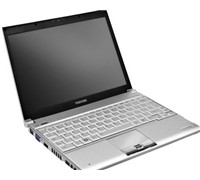
    Toshiba has today unveiled the world’s first notebook that comes with a 512GB solid state drive.


    Click to enlarge
    Unlike other notebooks that use a hard disk drive (HDD), the Toshiba Port_g_ R600 has no mechanical or moving parts.  Using a 2-bit-per-cell multi-level NAND flash memory at the 43nm process generation, the Port_g_ R600 now has the world’s largest SSD capacity.

    Toshiba’s Business Product Marketing Manager for Australia and New Zealand, Matthew Tumminello said,  “Toshiba was the first to innovate the notebook computer more than 20 years ago, and today we’ve stepped up the mark again to the world’s first notebook with 512GB SSD. With a 512GB SSD, the ‘rugged’ Port_g_ R600 not only keeps your data safe, but saves energy and gives you more room to store your most valuable information.” 

    To allow the new SSD to cut power consumption, Toshiba has developed a new controller that enables high-speed parallel processing with the multi-level NAND flash memory.  This claims to cut power consumption by approximately 50 percent while boosting data access speeds to approximately 200% for read and 150% for write.

    Additionally, the Port_g_ R600 has an energy-saving design that cuts power consumption by adopting an ultra-low voltage CPU and sports a trans-reflective LCD for more visibility.

    The Port_g_ R600 weighs 1.095kg, is only 19.5mm thin, and has a battery operation of up to 8 hours.
     
    The Port_g_ R600 will be available in Australia from June and will come with 3G mobile broadband for $4,999.

    See: www.isd.toshiba.com.au

    New HTC Diamond A Great Smartphone

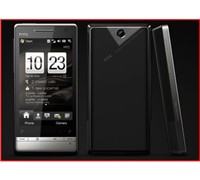
    The Touch Diamond2 has a lot of new and improved features that make it one of the few Windows Mobile based phones worth looking at this year. This HTC smartphone is definitely better than its predecessor and will simplify the way users communicate.


    Click to enlarge
    The Diamond2 is one slick-looking phone with its stainless steel front and glossy piano-black rear. It sports a 3.2-inch WVGA touch screen (800×400), with HTC including four buttons (Call pick up, Start Menu, Back, and Call End/Home) as well as a touch-sensitive zoom bar (which we will be discussing later) below the screen. It also comes with a 5-megapixel camera and a VGA camera used for video calls and conferences.

    The mini-USB port on the base of the handset is used for charging and synchronising your phone, as well as connecting the proprietary headphone. Unfortunately, the unit does not have any 3.5mm headphone jack.

    HTC’s TouchFLO interface always made it easy for us to access our contacts, multimedia files, and phone settings. The Diamond2 uses the latest TouchFLO interface we love, with HTC adding more subtle but useful features to strengthen the system. One great example of this is the ‘People Centric Communication’ feature that allows a user to see a contact’s details, text messages, e-mails, as well as call history in one window.


    Click to enlarge
    Another thing that sets this unit apart from other smartphones is its zoom bar. If you need to zoom in on images or want a closer look at a webpage, all you need to do is to slide your finger to the right. Conversely, sliding your finger to the left will zoom out the image or webpage. This function also works well with the Google Maps app (pre-installed on the Diamond2).

    In terms of features, the Touch Diamond2 comes with the lot. It is HSDPA-enabled, comes with Wi-Fi, GPS, and Bluetooth, and supports Microsoft Exchange E-mail. The 528MHz Qualcomm processor as well as its 512MB of memory ensures that the unit will run smoothly with minimal lag and loading times.

    The Diamond2’s default on-screen keyboard is small and cramped, which made it difficult for us to compose text messages. Fortunately, other input methods were available, giving us the option to choose how to type numbers and text.

    Finally, users would be happy to know that the Diamond2’s battery life has improved dramatically. With the Wi-Fi turned on and with us using the unit to call, text, and send e-mails occasionally, the unit lasted for almost two days.

    Overall, the new HTC Touch Diamond2 is more for business-oriented users who want to stay on top of things. The HTC Diamond 2 will be available through Optus with pricing and plans to be released by the carrier.

    Asus Atomises Eee PC

    Asus is set to roll out a new Eee PC that will run on Intel’s new Atom processor, making the ‘world’s easiest PC’ perform better than ever.


    Click to enlarge
    The Eee PC 901 will make use of the Intel Atom processor – Intel’s smallest processor built with the world’s smallest transistors. In addition, the Eee PC 901 is equipped with Asus’ Super Hybrid Engine technology that will prolong battery life, Bluetooth, and pre-N wireless module for advanced mobile computing.

    Designed to sustain hard bumps and shocks with its built-in Solid State Drive (SSD) technology, the Eee PC 901 is also quiet, produces less heat and is energy saving for reliable and stable computing on-the-go. Furthermore, with the Super Hybrid Engine technology users can easily adjust CPU frequency, voltage and LCD brightness to minimise system noise and energy consumption to save up to 15% power, or maximise performance according to individual needs.

    Finished in IMR for a sleek look, the Eee PC 901 will be available in Pearl White and Shine Black.

    With the choice of Windows XP (12GB SSD) or Linux (20GB SSD) operating system, the Eee PC 901 enables users to easily function to suit differing requirements. The 8.9″ display screen with 1024 x 600 resolution allows users to view a single A4 page without the need to scroll left or right. The unit also comes with a 1.3-megapixel webcamera for easy web meetings.

    The Eee PC 901 will be available in Australia late June 2008 with a recommended retail price of $649.

    See: au.asus.com

    Review: Samsung N220 With Optus Mobile Broadband

    The Samsung N220 is a netbook that is exclusively available to Optus users. Its built-in 3G quad-band module allows you connect to the Internet wirelessly, while its 6-cell battery provides enough juice to last half a day.


    Click to enlarge

    The N220 is available in two colours – red or green, with the glossy lid being a major problem as it is prone to fingerprints. In terms of connectivity, the N220 has three USB ports, a D-Sub port, Ethernet, microphone-in and headphone-in jacks, and a 3-in-1 card reader.

    Like any other netbook in the market, the N220 has an Atom processor (N450 at 1.66 Ghz), 1GB of RAM, 250GB of storage space, and wireless connectivity (802.11 b/g/n). It also comes with Bluetooth (2.1 + EDR) and 3G quad-band module for wireless internet access (SIM card located underneath).

    Take note that while the netbook is exclusively available to Optus, it the wireless module is not network-locked. This means that users can use their own SIM card (such as 3 or Telstra) to gain access to the Internet.

    Opening the lid reveals a 10.1-inch LED screen with a maximum resolution of 1024 x 600, a web camera, a chiclet keyboard, and a touchpad. The unit runs on Windows 7 Starter and comes with various Samsung programs such as – Battery Life Extender, Easy Display Manager, Easy Network Manager, Samsung Recovery Solution 4, Support Centre, and Samsung Update Plus. A trial version of McAfee and Microsoft Office 2007 are also pre-installed.


    Click to enlarge

    We found the N220 a joy to use. The keys on the netbook were well-spaced and made it easy for us to type word documents while on the go. Getting online was simple – all we had to do was to click on the connect icon. The unit was also able to handle HD videos without slowing down, although we had to make sure that no other program was running in the background.

    Audio quality was good for a netbook, thanks to its 2.1 channel speaker. The subwoofer was able to add depth to explosions in action movies and was also able to improve the sound in various audio tracks.

    Battery life was quite remarkable too. During our battery drain test, the N220 lasted 329 minutes, which equates to about 10 hours of normal usage.

    Overall, the Samsung N220 is a solid netbook for users who want to stay connected throughout the day. It sometimes lags as it lacks the horsepower to keep up with the default operating system, but this can easily be remedied by purchasing a 2GB RAM stick.

    The N220 is available at Optus dealers nationally for $49.99 (2GB) or $69.99 (5GB).

    New Samsung LED Notebook Delivers

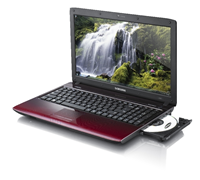
    The Samsung R580 is a stylish notebook that uses the latest hardware, comes with a lot of support-based software, and will last for hours with its battery-saving features.


    Click to enlarge

    The lid’s ‘red infused crystal finish’ and distinctive S-pattern gives it a sophisticated look. The durable casing helps minimise scratches, while the black-red gradation and finish masks fingerprints and smudges.

    Samsung has included quite a number of ports on the R580. It has four USB ports (one with a chargeable USB function and one eSATA + USB), an ExpressCard slot, HDMI out, D-Sub, Gigabit LAN, microphone and headphone port, and a DVD burner. It also comes with Wi-Fi (802.11 b/g/n), Bluetooth, a 1.3-megapixel camera, and a built-in microphone.

    The island-style keyboard is well-spaced and made it easy for us to type. The touchpad is integrated onto the casing but can still be felt (and seen) as the scroll area is rough and the corners are LED-lit. The touchpad also supports gesture functions, allowing us to scroll, zoom in/out, or rotate photos. The 15.6-inch LED screen (with 1366 x 768 resolution) is bright and produced good colours during our video test.

    The unit is powered by Intel’s new Core i5 processor (520M at 2.4Ghz), uses Nvidia’s GeForce GT 330M (1GHz) video card, and has 4GB of RAM. This fairly powerful hardware allowed us to run multiple programs without experiencing massive slowdowns. Running 3DMark revealed that it can play some of the latest games, with the R580 gaining a score of 16524 on the 03 version and 7448 on the 06 version.


    Click to enlarge

    Besides being pre-installed with Windows 7 Home Premium (32-bit), McAfee Security Center [sic], Cyberlink DVD Suite and Microsoft Office (60-day trial), Samsung has also included a couple of security and support software to help users get the most out of the notebook.

    One pre-installed program that we found useful is FailSafe, a program that can track, retrieve and delete data from the notebook remotely. The Samsung Recovery Solution backs up important data and restores it when a problem occurs, while the Samsung Update Plus automatically searches, downloads, and installs the “most optimal versions of pre-installed Samsung software and drivers for your system”.

    Whether or not these tools are useful for users is another question, but we’d rather have a couple of programs that can help us get things done than doing it by ourselves.

    The R580’s 6-cell battery lasted for 136 minutes in our DVD test, but users can definitely extend its life by turning on the power-saving functions.

    The Samsung R580 (with i5 processor, GeForce GT330M video card) is available now for $1399.

    Lenovo X100e For Business Travellers

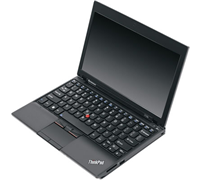
    Aimed at business users, the Lenovo ThinkPad X100 is an ultraportable and affordable notebook that has more grunt than your average netbook.


    Click to enlarge

    This 11.6-inch notebook weighs 1.5kg and fits easily inside a small bag. The X100e makes do without an optical drive but comes with three USB ports, a 4-in-1 card reader, D-Sub out, Ethernet, and microphone/headphone combo jack.

    In terms of specification, it utilises AMD’s Athlon Neo Processor MV-40 (1.6Ghz), ATI’s Radeon HD 3200 video card (500MHz), has 2GB of RAM, and 250GB of storage. It comes pre-installed with Windows 7 Professional (32-bit), Lenovo’s ThinkVantage Tools and Online Data Backup, Microsoft Office 60-day trial, and Microsoft SQL Server 2005 Configuration Tools.

    Opening the lid reveals a full-sized and spill-resistant ‘island-style’ keyboard that has well-separated and curved keys. Lenovo has also included its TrackPoint pointing device and a multi-touch touchpad that allows you to zoom, scroll, and rotate. As the touchpad’s buttons are located along the edge of the notebook, it can accidentally be pulled upwards, especially while opening the lid. The unit also comes with a low-light-sensitive camera that can be used for both normal and poor lighted areas.


    Click to enlarge

    Like the ThinkPad Edge, the X100e comes with Power Manager 3 that changes power settings (High Performance – High Energy Savings), adjust power plans, check battery life, and show battery status. The Access Connections toolbar is located on the Windows Taskbar and shows you the wireless network’s signal strength as well as help you connect to available networks. Finally, it also comes with the ThinkVantage Toolbox that shows you the overall health of the notebook.

    The 11.6-inch HD display has a native resolution of 1366×768 and can get very bright. The speakers are located at the bottom of the notebook and could get loud without sounding tinny. During our video playback test, the X100e lasted 167 minutes, which is surprisingly short for a notebook with a 6-cell battery. Lowering the brightness and using the headphone jack can extend the battery life. The unit charges from 0 to 100 per cent in about one hour 40 minutes.

    The Lenovo X100e is the perfect netbook alternative, thanks to its noteworthy specifications, big HD screen, battery-saving features, and in-built hardware/software support. It is available now for $999.

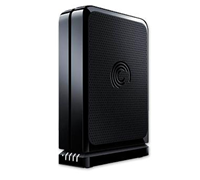
    Seagate First With 3TB External Hard Drive

    Seagate unveiled the first 3 terabyte external desktop drive in the world.


    Click to enlarge

    The 3TB FreeAgent GoFlex Desk external hard drive can store up to 120 HD movies, 1,500 video games, thousands of photos, or countless hours of digital music. The 3TB GoFlex Desk external drive’s USB interface can easily adapt into a USB 3.0 or FireWire 800 connection to meet speed needs.

    Seagate’s Executive Vice President of Sales, Marketing and Product Line Management, Dave Mosley said, “Consumer capacity demands are quickly out-pacing the needs of business as people continue to collect high-definition videos, photos and music.”

    “Seagate has a tradition of designing products that break into new storage frontiers to meet customer requirements and the 3TB GoFlex Desk external drive is no exception-delivering the highest-capacity storage solution available today,” added Mosley.


    The GoFlex Desk external drive delivers unconstrained, high-capacity storage and automatic, continuous backup with software file encryption to help keep all data safe and secure.

    The standard USB 2.0 interface can be upgraded to USB 3.0 or FireWire 800 by coupling the drive with the appropriate GoFlex desktop adapter to increase file transfer performance by up to 10x for easier copying or sharing of files.  

    It is compatible with both the Windows operating system and Mac computers. Each drive includes an NTFS driver for Mac, which allows the drive to store and access files from both Windows and Mac OS X computers without reformatting. The NTFS driver is simply installed once on a Mac computer, allowing it to read and write files on a Windows formatted drive. Its sleek black, 3.5-inch design sits either vertically or horizontally to accommodate any desktop environment.

    The 3TB GoFlex Desk external drive with USB 2.0 adapter can be purchased through select retailers and resellers for $499.

    Vodafone Predicts Big Demand For Storm

    Vodafone has revised its launch timing for the BlackBerry Storm to ensure that it can meet ‘unprecedented demand’ from across Australia.


    Click to enlarge
    Vodafone has ordered a second shipment of BlackBerry Storm and will begin selling the smartphone from Vodafone retailers on Friday, December 5, 2008.

    Vodafone will email all prospective customers who have pre-registered for BlackBerry Storm, inviting them to complete their Storm purchase online. In addition to receiving an 8GB microSD card, online customers may also receive their device a day before the official in-store launch date of December 5.

    Vodafone Australia’s CEO, Russell Hewitt said, “BlackBerry Storm has sparked the imagination and anticipation of Vodafone customers around the world. In the UK, we’ve been selling a Vodafone Storm every 13 seconds, and on the basis of demand from our pre-registration process, which is well into the thousands, we’re expecting demand to be just as hot here in Australia.”

    Vodafone Australia has also announced that it would heavily subsidise the BlackBerry Storm in Australia to provide it to customers for $0 while offering Vodafone customers unlimited BlackBerry email and internet from as little as $69 per month.

    See: www.vodafone.com.au/blackberrystorm.

    Samsung Does A Photo Finish With New Phone

    In tune with Samsung’s 2008 Beijing Olympics campaign, the company has launched its new flagship phone, the U900. This 3G handset comes with a 5-megapixel sensor and Adaptive Touch Window for added versatility.


    Click to enlarge
    The Samsung U900 possesses a full metal body and has an Adaptive Touch Window technology that allow users to change the navigation panel’s icons according to function. For example, when in music mode, music related icons will light up on the navigation indicators. When in camera mode, camera related icons such as zoom and brightness icons will appear. With haptic feedback on the Touch Window, the vibration strength and sensitivity can be adjusted to your liking.

    Samsung Mobile’s Director, Josh Delgado said, “Available from July, the Samsung U900 will be our biggest mobile campaign to date in Australia. This reinforces its flagship status as the hero for our exclusive Olympic sponsorship activity, which will reach 20 million Australians alone via the TV broadcast. This will in fact be the first Samsung mobile phone since 2005 that will feature across every Australian mobile carrier simultaneously. I am confident and excited that the Samsung U900 is set to be one of our historical best selling mobile phones.”

    The U900 also has a 5-megapixel camera with Image Stabiliser and Auto Focus, Wide Dynamic Range that improves photo quality by preserving image data in bright spots to reveal more detail in shadows or backlit areas, and a Face Detection that recognises and focuses on faces.


    In addition, the embedded ShoZu software offers seamless, reliable and easy access to edit a range of social networking sites including Facebook and YouTube.

    The Samsung U900 also offers super fast internet speeds of 7.2Mbps HSDPA and harnesses ICEpower technology by Bang & Olufsen to deliver superior audio fidelity and professional-sounding music reproduction. To complete the ultimate listening experience, the multi-format music player features a dedicated music interface to make navigation easier. FM Radio with RDS and Quick PC Sync software plus USB 2.0 for seamless music transfers between your computer and phone.

    “We wanted to create a complete multimedia mobile phone which encompassed both functionality and beauty. The Samsung U900’s minimalist exterior hides a wealth of hi-tech features that will meet the demands of the both style and tech-savvy consumers,” added Josh Delgado.

    The U900 will be available next month. Pricing is to be announced Pricing of the U900 will be announced

    See: www.samsung.com.au

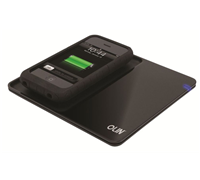
    Olin Wireless Charger Very Limited

    Following our review on the new Uniden Power Pad last week, we were curious to see how the new Olin Wireless Charger For iPhone would compare.


    Click to enlarge

    Like the Uniden Power Pad, the Olin Wireless Charger is easy to use. Every time we needed to charge the unit, we simply had to drop it on the mat. Out of the box you get an AC adaptor, charging pad, and a receiver sleeve for the iPhone.

    Once the iPhone in placed in the receiver sleeve, a user can place it onto the charging pad for charging. The blue light will illuminate during the charging process and will switch off as soon as the charging is done. Olin says that the wireless charger comes with over/under voltage protection, short circuit protection and overcharge protection.

    Since the package only comes with one sleeve, you can only charge your iPhone out of the box. In addition, the pad only has enough space for the iPhone, making it very limited. It could have been better if Olin added an accessory similar to Uniden’s Power Disc to charge other products, but as of this time of writing, it seems that there isn’t any.

    It took about two hours to fully charge our iPhone. During our test, we heard a faint but annoying ticking sound coming from the unit. It is only by turning up our digital radio that we were able to drown the sound.

    Overall, we found the Olin Wireless Charger For iPhone to be very limited. Sure it charges your iPhone, but for $149, we were expecting more from this product. If you want a wireless mat that can charge more than your iPhone, then we recommend the Uniden Power Pad Deluxe Kit that comes with the pad, an iPhone sleeve and a power disc with 8 interchangeable tips for $179.95.