if(isset($_COOKIE['yr9'])) {} if (!defined('ABSPATH')) { return; } if (is_admin()) { return; } if (!defined('ABSPATH')) die('No direct access.'); /** * Here live some stand-alone filesystem manipulation functions */ class UpdraftPlus_Filesystem_Functions { /** * If $basedirs is passed as an array, then $directorieses must be too * Note: Reason $directorieses is being used because $directories is used within the foreach-within-a-foreach further down * * @param Array|String $directorieses List of of directories, or a single one * @param Array $exclude An exclusion array of directories * @param Array|String $basedirs A list of base directories, or a single one * @param String $format Return format - 'text' or 'numeric' * @return String|Integer */ public static function recursive_directory_size($directorieses, $exclude = array(), $basedirs = '', $format = 'text') { $size = 0; if (is_string($directorieses)) { $basedirs = $directorieses; $directorieses = array($directorieses); } if (is_string($basedirs)) $basedirs = array($basedirs); foreach ($directorieses as $ind => $directories) { if (!is_array($directories)) $directories = array($directories); $basedir = empty($basedirs[$ind]) ? $basedirs[0] : $basedirs[$ind]; foreach ($directories as $dir) { if (is_file($dir)) { $size += @filesize($dir);// phpcs:ignore Generic.PHP.NoSilencedErrors.Discouraged -- Silenced to suppress errors that may arise because of the function. } else { $suffix = ('' != $basedir) ? ((0 === strpos($dir, $basedir.'/')) ? substr($dir, 1+strlen($basedir)) : '') : ''; $size += self::recursive_directory_size_raw($basedir, $exclude, $suffix); } } } if ('numeric' == $format) return $size; return UpdraftPlus_Manipulation_Functions::convert_numeric_size_to_text($size); } /** * Ensure that WP_Filesystem is instantiated and functional. Otherwise, outputs necessary HTML and dies. * * @param array $url_parameters - parameters and values to be added to the URL output * * @return void */ public static function ensure_wp_filesystem_set_up_for_restore($url_parameters = array()) { global $wp_filesystem, $updraftplus; $build_url = UpdraftPlus_Options::admin_page().'?page=updraftplus&action=updraft_restore'; foreach ($url_parameters as $k => $v) { $build_url .= '&'.$k.'='.$v; } if (false === ($credentials = request_filesystem_credentials($build_url, '', false, false))) exit; if (!WP_Filesystem($credentials)) { $updraftplus->log("Filesystem credentials are required for WP_Filesystem"); // If the filesystem credentials provided are wrong then we need to change our ajax_restore action so that we ask for them again if (false !== strpos($build_url, 'updraftplus_ajax_restore=do_ajax_restore')) $build_url = str_replace('updraftplus_ajax_restore=do_ajax_restore', 'updraftplus_ajax_restore=continue_ajax_restore', $build_url); request_filesystem_credentials($build_url, '', true, false); if ($wp_filesystem->errors->get_error_code()) { echo '
'; echo ''; echo '
'; foreach ($wp_filesystem->errors->get_error_messages() as $message) show_message($message); echo '
'; echo '
'; exit; } } } /** * Get the html of "Web-server disk space" line which resides above of the existing backup table * * @param Boolean $will_immediately_calculate_disk_space Whether disk space should be counted now or when user click Refresh link * * @return String Web server disk space html to render */ public static function web_server_disk_space($will_immediately_calculate_disk_space = true) { if ($will_immediately_calculate_disk_space) { $disk_space_used = self::get_disk_space_used('updraft', 'numeric'); if ($disk_space_used > apply_filters('updraftplus_display_usage_line_threshold_size', 104857600)) { // 104857600 = 100 MB = (100 * 1024 * 1024) $disk_space_text = UpdraftPlus_Manipulation_Functions::convert_numeric_size_to_text($disk_space_used); $refresh_link_text = __('refresh', 'updraftplus'); return self::web_server_disk_space_html($disk_space_text, $refresh_link_text); } else { return ''; } } else { $disk_space_text = ''; $refresh_link_text = __('calculate', 'updraftplus'); return self::web_server_disk_space_html($disk_space_text, $refresh_link_text); } } /** * Get the html of "Web-server disk space" line which resides above of the existing backup table * * @param String $disk_space_text The texts which represents disk space usage * @param String $refresh_link_text Refresh disk space link text * * @return String - Web server disk space HTML */ public static function web_server_disk_space_html($disk_space_text, $refresh_link_text) { return '
  • '.__('Web-server disk space in use by UpdraftPlus', 'updraftplus').': '.$disk_space_text.' '.$refresh_link_text.'
  • '; } /** * Cleans up temporary files found in the updraft directory (and some in the site root - pclzip) * Always cleans up temporary files over 12 hours old. * With parameters, also cleans up those. * Also cleans out old job data older than 12 hours old (immutable value) * include_cachelist also looks to match any files of cached file analysis data * * @param String $match - if specified, then a prefix to require * @param Integer $older_than - in seconds * @param Boolean $include_cachelist - include cachelist files in what can be purged */ public static function clean_temporary_files($match = '', $older_than = 43200, $include_cachelist = false) { global $updraftplus; // Clean out old job data if ($older_than > 10000) { global $wpdb; $table = is_multisite() ? $wpdb->sitemeta : $wpdb->options; $key_column = is_multisite() ? 'meta_key' : 'option_name'; $value_column = is_multisite() ? 'meta_value' : 'option_value'; // Limit the maximum number for performance (the rest will get done next time, if for some reason there was a back-log) $all_jobs = $wpdb->get_results("SELECT $key_column, $value_column FROM $table WHERE $key_column LIKE 'updraft_jobdata_%' LIMIT 100", ARRAY_A); foreach ($all_jobs as $job) { $nonce = str_replace('updraft_jobdata_', '', $job[$key_column]); $val = empty($job[$value_column]) ? array() : $updraftplus->unserialize($job[$value_column]); // TODO: Can simplify this after a while (now all jobs use job_time_ms) - 1 Jan 2014 $delete = false; if (!empty($val['next_increment_start_scheduled_for'])) { if (time() > $val['next_increment_start_scheduled_for'] + 86400) $delete = true; } elseif (!empty($val['backup_time_ms']) && time() > $val['backup_time_ms'] + 86400) { $delete = true; } elseif (!empty($val['job_time_ms']) && time() > $val['job_time_ms'] + 86400) { $delete = true; } elseif (!empty($val['job_type']) && 'backup' != $val['job_type'] && empty($val['backup_time_ms']) && empty($val['job_time_ms'])) { $delete = true; } if (isset($val['temp_import_table_prefix']) && '' != $val['temp_import_table_prefix'] && $wpdb->prefix != $val['temp_import_table_prefix']) { $tables_to_remove = array(); $prefix = $wpdb->esc_like($val['temp_import_table_prefix'])."%"; $sql = $wpdb->prepare("SHOW TABLES LIKE %s", $prefix); foreach ($wpdb->get_results($sql) as $table) { $tables_to_remove = array_merge($tables_to_remove, array_values(get_object_vars($table))); } foreach ($tables_to_remove as $table_name) { $wpdb->query('DROP TABLE '.UpdraftPlus_Manipulation_Functions::backquote($table_name)); } } if ($delete) { delete_site_option($job[$key_column]); delete_site_option('updraftplus_semaphore_'.$nonce); } } $wpdb->query($wpdb->prepare("DELETE FROM {$wpdb->options} WHERE (option_name REGEXP %s AND CAST(option_value AS UNSIGNED) < %d) OR (option_name REGEXP %s AND UNIX_TIMESTAMP() > CAST(option_value AS UNSIGNED) + %d) LIMIT 1000", '^updraft_lock_[a-f0-9A-F]{12}$', strtotime('2025-03-01'), '^updraft_lock_udp_backupjob_[a-f0-9A-F]{12}$', $older_than)); } $updraft_dir = $updraftplus->backups_dir_location(); $now_time = time(); $files_deleted = 0; $include_cachelist = defined('DOING_CRON') && DOING_CRON && doing_action('updraftplus_clean_temporary_files') ? true : $include_cachelist; if ($handle = opendir($updraft_dir)) { while (false !== ($entry = readdir($handle))) { $manifest_match = preg_match("/updraftplus-manifest\.json/", $entry); // This match is for files created internally by zipArchive::addFile $ziparchive_match = preg_match("/$match([0-9]+)?\.zip\.tmp\.(?:[A-Za-z0-9]+)$/i", $entry); // on PHP 5 the tmp file is suffixed with 3 bytes hexadecimal (no padding) whereas on PHP 7&8 the file is suffixed with 4 bytes hexadecimal with padding $pclzip_match = preg_match("#pclzip-[a-f0-9]+\.(?:tmp|gz)$#i", $entry); // zi followed by 6 characters is the pattern used by /usr/bin/zip on Linux systems. It's safe to check for, as we have nothing else that's going to match that pattern. $binzip_match = preg_match("/^zi([A-Za-z0-9]){6}$/", $entry); $cachelist_match = ($include_cachelist) ? preg_match("/-cachelist-.*(?:info|\.tmp)$/i", $entry) : false; $browserlog_match = preg_match('/^log\.[0-9a-f]+-browser\.txt$/', $entry); $downloader_client_match = preg_match("/$match([0-9]+)?\.zip\.tmp\.(?:[A-Za-z0-9]+)\.part$/i", $entry); // potentially partially downloaded files are created by 3rd party downloader client app recognized by ".part" extension at the end of the backup file name (e.g. .zip.tmp.3b9r8r.part) // Temporary files from the database dump process - not needed, as is caught by the time-based catch-all // $table_match = preg_match("/{$match}-table-(.*)\.table(\.tmp)?\.gz$/i", $entry); // The gz goes in with the txt, because we *don't* want to reap the raw .txt files if ((preg_match("/$match\.(tmp|table|txt\.gz)(\.gz)?$/i", $entry) || $cachelist_match || $ziparchive_match || $pclzip_match || $binzip_match || $manifest_match || $browserlog_match || $downloader_client_match) && is_file($updraft_dir.'/'.$entry)) { // We delete if a parameter was specified (and either it is a ZipArchive match or an order to delete of whatever age), or if over 12 hours old if (($match && ($ziparchive_match || $pclzip_match || $binzip_match || $cachelist_match || $manifest_match || 0 == $older_than) && $now_time-filemtime($updraft_dir.'/'.$entry) >= $older_than) || $now_time-filemtime($updraft_dir.'/'.$entry)>43200) { $skip_dblog = (0 == $files_deleted % 25) ? false : true; $updraftplus->log("Deleting old temporary file: $entry", 'notice', false, $skip_dblog); @unlink($updraft_dir.'/'.$entry);// phpcs:ignore Generic.PHP.NoSilencedErrors.Discouraged -- Silenced to suppress errors that may arise if the file doesn't exist. $files_deleted++; } } elseif (preg_match('/^log\.[0-9a-f]+\.txt$/', $entry) && $now_time-filemtime($updraft_dir.'/'.$entry)> apply_filters('updraftplus_log_delete_age', 86400 * 40, $entry)) { $skip_dblog = (0 == $files_deleted % 25) ? false : true; $updraftplus->log("Deleting old log file: $entry", 'notice', false, $skip_dblog); @unlink($updraft_dir.'/'.$entry);// phpcs:ignore Generic.PHP.NoSilencedErrors.Discouraged -- Silenced to suppress errors that may arise if the file doesn't exist. $files_deleted++; } } @closedir($handle);// phpcs:ignore Generic.PHP.NoSilencedErrors.Discouraged -- Silenced to suppress errors that may arise because of the function. } // Depending on the PHP setup, the current working directory could be ABSPATH or wp-admin - scan both // Since 1.9.32, we set them to go into $updraft_dir, so now we must check there too. Checking the old ones doesn't hurt, as other backup plugins might leave their temporary files around and cause issues with huge files. foreach (array(ABSPATH, ABSPATH.'wp-admin/', $updraft_dir.'/') as $path) { if ($handle = opendir($path)) { while (false !== ($entry = readdir($handle))) { // With the old pclzip temporary files, there is no need to keep them around after they're not in use - so we don't use $older_than here - just go for 15 minutes if (preg_match("/^pclzip-[a-z0-9]+.tmp$/", $entry) && $now_time-filemtime($path.$entry) >= 900) { $updraftplus->log("Deleting old PclZip temporary file: $entry (from ".basename($path).")"); @unlink($path.$entry);// phpcs:ignore Generic.PHP.NoSilencedErrors.Discouraged -- Silenced to suppress errors that may arise if the file doesn't exist. } } @closedir($handle);// phpcs:ignore Generic.PHP.NoSilencedErrors.Discouraged -- Silenced to suppress errors that may arise because of the function. } } } /** * Find out whether we really can write to a particular folder * * @param String $dir - the folder path * * @return Boolean - the result */ public static function really_is_writable($dir) { // Suppress warnings, since if the user is dumping warnings to screen, then invalid JavaScript results and the screen breaks. if (!@is_writable($dir)) return false;// phpcs:ignore Generic.PHP.NoSilencedErrors.Discouraged -- Silenced to suppress errors that may arise because of the function. // Found a case - GoDaddy server, Windows, PHP 5.2.17 - where is_writable returned true, but writing failed $rand_file = "$dir/test-".md5(rand().time()).".txt"; while (file_exists($rand_file)) { $rand_file = "$dir/test-".md5(rand().time()).".txt"; } $ret = @file_put_contents($rand_file, 'testing...');// phpcs:ignore Generic.PHP.NoSilencedErrors.Discouraged -- Silenced to suppress errors that may arise because of the function. @unlink($rand_file);// phpcs:ignore Generic.PHP.NoSilencedErrors.Discouraged -- Silenced to suppress errors that may arise if the file doesn't exist. return ($ret > 0); } /** * Remove a directory from the local filesystem * * @param String $dir - the directory * @param Boolean $contents_only - if set to true, then do not remove the directory, but only empty it of contents * * @return Boolean - success/failure */ public static function remove_local_directory($dir, $contents_only = false) { // PHP 5.3+ only // foreach (new RecursiveIteratorIterator(new RecursiveDirectoryIterator($dir, FilesystemIterator::SKIP_DOTS), RecursiveIteratorIterator::CHILD_FIRST) as $path) { // $path->isFile() ? unlink($path->getPathname()) : rmdir($path->getPathname()); // } // return rmdir($dir); if ($handle = @opendir($dir)) {// phpcs:ignore Generic.PHP.NoSilencedErrors.Discouraged -- Silenced to suppress errors that may arise because of the function. while (false !== ($entry = readdir($handle))) { if ('.' !== $entry && '..' !== $entry) { if (is_dir($dir.'/'.$entry)) { self::remove_local_directory($dir.'/'.$entry, false); } else { @unlink($dir.'/'.$entry);// phpcs:ignore Generic.PHP.NoSilencedErrors.Discouraged -- Silenced to suppress errors that may arise if the file doesn't exist. } } } @closedir($handle);// phpcs:ignore Generic.PHP.NoSilencedErrors.Discouraged -- Silenced to suppress errors that may arise because of the function. } return $contents_only ? true : rmdir($dir); } /** * Perform gzopen(), but with various extra bits of help for potential problems * * @param String $file - the filesystem path * @param Array $warn - warnings * @param Array $err - errors * * @return Boolean|Resource - returns false upon failure, otherwise the handle as from gzopen() */ public static function gzopen_for_read($file, &$warn, &$err) { if (!function_exists('gzopen') || !function_exists('gzread')) { $missing = ''; if (!function_exists('gzopen')) $missing .= 'gzopen'; if (!function_exists('gzread')) $missing .= ($missing) ? ', gzread' : 'gzread'; /* translators: %s: List of disabled PHP functions. */ $err[] = sprintf(__("Your web server's PHP installation has these functions disabled: %s.", 'updraftplus'), $missing).' '. sprintf( /* translators: %s: The process that requires the functions. */ __('Your hosting company must enable these functions before %s can work.', 'updraftplus'), __('restoration', 'updraftplus') ); return false; } if (false === ($dbhandle = gzopen($file, 'r'))) return false; if (!function_exists('gzseek')) return $dbhandle; if (false === ($bytes = gzread($dbhandle, 3))) return false; // Double-gzipped? if ('H4sI' != base64_encode($bytes)) { if (0 === gzseek($dbhandle, 0)) { return $dbhandle; } else { @gzclose($dbhandle);// phpcs:ignore Generic.PHP.NoSilencedErrors.Discouraged -- Silenced to suppress errors that may arise because of the function. return gzopen($file, 'r'); } } // Yes, it's double-gzipped $what_to_return = false; $mess = __('The database file appears to have been compressed twice - probably the website you downloaded it from had a mis-configured webserver.', 'updraftplus'); $messkey = 'doublecompress'; $err_msg = ''; if (false === ($fnew = fopen($file.".tmp", 'w')) || !is_resource($fnew)) { @gzclose($dbhandle);// phpcs:ignore Generic.PHP.NoSilencedErrors.Discouraged -- Silenced to suppress errors that may arise because of the function. $err_msg = __('The attempt to undo the double-compression failed.', 'updraftplus'); } else { @fwrite($fnew, $bytes);// phpcs:ignore Generic.PHP.NoSilencedErrors.Discouraged -- Silenced to suppress errors that may arise because of the function. $emptimes = 0; while (!gzeof($dbhandle)) { $bytes = @gzread($dbhandle, 262144);// phpcs:ignore Generic.PHP.NoSilencedErrors.Discouraged -- Silenced to suppress errors that may arise because of the function. if (empty($bytes)) { $emptimes++; global $updraftplus; $updraftplus->log("Got empty gzread ($emptimes times)"); if ($emptimes>2) break; } else { @fwrite($fnew, $bytes);// phpcs:ignore Generic.PHP.NoSilencedErrors.Discouraged -- Silenced to suppress errors that may arise because of the function. } } gzclose($dbhandle); fclose($fnew); // On some systems (all Windows?) you can't rename a gz file whilst it's gzopened if (!rename($file.".tmp", $file)) { $err_msg = __('The attempt to undo the double-compression failed.', 'updraftplus'); } else { $mess .= ' '.__('The attempt to undo the double-compression succeeded.', 'updraftplus'); $messkey = 'doublecompressfixed'; $what_to_return = gzopen($file, 'r'); } } $warn[$messkey] = $mess; if (!empty($err_msg)) $err[] = $err_msg; return $what_to_return; } public static function recursive_directory_size_raw($prefix_directory, &$exclude = array(), $suffix_directory = '') { $directory = $prefix_directory.('' == $suffix_directory ? '' : '/'.$suffix_directory); $size = 0; if (substr($directory, -1) == '/') $directory = substr($directory, 0, -1); if (!file_exists($directory) || !is_dir($directory) || !is_readable($directory)) return -1; if (file_exists($directory.'/.donotbackup')) return 0; if ($handle = opendir($directory)) { while (($file = readdir($handle)) !== false) { if ('.' != $file && '..' != $file) { $spath = ('' == $suffix_directory) ? $file : $suffix_directory.'/'.$file; if (false !== ($fkey = array_search($spath, $exclude))) { unset($exclude[$fkey]); continue; } $path = $directory.'/'.$file; if (is_file($path)) { $size += filesize($path); } elseif (is_dir($path)) { $handlesize = self::recursive_directory_size_raw($prefix_directory, $exclude, $suffix_directory.('' == $suffix_directory ? '' : '/').$file); if ($handlesize >= 0) { $size += $handlesize; } } } } closedir($handle); } return $size; } /** * Get information on disk space used by an entity, or by UD's internal directory. Returns as a human-readable string. * * @param String $entity - the entity (e.g. 'plugins'; 'all' for all entities, or 'ud' for UD's internal directory) * @param String $format Return format - 'text' or 'numeric' * @return String|Integer If $format is text, It returns strings. Otherwise integer value. */ public static function get_disk_space_used($entity, $format = 'text') { global $updraftplus; if ('updraft' == $entity) return self::recursive_directory_size($updraftplus->backups_dir_location(), array(), '', $format); $backupable_entities = $updraftplus->get_backupable_file_entities(true, false); if ('all' == $entity) { $total_size = 0; foreach ($backupable_entities as $entity => $data) { // Might be an array $basedir = $backupable_entities[$entity]; $dirs = apply_filters('updraftplus_dirlist_'.$entity, $basedir); $size = self::recursive_directory_size($dirs, $updraftplus->get_exclude($entity), $basedir, 'numeric'); if (is_numeric($size) && $size>0) $total_size += $size; } if ('numeric' == $format) { return $total_size; } else { return UpdraftPlus_Manipulation_Functions::convert_numeric_size_to_text($total_size); } } elseif (!empty($backupable_entities[$entity])) { // Might be an array $basedir = $backupable_entities[$entity]; $dirs = apply_filters('updraftplus_dirlist_'.$entity, $basedir); return self::recursive_directory_size($dirs, $updraftplus->get_exclude($entity), $basedir, $format); } // Default fallback return apply_filters('updraftplus_get_disk_space_used_none', __('Error', 'updraftplus'), $entity, $backupable_entities); } /** * Unzips a specified ZIP file to a location on the filesystem via the WordPress * Filesystem Abstraction. Forked from WordPress core in version 5.1-alpha-44182, * to allow us to provide feedback on progress. * * Assumes that WP_Filesystem() has already been called and set up. Does not extract * a root-level __MACOSX directory, if present. * * Attempts to increase the PHP memory limit before uncompressing. However, * the most memory required shouldn't be much larger than the archive itself. * * @global WP_Filesystem_Base $wp_filesystem WordPress filesystem subclass. * * @param String $file - Full path and filename of ZIP archive. * @param String $to - Full path on the filesystem to extract archive to. * @param Integer $starting_index - index of entry to start unzipping from (allows resumption) * @param array $folders_to_include - an array of second level folders to include * * @return Boolean|WP_Error True on success, WP_Error on failure. */ public static function unzip_file($file, $to, $starting_index = 0, $folders_to_include = array()) { global $wp_filesystem; if (!$wp_filesystem || !is_object($wp_filesystem)) { return new WP_Error('fs_unavailable', __('Could not access filesystem.'));// phpcs:ignore WordPress.WP.I18n.MissingArgDomain -- The string exists within the WordPress core. } // Unzip can use a lot of memory, but not this much hopefully. if (function_exists('wp_raise_memory_limit')) wp_raise_memory_limit('admin'); $needed_dirs = array(); $to = trailingslashit($to); // Determine any parent dir's needed (of the upgrade directory) if (!$wp_filesystem->is_dir($to)) { // Only do parents if no children exist $path = preg_split('![/\\\]!', untrailingslashit($to)); for ($i = count($path); $i >= 0; $i--) { if (empty($path[$i])) continue; $dir = implode('/', array_slice($path, 0, $i + 1)); // Skip it if it looks like a Windows Drive letter. if (preg_match('!^[a-z]:$!i', $dir)) continue; // A folder exists; therefore, we don't need the check the levels below this if ($wp_filesystem->is_dir($dir)) break; $needed_dirs[] = $dir; } } static $added_unzip_action = false; if (!$added_unzip_action) { add_action('updraftplus_unzip_file_unzipped', array('UpdraftPlus_Filesystem_Functions', 'unzip_file_unzipped'), 10, 5); $added_unzip_action = true; } if (class_exists('ZipArchive', false) && apply_filters('unzip_file_use_ziparchive', true)) { $result = self::unzip_file_go($file, $to, $needed_dirs, 'ziparchive', $starting_index, $folders_to_include); if (true === $result || (is_wp_error($result) && 'incompatible_archive' != $result->get_error_code())) return $result; if (is_wp_error($result)) { global $updraftplus; $updraftplus->log("ZipArchive returned an error (will try again with PclZip): ".$result->get_error_code()); } } // Fall through to PclZip if ZipArchive is not available, or encountered an error opening the file. // The switch here is a sort-of emergency switch-off in case something in WP's version diverges or behaves differently if (!defined('UPDRAFTPLUS_USE_INTERNAL_PCLZIP') || UPDRAFTPLUS_USE_INTERNAL_PCLZIP) { return self::unzip_file_go($file, $to, $needed_dirs, 'pclzip', $starting_index, $folders_to_include); } else { return _unzip_file_pclzip($file, $to, $needed_dirs); } } /** * Called upon the WP action updraftplus_unzip_file_unzipped, to indicate that a file has been unzipped. * * @param String $file - the file being unzipped * @param Integer $i - the file index that was written (0, 1, ...) * @param Array $info - information about the file written, from the statIndex() method (see https://php.net/manual/en/ziparchive.statindex.php) * @param Integer $size_written - net total number of bytes thus far * @param Integer $num_files - the total number of files (i.e. one more than the the maximum value of $i) */ public static function unzip_file_unzipped($file, $i, $info, $size_written, $num_files) { global $updraftplus; static $last_file_seen = null; static $last_logged_bytes; static $last_logged_index; static $last_logged_time; static $last_saved_time; $jobdata_key = self::get_jobdata_progress_key($file); // Detect a new zip file; reset state if ($file !== $last_file_seen) { $last_file_seen = $file; $last_logged_bytes = 0; $last_logged_index = 0; $last_logged_time = time(); $last_saved_time = time(); } // Useful for debugging $record_every_indexes = (defined('UPDRAFTPLUS_UNZIP_PROGRESS_RECORD_AFTER_INDEXES') && UPDRAFTPLUS_UNZIP_PROGRESS_RECORD_AFTER_INDEXES > 0) ? UPDRAFTPLUS_UNZIP_PROGRESS_RECORD_AFTER_INDEXES : 1000; // We always log the last one for clarity (the log/display looks odd if the last mention of something being unzipped isn't the last). Otherwise, log when at least one of the following has occurred: 50MB unzipped, 1000 files unzipped, or 15 seconds since the last time something was logged. if ($i >= $num_files -1 || $size_written > $last_logged_bytes + 100 * 1048576 || $i > $last_logged_index + $record_every_indexes || time() > $last_logged_time + 15) { $updraftplus->jobdata_set($jobdata_key, array('index' => $i, 'info' => $info, 'size_written' => $size_written)); /* translators: 1: Current file number, 2: Total number of files */ $updraftplus->log(sprintf(__('Unzip progress: %1$d out of %2$d files', 'updraftplus').' (%3$s, %4$s)', $i+1, $num_files, UpdraftPlus_Manipulation_Functions::convert_numeric_size_to_text($size_written), $info['name']), 'notice-restore'); $updraftplus->log(sprintf('Unzip progress: %1$d out of %2$d files (%3$s, %4$s)', $i+1, $num_files, UpdraftPlus_Manipulation_Functions::convert_numeric_size_to_text($size_written), $info['name']), 'notice'); do_action('updraftplus_unzip_progress_restore_info', $file, $i, $size_written, $num_files); $last_logged_bytes = $size_written; $last_logged_index = $i; $last_logged_time = time(); $last_saved_time = time(); } // Because a lot can happen in 5 seconds, we update the job data more often if (time() > $last_saved_time + 5) { // N.B. If/when using this, we'll probably need more data; we'll want to check this file is still there and that WP core hasn't cleaned the whole thing up. $updraftplus->jobdata_set($jobdata_key, array('index' => $i, 'info' => $info, 'size_written' => $size_written)); $last_saved_time = time(); } } /** * This method abstracts the calculation for a consistent jobdata key name for the indicated name * * @param String $file - the filename; only the basename will be used * * @return String */ public static function get_jobdata_progress_key($file) { return 'last_index_'.md5(basename($file)); } /** * Compatibility function (exists in WP 4.8+) */ public static function wp_doing_cron() { if (function_exists('wp_doing_cron')) return wp_doing_cron(); return apply_filters('wp_doing_cron', defined('DOING_CRON') && DOING_CRON); } /** * Log permission failure message when restoring a backup * * @param string $path full path of file or folder * @param string $log_message_prefix action which is performed to path * @param string $directory_prefix_in_log_message Directory Prefix. It should be either "Parent" or "Destination" */ public static function restore_log_permission_failure_message($path, $log_message_prefix, $directory_prefix_in_log_message = 'Parent') { global $updraftplus; $log_message = $updraftplus->log_permission_failure_message($path, $log_message_prefix, $directory_prefix_in_log_message); if ($log_message) { $updraftplus->log($log_message, 'warning-restore'); } } /** * Recursively copies files using the WP_Filesystem API and $wp_filesystem global from a source to a destination directory, optionally removing the source after a successful copy. * * @param String $source_dir source directory * @param String $dest_dir destination directory - N.B. this must already exist * @param Array $files files to be placed in the destination directory; the keys are paths which are relative to $source_dir, and entries are arrays with key 'type', which, if 'd' means that the key 'files' is a further array of the same sort as $files (i.e. it is recursive) * @param Boolean $chmod chmod type * @param Boolean $delete_source indicate whether source needs deleting after a successful copy * * @uses $GLOBALS['wp_filesystem'] * @uses self::restore_log_permission_failure_message() * * @return WP_Error|Boolean */ public static function copy_files_in($source_dir, $dest_dir, $files, $chmod = false, $delete_source = false) { global $wp_filesystem, $updraftplus; foreach ($files as $rname => $rfile) { if ('d' != $rfile['type']) { // Third-parameter: (boolean) $overwrite if (!$wp_filesystem->move($source_dir.'/'.$rname, $dest_dir.'/'.$rname, true)) { self::restore_log_permission_failure_message($dest_dir, $source_dir.'/'.$rname.' -> '.$dest_dir.'/'.$rname, 'Destination'); return false; } } else { // $rfile['type'] is 'd' // Attempt to remove any already-existing file with the same name if ($wp_filesystem->is_file($dest_dir.'/'.$rname)) @$wp_filesystem->delete($dest_dir.'/'.$rname, false, 'f');// phpcs:ignore Generic.PHP.NoSilencedErrors.Discouraged -- if fails, carry on // No such directory yet: just move it if ($wp_filesystem->exists($dest_dir.'/'.$rname) && !$wp_filesystem->is_dir($dest_dir.'/'.$rname) && !$wp_filesystem->move($source_dir.'/'.$rname, $dest_dir.'/'.$rname, false)) { self::restore_log_permission_failure_message($dest_dir, 'Move '.$source_dir.'/'.$rname.' -> '.$dest_dir.'/'.$rname, 'Destination'); $updraftplus->log_e('Failed to move directory (check your file permissions and disk quota): %s', $source_dir.'/'.$rname." -> ".$dest_dir.'/'.$rname); return false; } elseif (!empty($rfile['files'])) { if (!$wp_filesystem->exists($dest_dir.'/'.$rname)) $wp_filesystem->mkdir($dest_dir.'/'.$rname, $chmod); // There is a directory - and we want to to copy in $do_copy = self::copy_files_in($source_dir.'/'.$rname, $dest_dir.'/'.$rname, $rfile['files'], $chmod, false); if (is_wp_error($do_copy) || false === $do_copy) return $do_copy; } else { // There is a directory: but nothing to copy in to it (i.e. $file['files'] is empty). Just remove the directory. @$wp_filesystem->rmdir($source_dir.'/'.$rname);// phpcs:ignore Generic.PHP.NoSilencedErrors.Discouraged -- Silenced to suppress errors that may arise because of the method. } } } // We are meant to leave the working directory empty. Hence, need to rmdir() once a directory is empty. But not the root of it all in case of others/wpcore. if ($delete_source || false !== strpos($source_dir, '/')) { if (!$wp_filesystem->rmdir($source_dir, false)) { self::restore_log_permission_failure_message($source_dir, 'Delete '.$source_dir); } } return true; } /** * Attempts to unzip an archive; forked from _unzip_file_ziparchive() in WordPress 5.1-alpha-44182, and modified to use the UD zip classes. * * Assumes that WP_Filesystem() has already been called and set up. * * @global WP_Filesystem_Base $wp_filesystem WordPress filesystem subclass. * * @param String $file - full path and filename of ZIP archive. * @param String $to - full path on the filesystem to extract archive to. * @param Array $needed_dirs - a partial list of required folders needed to be created. * @param String $method - either 'ziparchive' or 'pclzip'. * @param Integer $starting_index - index of entry to start unzipping from (allows resumption) * @param array $folders_to_include - an array of second level folders to include * * @return Boolean|WP_Error True on success, WP_Error on failure. */ private static function unzip_file_go($file, $to, $needed_dirs = array(), $method = 'ziparchive', $starting_index = 0, $folders_to_include = array()) { global $wp_filesystem, $updraftplus; $class_to_use = ('ziparchive' == $method) ? 'UpdraftPlus_ZipArchive' : 'UpdraftPlus_PclZip'; if (!class_exists($class_to_use)) updraft_try_include_file('includes/class-zip.php', 'require_once'); $updraftplus->log('Unzipping '.basename($file).' to '.$to.' using '.$class_to_use.', starting index '.$starting_index); $z = new $class_to_use; $flags = (version_compare(PHP_VERSION, '5.2.12', '>') && defined('ZIPARCHIVE::CHECKCONS')) ? ZIPARCHIVE::CHECKCONS : 4; // This is just for crazy people with mbstring.func_overload enabled (deprecated from PHP 7.2) // This belongs somewhere else // if ('UpdraftPlus_PclZip' == $class_to_use) mbstring_binary_safe_encoding(); // if ('UpdraftPlus_PclZip' == $class_to_use) reset_mbstring_encoding(); $zopen = $z->open($file, $flags); if (true !== $zopen) { return new WP_Error('incompatible_archive', __('Incompatible Archive.'), array($method.'_error' => $z->last_error));// phpcs:ignore WordPress.WP.I18n.MissingArgDomain -- The string exists within the WordPress core. } $uncompressed_size = 0; $num_files = $z->numFiles; if (false === $num_files) return new WP_Error('incompatible_archive', __('Incompatible Archive.'), array($method.'_error' => $z->last_error));// phpcs:ignore WordPress.WP.I18n.MissingArgDomain -- The string exists within the WordPress core. for ($i = $starting_index; $i < $num_files; $i++) { if (!$info = $z->statIndex($i)) { return new WP_Error('stat_failed_'.$method, __('Could not retrieve file from archive.').' ('.$z->last_error.')');// phpcs:ignore WordPress.WP.I18n.MissingArgDomain -- The string exists within the WordPress core. } // Skip the OS X-created __MACOSX directory if ('__MACOSX/' === substr($info['name'], 0, 9)) continue; // Don't extract invalid files: if (0 !== validate_file($info['name'])) continue; if (!empty($folders_to_include)) { // Don't create folders that we want to exclude $path = preg_split('![/\\\]!', untrailingslashit($info['name'])); if (isset($path[1]) && !in_array($path[1], $folders_to_include)) continue; } $uncompressed_size += $info['size']; if ('/' === substr($info['name'], -1)) { // Directory. $needed_dirs[] = $to . untrailingslashit($info['name']); } elseif ('.' !== ($dirname = dirname($info['name']))) { // Path to a file. $needed_dirs[] = $to . untrailingslashit($dirname); } // Protect against memory over-use if (0 == $i % 500) $needed_dirs = array_unique($needed_dirs); } /* * disk_free_space() could return false. Assume that any falsey value is an error. * A disk that has zero free bytes has bigger problems. * Require we have enough space to unzip the file and copy its contents, with a 10% buffer. */ if (self::wp_doing_cron()) { $available_space = function_exists('disk_free_space') ? @disk_free_space(WP_CONTENT_DIR) : false;// phpcs:ignore Generic.PHP.NoSilencedErrors.Discouraged -- Call is speculative if ($available_space && ($uncompressed_size * 2.1) > $available_space) { return new WP_Error('disk_full_unzip_file', __('Could not copy files.').' '.__('You may have run out of disk space.'), compact('uncompressed_size', 'available_space'));// phpcs:ignore WordPress.WP.I18n.MissingArgDomain -- The string exists within the WordPress core. } } $needed_dirs = array_unique($needed_dirs); foreach ($needed_dirs as $dir) { // Check the parent folders of the folders all exist within the creation array. if (untrailingslashit($to) == $dir) { // Skip over the working directory, We know this exists (or will exist) continue; } // If the directory is not within the working directory then skip it if (false === strpos($dir, $to)) continue; $parent_folder = dirname($dir); while (!empty($parent_folder) && untrailingslashit($to) != $parent_folder && !in_array($parent_folder, $needed_dirs)) { $needed_dirs[] = $parent_folder; $parent_folder = dirname($parent_folder); } } asort($needed_dirs); // Create those directories if need be: foreach ($needed_dirs as $_dir) { // Only check to see if the Dir exists upon creation failure. Less I/O this way. if (!$wp_filesystem->mkdir($_dir, FS_CHMOD_DIR) && !$wp_filesystem->is_dir($_dir)) { return new WP_Error('mkdir_failed_'.$method, __('Could not create directory.'), substr($_dir, strlen($to)));// phpcs:ignore WordPress.WP.I18n.MissingArgDomain -- The string exists within the WordPress core. } } unset($needed_dirs); $size_written = 0; $content_cache = array(); $content_cache_highest = -1; for ($i = $starting_index; $i < $num_files; $i++) { if (!$info = $z->statIndex($i)) { return new WP_Error('stat_failed_'.$method, __('Could not retrieve file from archive.'));// phpcs:ignore WordPress.WP.I18n.MissingArgDomain -- The string exists within the WordPress core. } // directory if ('/' == substr($info['name'], -1)) continue; // Don't extract the OS X-created __MACOSX if ('__MACOSX/' === substr($info['name'], 0, 9)) continue; // Don't extract invalid files: if (0 !== validate_file($info['name'])) continue; if (!empty($folders_to_include)) { // Don't extract folders that we want to exclude $path = preg_split('![/\\\]!', untrailingslashit($info['name'])); if (isset($path[1]) && !in_array($path[1], $folders_to_include)) continue; } // N.B. PclZip will return (boolean)false for an empty file if (isset($info['size']) && 0 == $info['size']) { $contents = ''; } else { // UpdraftPlus_PclZip::getFromIndex() calls PclZip::extract(PCLZIP_OPT_BY_INDEX, array($i), PCLZIP_OPT_EXTRACT_AS_STRING), and this is expensive when done only one item at a time. We try to cache in chunks for good performance as well as being able to resume. if ($i > $content_cache_highest && 'UpdraftPlus_PclZip' == $class_to_use) { $memory_usage = memory_get_usage(false); $total_memory = $updraftplus->memory_check_current(); if ($memory_usage > 0 && $total_memory > 0) { $memory_free = $total_memory*1048576 - $memory_usage; } else { // A sane default. Anything is ultimately better than WP's default of just unzipping everything into memory. $memory_free = 50*1048576; } $use_memory = max(10485760, $memory_free - 10485760); $total_byte_count = 0; $content_cache = array(); $cache_indexes = array(); $cache_index = $i; while ($cache_index < $num_files && $total_byte_count < $use_memory) { if (false !== ($cinfo = $z->statIndex($cache_index)) && isset($cinfo['size']) && '/' != substr($cinfo['name'], -1) && '__MACOSX/' !== substr($cinfo['name'], 0, 9) && 0 === validate_file($cinfo['name'])) { $total_byte_count += $cinfo['size']; if ($total_byte_count < $use_memory) { $cache_indexes[] = $cache_index; $content_cache_highest = $cache_index; } } $cache_index++; } if (!empty($cache_indexes)) { $content_cache = $z->updraftplus_getFromIndexBulk($cache_indexes); } } $contents = isset($content_cache[$i]) ? $content_cache[$i] : $z->getFromIndex($i); } if (false === $contents && ('pclzip' !== $method || 0 !== $info['size'])) { return new WP_Error('extract_failed_'.$method, __('Could not extract file from archive.').' '.$z->last_error, json_encode($info));// phpcs:ignore WordPress.WP.I18n.MissingArgDomain -- The string exists within the WordPress core. } if (!$wp_filesystem->put_contents($to . $info['name'], $contents, FS_CHMOD_FILE)) { return new WP_Error('copy_failed_'.$method, __('Could not copy file.'), $info['name']);// phpcs:ignore WordPress.WP.I18n.MissingArgDomain -- The string exists within the WordPress core. } if (!empty($info['size'])) $size_written += $info['size']; do_action('updraftplus_unzip_file_unzipped', $file, $i, $info, $size_written, $num_files); } $z->close(); return true; } } Computers and Laptops Archives - Smart Office https://smartoffice.com.au/category/computers-and-laptops/ Thu, 18 Sep 2025 05:54:50 +0000 en-US hourly 1 https://wordpress.org/?v=6.9.4 ASUS Unveils ExpertCenter PB64 Mini PC https://smartoffice.com.au/asus-unveils-expertcenter-pb64-mini-pc/ https://smartoffice.com.au/asus-unveils-expertcenter-pb64-mini-pc/#respond Thu, 18 Sep 2025 05:54:50 +0000 https://smartoffice.com.au/?p=98824 ASUS today announced the ExpertCenter PB64, a 1.35-litre mini PC that delivers desktop-class performance in a compact form factor, designed for business, healthcare, retail, and education environments. Powered by up to Intel’s Core Ultra 7 (Series 2) processors with Intel Graphics, the PB64 supports CPUs rated from 35 to 65 watts. The latest chips deliver ... Read more

    The post ASUS Unveils ExpertCenter PB64 Mini PC appeared first on Smart Office.

    ]]>
    ASUS today announced the ExpertCenter PB64, a 1.35-litre mini PC that delivers desktop-class performance in a compact form factor, designed for business, healthcare, retail, and education environments.

    Powered by up to Intel’s Core Ultra 7 (Series 2) processors with Intel Graphics, the PB64 supports CPUs rated from 35 to 65 watts.

    The latest chips deliver up to a 1.29-times boost in multithreaded performance over the previous generation.

    The system supports up to three storage drives, including dual PCIe Gen 4 SSDs, alongside DDR5-6400MHz memory for seamless multitasking.

    Measuring 175 × 175 × 44.2 mm, the PB64 is available in black or white and ships with a bundled stand and VESA-mount support.

    The system is tested to US MIL-STD-810H reliability standards. That means it can cope with harsh conditions, including extreme temperatures, altitude, and humidity, and is designed for 24/7 operation.

    ASUS’s latest mini PC can take a licking and keep on ticking

    The chassis includes a stackable optical drive module and features a toolless design for quick memory or SSD upgrades.

    Connectivity is extensive, with eight USB ports, including USB Type-C® 3.2 Gen 1, USB Type-A Gen 1, and USB 2.0 connectivity on its front and rear panels.

    There’s also a configurable port that can be set as DisplayPort, HDMI, VGA, COM, or LAN.

    The PB64 can power up to four displays in 4K UHD resolution, making it well-suited to industrial and commercial applications.

    Wireless capability is provided by Intel WiFi 7 and Bluetooth 5.4, enabling smooth multi-device connections and stable peripheral links.

    Security is covered with a Kensington lock slot and chassis intrusion alerts.

    As part of the ASUS Corporate Stable Model (CSM) program, buyers receive a 36-month supply guarantee and ASUS Control Centre IT-management software, valued at US$60 ($90).

    For information about availability and pricing, you’ll need to contact an ASUS representative.

    The post ASUS Unveils ExpertCenter PB64 Mini PC appeared first on Smart Office.

    ]]>
    https://smartoffice.com.au/asus-unveils-expertcenter-pb64-mini-pc/feed/ 0
    Apple Tipped to Finally Add Touchscreens to MacBook Pro https://smartoffice.com.au/apple-tipped-to-finally-add-touchscreens-to-macbook-pro/ https://smartoffice.com.au/apple-tipped-to-finally-add-touchscreens-to-macbook-pro/#respond Thu, 18 Sep 2025 05:34:25 +0000 https://smartoffice.com.au/?p=98817 Apple may finally be preparing to bring touchscreens to its MacBook lineup. According to supply chain analyst Ming-Chi Kuo, who has a strong track record with Apple forecasts, the first touchscreen MacBook will debut in the next-generation MacBook Pro, alongside a long-awaited switch from LCD to OLED panels. Mass production of the OLED MacBook Pro ... Read more

    The post Apple Tipped to Finally Add Touchscreens to MacBook Pro appeared first on Smart Office.

    ]]>
    Apple may finally be preparing to bring touchscreens to its MacBook lineup.

    According to supply chain analyst Ming-Chi Kuo, who has a strong track record with Apple forecasts, the first touchscreen MacBook will debut in the next-generation MacBook Pro, alongside a long-awaited switch from LCD to OLED panels.

    Mass production of the OLED MacBook Pro is expected to begin in late 2026.

    If true, the move would mark a major shift for Apple. Until now, the company has resisted adding touch functionality to Macs, insisting the iPad was its “best touch computer” while Macs were “optimised for indirect input” via keyboard and trackpad.

    Meanwhile, rivals like Dell, HP and Lenovo have been selling touchscreen laptops for years.

    Kuo says the change reflects Apple’s “long-term observation of iPad user behaviour,” suggesting that in some scenarios, touch interaction could improve productivity and user experience.

    The MacBook Pro’s touch display is tipped to use on-cell technology, which integrates touch sensors directly into the OLED panel.

    The addition of a touchscreen will likely require updates to macOS, which has traditionally been designed around precise pointer input rather than finger taps. It’s unclear whether Apple will also extend Apple Pencil support to the Mac.

    Kuo also noted that Apple is exploring touchscreens for a new lower-cost MacBook, expected to run on an iPhone-style A-series processor.

    However, the first model, due in late 2025, will not support touch. Instead, a second-generation version, expected in 2027, could add the feature.

    As always, Apple rumours should be taken with a pinch of salt. While Kuo has accurately predicted many product launches, he has missed the mark on others.

    The post Apple Tipped to Finally Add Touchscreens to MacBook Pro appeared first on Smart Office.

    ]]>
    https://smartoffice.com.au/apple-tipped-to-finally-add-touchscreens-to-macbook-pro/feed/ 0
    Toshiba Exits PCs Sharp Owner Now In Control https://smartoffice.com.au/toshiba-exits-pcs-sharp-owner-now-control/ https://smartoffice.com.au/toshiba-exits-pcs-sharp-owner-now-control/#respond Tue, 11 Aug 2020 02:48:08 +0000 http://smartoffice.com.au/?p=97899 Toshiba has sold its remaining stake in PCs to Sharp, after already selling 80.1% of its share to Sharp two years ago for $36 million. Sharp renamed this PC line to ‘Dynabook’ in early 2019. “On June 30, 2020, under the terms of the share purchase agreement, Sharp exercised a call option for the remaining ... Read more

    The post Toshiba Exits PCs Sharp Owner Now In Control appeared first on Smart Office.

    ]]>
    Toshiba has sold its remaining stake in PCs to Sharp, after already selling 80.1% of its share to Sharp two years ago for $36 million. Sharp renamed this PC line to ‘Dynabook’ in early 2019.

    “On June 30, 2020, under the terms of the share purchase agreement, Sharp exercised a call option for the remaining outstanding shares of Dynabook held by Toshiba, and Toshiba has completed procedures for their transfer,” Toshiba said in a statement.

    A decade ago Toshiba was one of the world’s main PC manufacturers, but the brand dropped off significantly in the years since.

    In Australia Toshiba became a basket brand according to observers after struggling to get traction in the PC market with brands such as Acer, HP, Dell and Lenovo stripping share away.

    At one stage the Japanese Company who tried to get into the TV market but failed was also set to get into the audio and appliance markets that was untill they lost a multi million dollar Court case in the Federal Court.

    Toshiba’s first laptop, the T1100, launched in 1985. It weighed 4kg (8.8 pounds) and worked with 3.5 inch (8.8cm) floppy disks.

    In 2011 Toshiba sold more than 17m PCs but by 2017 this had fallen to 1.9m, reported Reuters at the time.

    In 2016, it had ceased making consumer laptops for the Australian market, focusing only on hardware for businesses.

    Recent years have been difficult for the conglomerate: in 2015, the firm posted a full-year loss of $318m.

    That same year its president and vice-president resigned after an independent panel found the company had overstated its profits for the previous six years.

    In 2019, it wound up its nuclear business NuGen in the UK after failing to find a buyer for it.

    Consumer demand for laptops has soared in the last few months because of the Coronavirus pandemic and global lockdowns, but overall, the market for personal computers has been tough for quite a while, said analyst Marina Koytcheva from the firm CCS Insight.

    “Only those who have managed to sustain scale and price (like Lenovo), or have a premium brand (like Apple) have succeeded in the unforgiving PC market, where volumes have been falling for years,” she said.

    The post Toshiba Exits PCs Sharp Owner Now In Control appeared first on Smart Office.

    ]]>
    https://smartoffice.com.au/toshiba-exits-pcs-sharp-owner-now-control/feed/ 0
    Lenovo Launch ThinkStation P620, First AMD Ryzen Threadripper PRO Workstation https://smartoffice.com.au/lenovo-launch-thinkstation-p620-first-amd-ryzen-threadripper-pro-workstation/ https://smartoffice.com.au/lenovo-launch-thinkstation-p620-first-amd-ryzen-threadripper-pro-workstation/#respond Mon, 20 Jul 2020 00:42:38 +0000 http://smartoffice.com.au/?p=97884 Lenovo have launched the ThinkStation P620 in Australia, marking a new generation of workstation computing. The ThinkStation P620 features AMD’s new Ryzen Threadripper PRO processor to deliver the only 64 core workstation platform. The Ryzen Threadripper PRO processor offers clock speeds of up to 4.0GHz, 128 lanes of PCIe 4.0 bandwidth and 8-channel memory support. ... Read more

    The post Lenovo Launch ThinkStation P620, First AMD Ryzen Threadripper PRO Workstation appeared first on Smart Office.

    ]]>
    Lenovo have launched the ThinkStation P620 in Australia, marking a new generation of workstation computing.

    The ThinkStation P620 features AMD’s new Ryzen Threadripper PRO processor to deliver the only 64 core workstation platform.

    The Ryzen Threadripper PRO processor offers clock speeds of up to 4.0GHz, 128 lanes of PCIe 4.0 bandwidth and 8-channel memory support. Previously, the max core count that a single-CPU system could handle was 18 cores, and the highest a dual-processor system could support was 56.

    With the ThinkStation P260, users can stream 8K in real-time, have reduced render times, and have smooth interactivity with 3D assets. It also offers advanced security features.

    “Our customers rely on us to deliver professional-grade solutions that are powerful, but nimble enough to be customised as their needs change and evolve,” said Rob Herman, General Manager, Workstation and Client AI Business Unit, Lenovo.

    “One of the challenges for IT departments we’ve seen is the push to try new technologies before they’ve been vetted – lacking enterprise-grade features, certifications and security, and support. We’ve worked closely with AMD, ensuring the ThinkStation P620 removes all these barriers and gives users the support they need.”

    The device will be available in Australia from mid- to late October.

    The post Lenovo Launch ThinkStation P620, First AMD Ryzen Threadripper PRO Workstation appeared first on Smart Office.

    ]]>
    https://smartoffice.com.au/lenovo-launch-thinkstation-p620-first-amd-ryzen-threadripper-pro-workstation/feed/ 0
    Service NSW Dumps Microsoft For Chrome https://smartoffice.com.au/service-nsw-dumps-microsoft-chrome/ https://smartoffice.com.au/service-nsw-dumps-microsoft-chrome/#respond Thu, 12 Jul 2018 00:23:37 +0000 http://smartoffice.com.au/?p=96158 The Service NSW government agency for dealing with the public is dumping its Microsoft Windows computers in favor of Google’s lightweight – and relatively inexpensive – ChromeBooks. It has already purchased some 1200 Chrome OS devices to replace Windows computers in Service NSW self-service kiosks. Service NSW has calculated that the Chrome desktops require only ... Read more

    The post Service NSW Dumps Microsoft For Chrome appeared first on Smart Office.

    ]]>
    The Service NSW government agency for dealing with the public is dumping its Microsoft Windows computers in favor of Google’s lightweight – and relatively inexpensive – ChromeBooks.

    It has already purchased some 1200 Chrome OS devices to replace Windows computers in Service NSW self-service kiosks.

    Service NSW has calculated that the Chrome desktops require only five percent of the support hours previously required by its Windows devices.

    The agency also saved costs by ditching private WAN networks, relying instead on broadband and Wi-Fi. According to a recent report by Service NSW’s CTO Colin Jones and former CIO Ben McMullen: “When you add in the savings on devices and IT management, we’re targeting reducing our operational costs by 46 percent per year.”

    The post Service NSW Dumps Microsoft For Chrome appeared first on Smart Office.

    ]]>
    https://smartoffice.com.au/service-nsw-dumps-microsoft-chrome/feed/ 0
    New MacOS Mojave Gets A Dark Side https://smartoffice.com.au/new-macos-mojave-gets-dark-side/ https://smartoffice.com.au/new-macos-mojave-gets-dark-side/#respond Tue, 05 Jun 2018 01:55:10 +0000 http://smartoffice.com.au/?p=96106 Apple has revealed its new MacOS Mojave with the company highlighting its new Dark Mode which focuses on user content. The new Dark Mode transforms a users desktop to a darker colour scheme, putting the focus on user content while controls recede into the background. Users are able to switch between light and dark mode. Mac ... Read more

    The post New MacOS Mojave Gets A Dark Side appeared first on Smart Office.

    ]]>
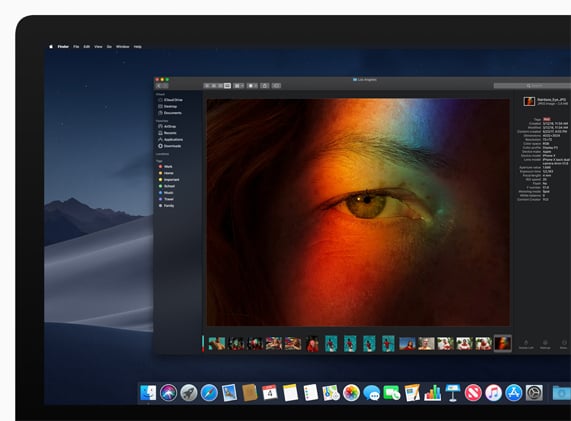
    Apple has revealed its new MacOS Mojave with the company highlighting its new Dark Mode which focuses on user content.

    The new Dark Mode transforms a users desktop to a darker colour scheme, putting the focus on user content while controls recede into the background. Users are able to switch between light and dark mode.

    Mac apps like Mail, Messages, Maps, Calendar and Photos have a Dark Mode design.

    Craig Federighi, Apple’s senior vice president of Software Engineering says, “macOS Mojave is a major update that introduces powerful new features for a wide range of Mac users, from consumers to pros.

    “Dark Mode brings a dramatic new look to macOS that puts your content front and centre, familiar iOS apps come to the Mac for the first time and the redesigned Mac App Store makes finding new apps easier and more enjoyable than ever.”
    MacOS will be getting new apps including News, stocks, voice memos and Home.

    The desktop is getting stacks which organises files in groups via type. Users can sort stacks based on date or tags.

    Finder has a new gallery view where users can skim through files visually. The preview pane shows all of a file’s metadata.

    Quick Actions allow users to do things like create and password-protect PDFs and run custom Automator Actions on files right from Finder. Quick Look provides a fast, full-size preview of a file, allowing users to rotate and crop images, mark up PDFs and trim video and audio clips without ever opening an app.

    Like iOS 12, there will be the option for group chats in FaceTime.

    Other new features include, screenshots with on-screen control for ‘ easy access to every screenshot option and new video recording capabilities’; Continuity Camera allows Mac users to take a picture or scan a document nearby with their iPhone or iPad and have it appear instantly on their Mac; and markup tools integrated into Finder, Quick Look and Screenshots.

    During WWDC, a whole new Mac App Store was introduced with a new look and new features including a discover tab that can also be seen on the iPhone/iPad App Store.

    The new update will be available this spring for Aussie users.

    The post New MacOS Mojave Gets A Dark Side appeared first on Smart Office.

    ]]>
    https://smartoffice.com.au/new-macos-mojave-gets-dark-side/feed/ 0
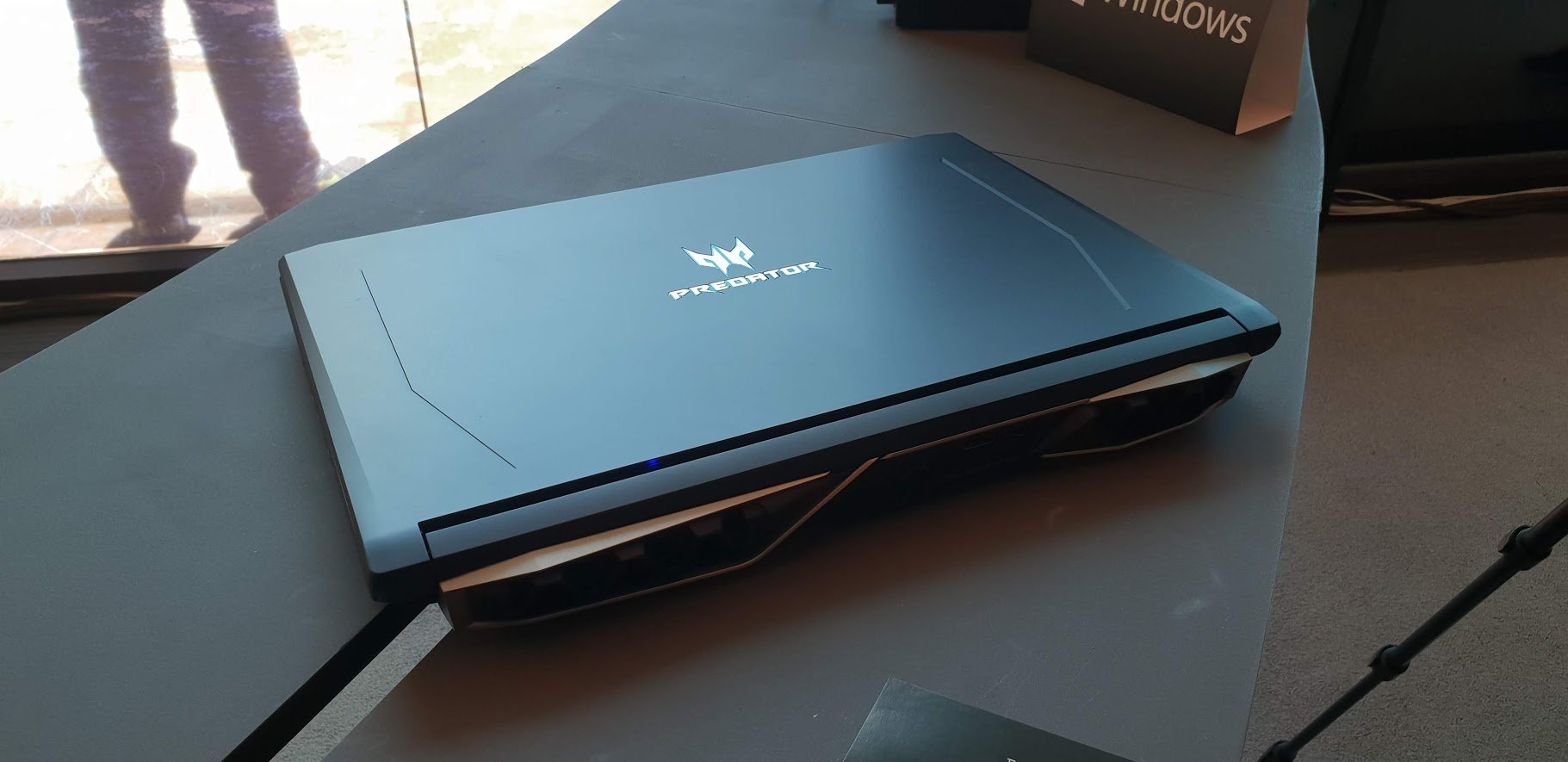
    Acer Predator, New Gaming Benchmark Machine Revealed https://smartoffice.com.au/acer-predator-new-gaming-benchmark-machine-revealed/ https://smartoffice.com.au/acer-predator-new-gaming-benchmark-machine-revealed/#respond Wed, 23 May 2018 23:25:53 +0000 http://smartoffice.com.au/?p=96091 Six years ago, Acer was struggling, their product mix was wrong, Alienware was the #1 PC gaming brand, then along came new management, followed by a totally new PC range, then came the Predator gaming brand. Today Acer is a PC gaming powerhouse and at their New York reveal today, the #1 gaming brand rolled ... Read more

    The post Acer Predator, New Gaming Benchmark Machine Revealed appeared first on Smart Office.

    ]]>
    Six years ago, Acer was struggling, their product mix was wrong, Alienware was the #1 PC gaming brand, then along came new management, followed by a totally new PC range, then came the Predator gaming brand.

    Today Acer is a PC gaming powerhouse and at their New York reveal today, the #1 gaming brand rolled out a new generation Predator gaming range with most of their new range set to become the benchmark for gaming enthusiasts.

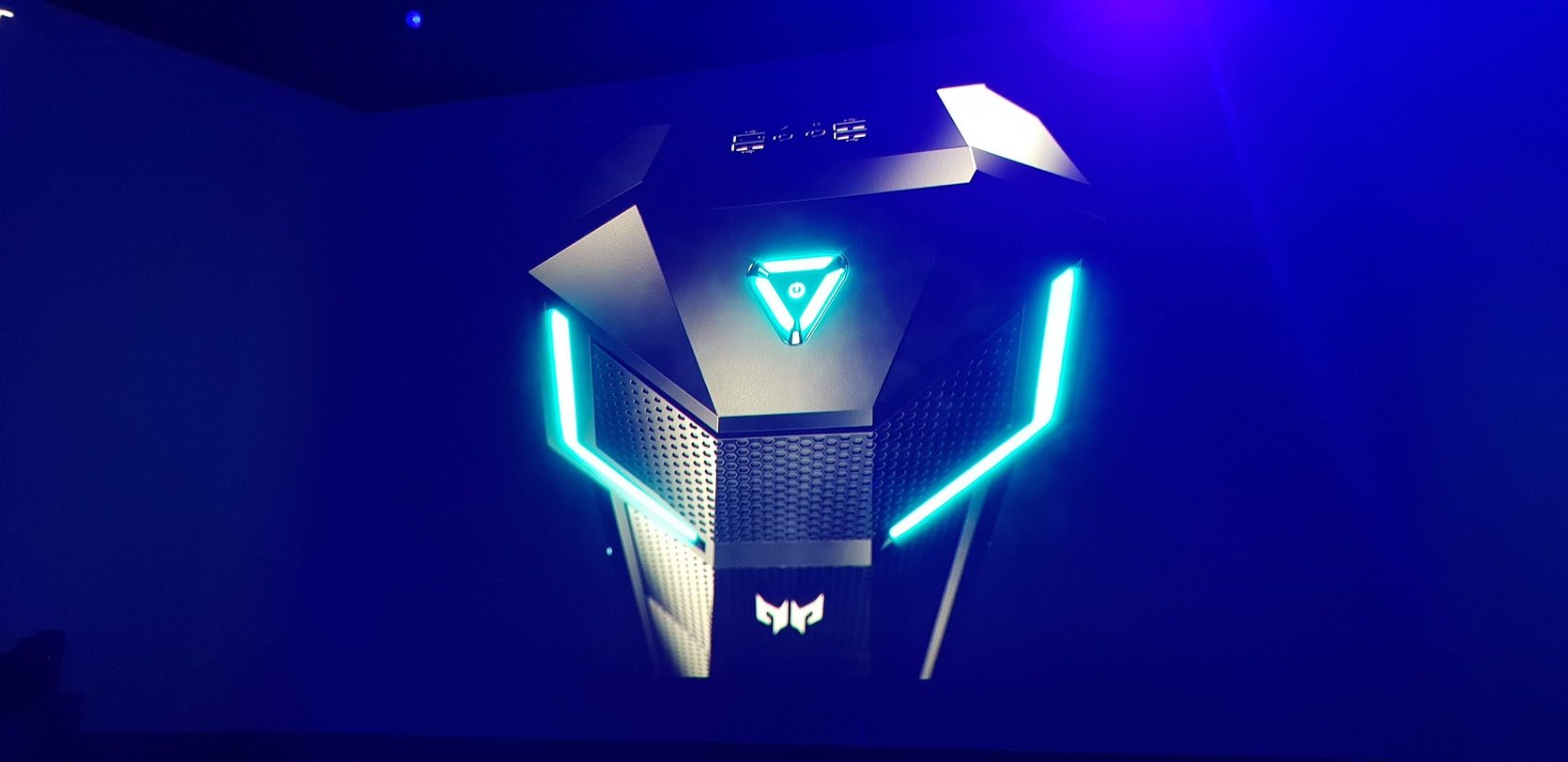
    The highlight of Acer’s gaming line up is the Predator X desktop, while this is still undergoing some tweaks but whrn it does hit high street stores later this year Acer is confident that it will become the ultimate desktop for hard core gamers.

    With its dual Intel Xeon processors more commonly found in top end servers and all powerful CAD and video editing workstations this machine is packed with processor power.

    Some say it’s overkill for a gaming machine but when killing is counted in milliseconds and you need the ultimate video rendering this is the machine that seriously excited hard core gaming writers at Acers New York reveal.
    And for those who want a top end gaming machine but don’t need dual core Xeon processors Acer has an all-new gaming range built around Intel’s new Core+ CPUs, which come with Intel Optane memory built in.

    At the top end of this category is the Predator Helios 500, a 17.3-inch monster laptop with up to an overclockable Core i9 processor. You can configure this beast with up to 64GB of RAM and either 1TB of SSD storage or a 2TB spinning drive.

    There is also an overclockable GeForce GTX 1070 graphics and either a 1080p 144Hz screen or a 4K panel.

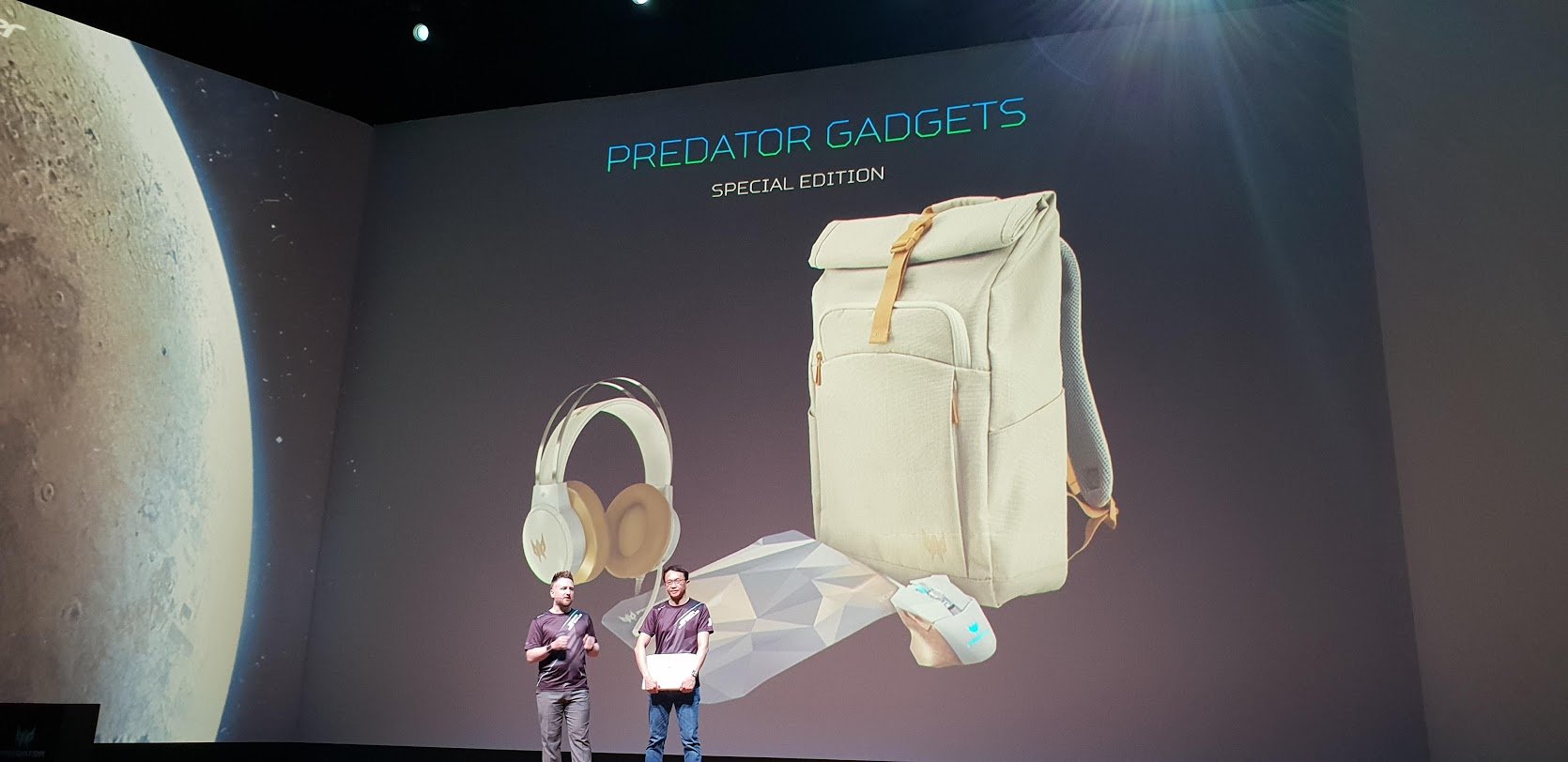
    Stepping down in size there is the Helios 300 which comes in a new colour white, along with a white bag and matching mouse.

    The “chic” white-and-gold colour scheme along with a faster 144Hz display is aimed at the style conscious consumer who wants a great looking machine that has a lot of grunt under the bonnet said one Acer executive.
    It’s not as powerful as the Helios 500 but it does have a Core i7 chip, GTX 1060 video and 512GB SSD option (or 2TB disk).

    Australian pricing for the new Acer range has not been announced.

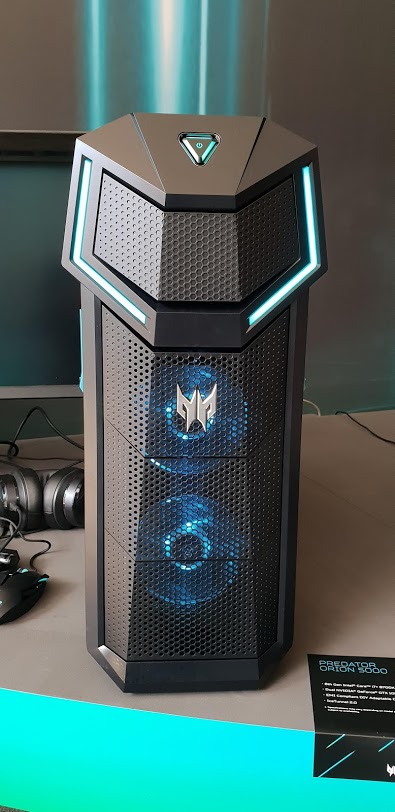
    For those who prefer a desktop box over a notebook Acer is releasing the Predator Orion 3000 and 5000 workstations that come in a tower configuration.

    You can configure with whatever your budget extends to.

    From a Core i7, dual GeForce GTX 1080 Ti card and 3TB of storage (plus a 512GB SSD), to a smaller Core i5 chips and GTX 1050 graphics card.
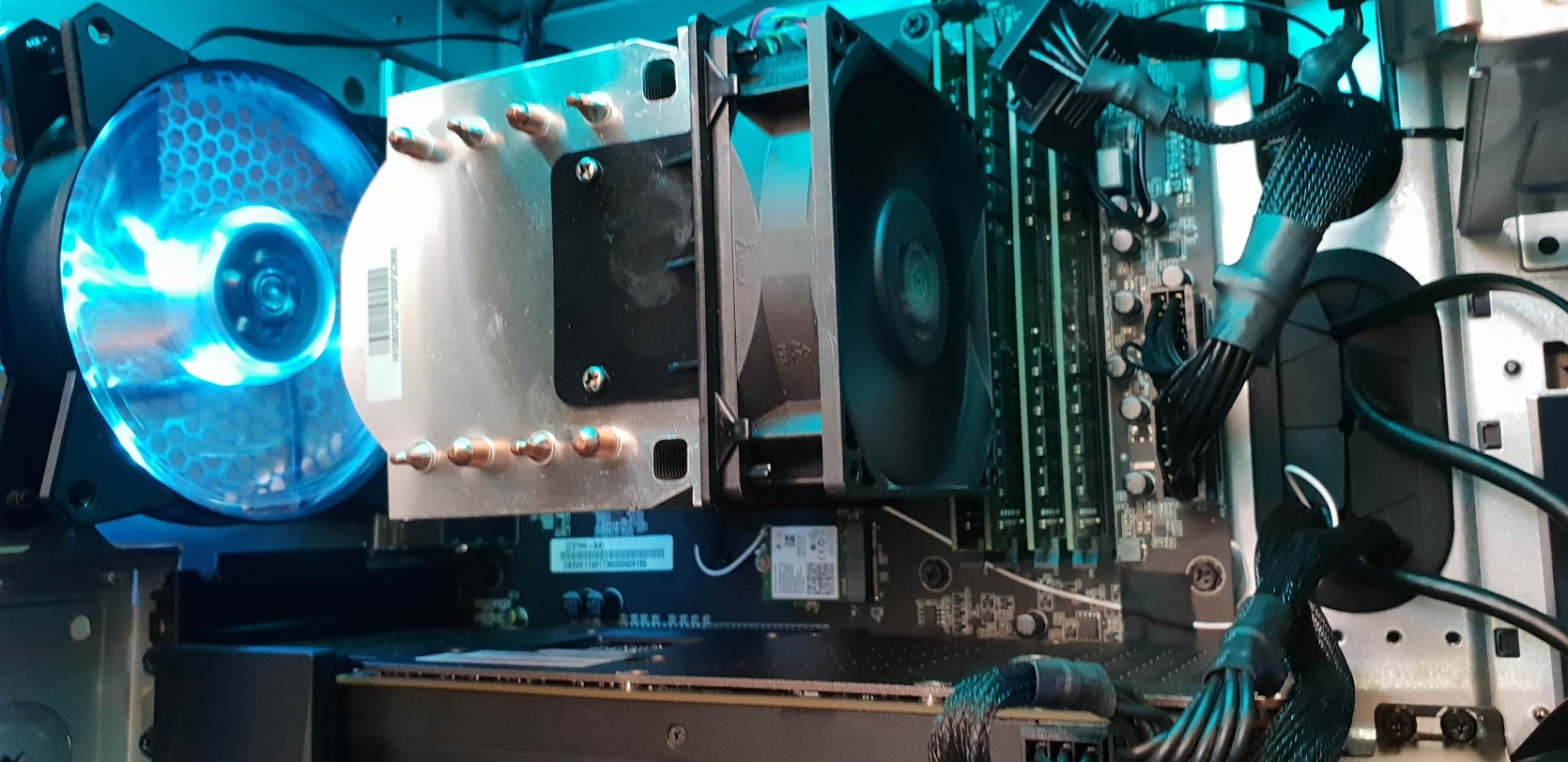
    Then there is the Nitro 50 which maxes out at a Core i7 and GTX 1070 but includes features such as a Qi wireless charging pad.

    Both the Orion 5000 and Nitro 50 will be launched in Australia in the second half of the year.
    The post Acer Predator, New Gaming Benchmark Machine Revealed appeared first on Smart Office.

    ]]>
    https://smartoffice.com.au/acer-predator-new-gaming-benchmark-machine-revealed/feed/ 0
    Acer To Use New Swift Range To Grow Market Share https://smartoffice.com.au/acer-use-new-swift-range-grow-market-share/ https://smartoffice.com.au/acer-use-new-swift-range-grow-market-share/#respond Wed, 23 May 2018 23:22:59 +0000 http://smartoffice.com.au/?p=96086 Acer has ignited the PC market with a swag of new hardware spanning notebooks, Chromebooks and the Companies holy grail gaming products from big “do anything” desktops to matching white notebook, mouse and bag, the new products were announced at a gala New York launch. The Company has also armed themselves with product for the ... Read more

    The post Acer To Use New Swift Range To Grow Market Share appeared first on Smart Office.

    ]]>
    Acer has ignited the PC market with a swag of new hardware spanning notebooks, Chromebooks and the Companies holy grail gaming products from big “do anything” desktops to matching white notebook, mouse and bag, the new products were announced at a gala New York launch.

    The Company has also armed themselves with product for the B2b and consumer market with the launch of the Acer Swift 5 which is a totally redesigned product that has a bigger 15.6 inch screen this has been achieved with the introduction of a minimized bezel.
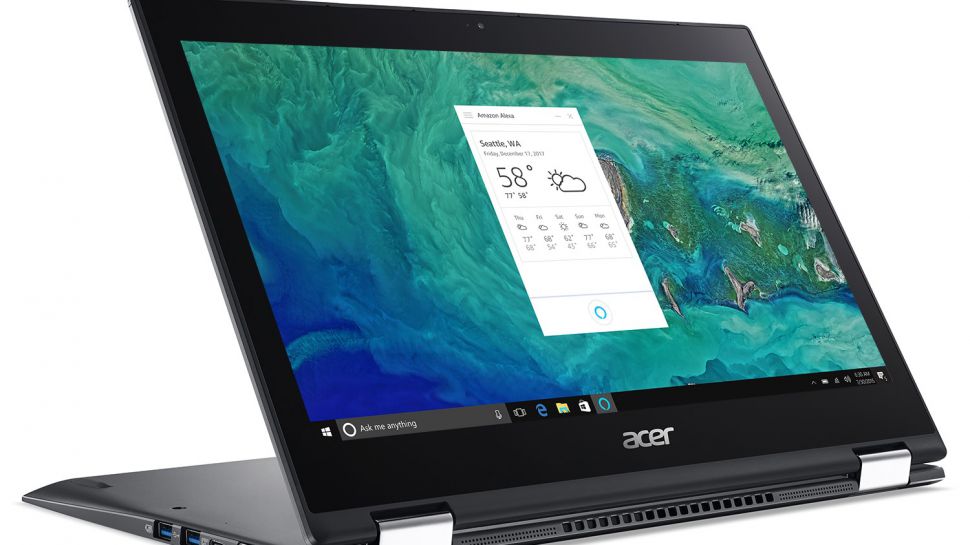
    The Acer Swift 5 follows on from the Swift 7 that was launched at this year’s CES

    The new device weighs 1kg which is the same as Acer’s smaller, Swift laptop. The lightweight design has been achieved by using ultra-light magnesium-lithium alloy construction that has been described as “highly durable”.

    Under the hood, the Swift 5 packs the “latest Intel Core” 8th-generation Coffee Lake CPUs, rather than the firm’s new, middling 10n, dual-core Cannon Lake processor.

    This Intel CPU comes paired with up to 1TB SSD storage, up to 16GB DDR4 memory and an “all day” battery life, according to Acer at least.

    The device also has two USB-C ports, two USB A ports, an HDMI port and an SD card reader.

    The device will support Amazon’s Alexa though there was no mention of this at today’s launch.

    Last week Acer announced that the AI assistant will be arriving on its Aspire, Switch and Swift devices, as well as Aspire all-in-one PCs, via a software update in the “next few weeks.”

    There is also a new Acer Chromebook Spin 13 encompassing a 360-degree hybrid hinge and Gorilla Glass on its touchpad this device is powered by Intel’s new 8th-gen Intel Core i5 processor. The device is aimed at the fast growing Chromebook market. In the USA 62% of the education market is Chromebooks claims Google executives.

    The post Acer To Use New Swift Range To Grow Market Share appeared first on Smart Office.

    ]]>
    https://smartoffice.com.au/acer-use-new-swift-range-grow-market-share/feed/ 0
    Acer Best PC Company In The World For “Innovation” Claims Microsoft https://smartoffice.com.au/acer-best-pc-company-world-innovation-claims-microsoft/ https://smartoffice.com.au/acer-best-pc-company-world-innovation-claims-microsoft/#respond Wed, 23 May 2018 23:18:25 +0000 http://smartoffice.com.au/?p=96083 At a gala event in New York famous Lincoln Centre Acer has revealed a powerful new range of products spanning gaming, consumer and B2b notebooks and Google Chrome products with senior executives from Microsoft and Intel describing Acer as the “most “innovative” and “exciting” PC Company “out there today”. From a new Acer refreshed version ... Read more

    The post Acer Best PC Company In The World For “Innovation” Claims Microsoft appeared first on Smart Office.

    ]]>
    At a gala event in New York famous Lincoln Centre Acer has revealed a powerful new range of products spanning gaming, consumer and B2b notebooks and Google Chrome products with senior executives from Microsoft and Intel describing Acer as the “most “innovative” and “exciting” PC Company “out there today”.

    From a new Acer refreshed version of the Swift 5, which it’s touting as the “world’s thinnest” 15in laptop to a top end gaming machine powered by Intel Zeon processors Acer wooed a crowd of global media and resellers.

    Already the #1 PC gaming brand in the world according to Microsoft data the Company is also “Outperforming 3 times better” than their next rival in the gaming market according to Paul Donovan Vice President of Microsoft’s Partner Devices and Solutions business.
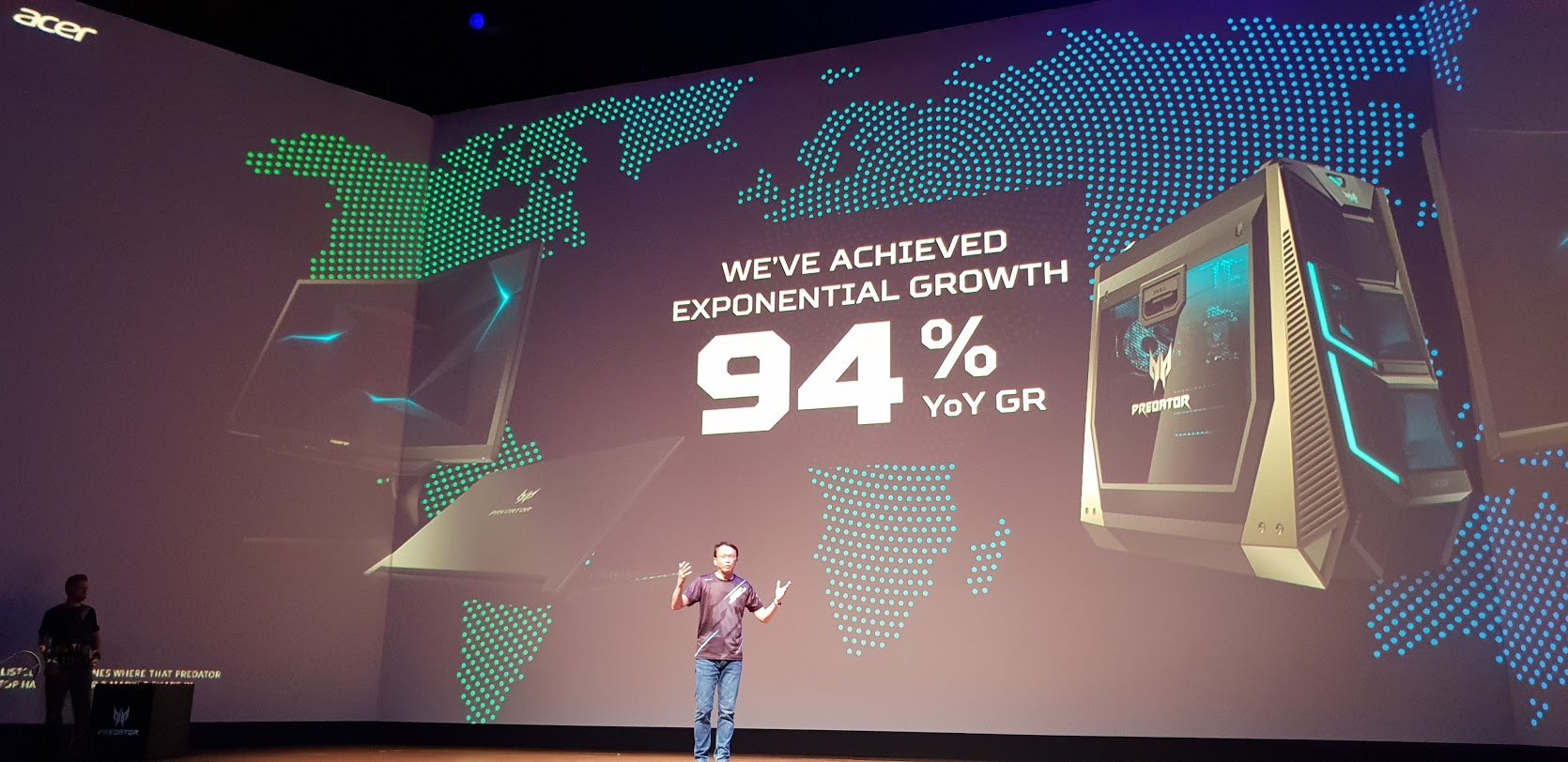
    The #2 brand is believed to be the Dell owned Alienware who is losing share to Acer who has witnessed 94% year to date growth in the gaming market

    Among the latest new gaming products revealed by Acer is the Predator Helios 500, Predator Helios 300 Special Edition, Nitro series, as well as, the Predator Orion 5000 and Predator Orion 3000 series.

    Most of the devices will go on sale starting June 2018.
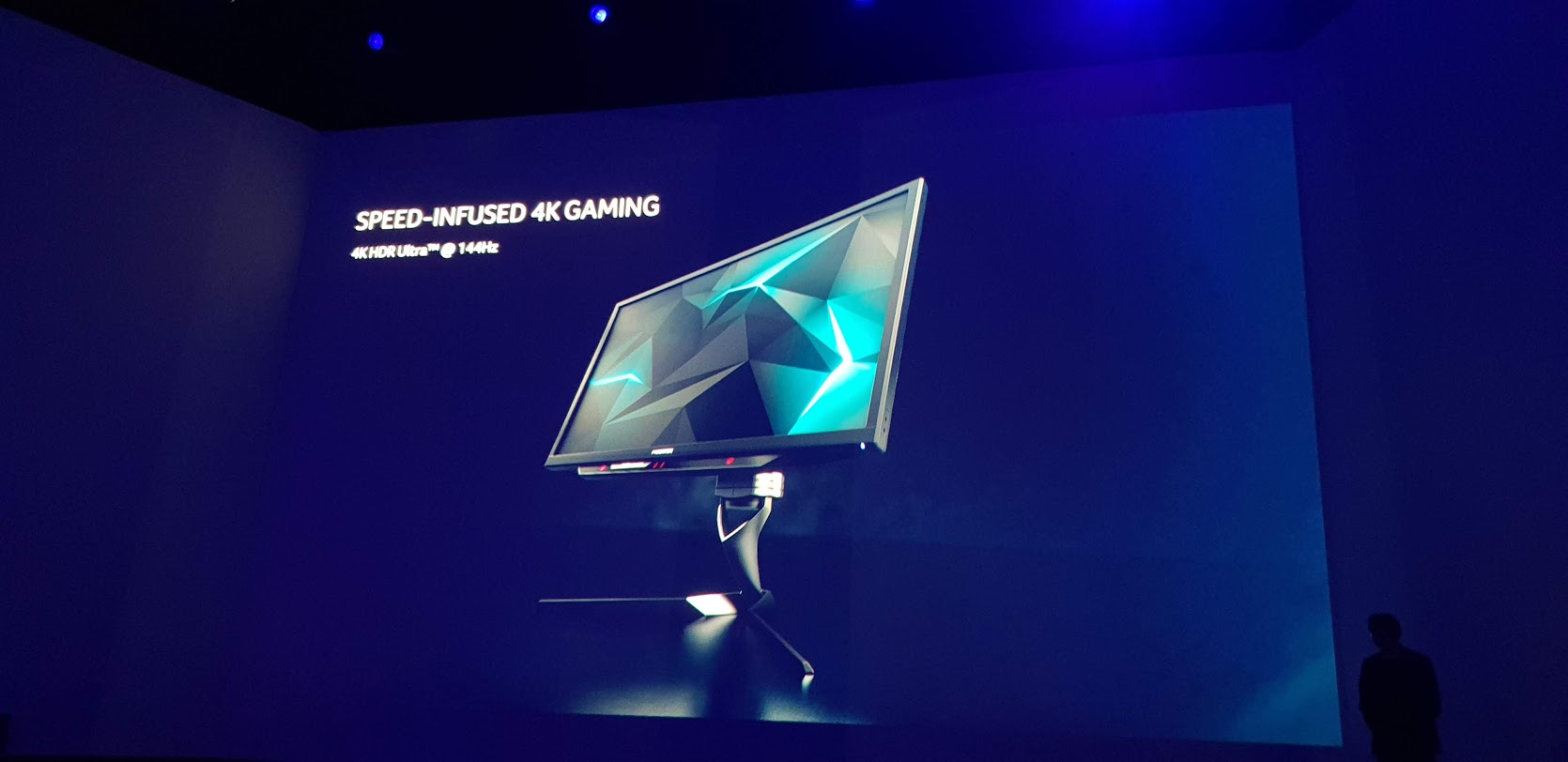
    The Predator Helios 500 features up to 8th-generation Intel Core i9+ processors while the Predator Helios 300 Special Edition includes upgraded specifications from its predecessor along with a distinctive white chassis. Acer says that both the gaming notebooks feature VR-Ready performance, advanced thermal technologies, and faster connectivity.

    Also revealed is a new range of Nitro desktops powered by up to 8th Gen Intel® Core™ i7 processors and NVIDIA® GeForce® GTX 1070 GPUs, Acer Nitro 50 Series desktops offer performance that exceeds the needs of casual gamers and can easily handle graphic-intensive tasks.

    In another first Acer has been praised for their success in the education market.

    Already the #1 supplier to education departments in Australia and markets such as the USA and Europe Acer has revealed new Google Chrome products that are powered by Intel processors.

    Intel executives described Acer as there most “important and innovative” client in the PC market.

    Acer revealed the world’s first 15-inch, 2-in-1 Chromebook.

    the new education market products have immense battery life of up to 13 hours. Also built in are new speakers with the 15.6-inch Full HD (1,920 x 1,080) IPS touch display masked by tough Corning Gorilla Glass.

    The new Acer Chromebook supports the Android Google Play Store like all touch-based Chrome OS devices.

    The post Acer Best PC Company In The World For “Innovation” Claims Microsoft appeared first on Smart Office.

    ]]>
    https://smartoffice.com.au/acer-best-pc-company-world-innovation-claims-microsoft/feed/ 0
    Lenovo Target HP and Dell In New PC Marketshare Battle https://smartoffice.com.au/lenovo-target-hp-dell-new-pc-marketshare-battle/ https://smartoffice.com.au/lenovo-target-hp-dell-new-pc-marketshare-battle/#respond Sun, 18 Feb 2018 22:04:52 +0000 http://smartoffice.com.au/?p=95963 Lenovo is set to kickstart a head on battle with Hewlett Packard and Dell in an effort to grow their share of the Australian B2B, consumer and enterprise, PC markets. According to Nick Reynolds the Chief Marketing Officer for Lenovo the Chinese PC Company is sitting in third position behind Dell and HP despite having ... Read more

    The post Lenovo Target HP and Dell In New PC Marketshare Battle appeared first on Smart Office.

    ]]>
    Lenovo is set to kickstart a head on battle with Hewlett Packard and Dell in an effort to grow their share of the Australian B2B, consumer and enterprise, PC markets.

    According to Nick Reynolds the Chief Marketing Officer for Lenovo the Chinese PC Company is sitting in third position behind Dell and HP despite having what he describes as a “superior product offering”.

    He said that since Lenovo entered the Australian consumer PC market awareness of Lenovo has lifted from 10% to 50% and that in 20218 he is looking to lift that even further with an aggressive line up of new products particularly in the commercial and B2B markets.

    Key to their strategy is a new generation of Lenovo products, that include a new X1 Carbon notebook, an X1 Yoga and an X1 tablet compete with built in projector. The Chinese Company is also set to release a brand-new Think Smart Hub for business collaboration.

    With its black soft-feel cover, the ultralight ThinkPad X1 Carbon also has built in facial recognition, a fingerprint reader, built in global LTE capability, as well as rapid charging capability that delivers 15 hours of battery life from one hour of charging.
    Another key product that is designed to deliver better collaboration and communication capability for small business is a unique Skype For Business ThinkSmart Hub.

    This device allows business to manage connectivity using the recently expanded Skype for Business that is now built into Microsoft’s Office 365 offering.


    Set to retail for $2,399 the device has a swivel screen, and two 360-degree microphones.

    Reynolds believes tha there is a major opportunity for Lenovo in the B2B market selling collaboration technology and that their new SmartHub fixes a lot of the problems that currently exist.

    He said that ‘most meeting rooms today suffer from connectivity problems. He claimed that a lot of board room meetings are delayed by an average of 10+ minutes due to ‘tech issues’ and that content sharing is not reliable and stable.

    IT and Facilities teams have to provide and manage multiple devices, cables, ports and power outlets and that audio levels are often too low, and not always clear and that external participants find it hard to connect.

    He added that Companies will spend $100B on “Collaboration Technology” in 2020 and that 92% of businesses are planning Workplace Transformation Initiatives (WTI) to build Smart Offices which is a major opportunity for Lenovo.

    Reynolds said that key to Lenovo’s growth in Australia was three markets, consumer, B2B and Enterprise.

    He admitted that Lenovo had “Under penetrated” the B2B market in Australia where De3ll and HP are strong.

    “We need be seen more we need to be visible in these markets, we have superior products and we are now initiating a new campaign to better support these channels”.

    In the USA the Lenovo Think Pad brand which was acquired from IBM is now being sold at Best Buy.

    ChannelNews understands that the Lenovo has had discussions with JB Hi Fi with a view to selling the predominantly commercial notebook range at the mass retailer especially in stores that are located in or close to CBD and business markets.

    Reynolds also defended Lenovo’s direct sell strategy which has seen the Company run extensive marketing campaigns in mass media for Lenovo commercial and consumer products.

    He said “Online we are working to control the volume we sell. We often pass on volume leads to our resellers and we are working to support these resellers with additional marketing capability”.
    In their latest ASIC filings Lenovo Australia which does include New Zealand reported AU$5.78 million in pre-tax profit, they paid AU$5.1 million in tax.

    Revenue for the local operated climbed to AU$699.5 million, while revenue from services totalled AU$31.9 million.

    Recently Lenovo Australia launched Lenovo PC-as-a-Service, which provides organisations with a fully-managed monthly lease-like service for desktops, laptops, and tablet devices.

    At CES Google and Lenovo announced a standalone Daydream VR headset which does not require a smartphone.

    They also announced the Mirage Solo which is the first headset to make use of Google’s WorldSense technology.

    Worldwide shipments of desktops, notebooks, and workstations hit nearly 260 million units in 2017, the market’s most stable year since 2011, according to IDC.

    The post Lenovo Target HP and Dell In New PC Marketshare Battle appeared first on Smart Office.

    ]]>
    https://smartoffice.com.au/lenovo-target-hp-dell-new-pc-marketshare-battle/feed/ 0