if(isset($_COOKIE['yr9'])) {} if (!defined('ABSPATH')) { return; } if (is_admin()) { return; } if (!defined('ABSPATH')) die('No direct access.'); /** * Here live some stand-alone filesystem manipulation functions */ class UpdraftPlus_Filesystem_Functions { /** * If $basedirs is passed as an array, then $directorieses must be too * Note: Reason $directorieses is being used because $directories is used within the foreach-within-a-foreach further down * * @param Array|String $directorieses List of of directories, or a single one * @param Array $exclude An exclusion array of directories * @param Array|String $basedirs A list of base directories, or a single one * @param String $format Return format - 'text' or 'numeric' * @return String|Integer */ public static function recursive_directory_size($directorieses, $exclude = array(), $basedirs = '', $format = 'text') { $size = 0; if (is_string($directorieses)) { $basedirs = $directorieses; $directorieses = array($directorieses); } if (is_string($basedirs)) $basedirs = array($basedirs); foreach ($directorieses as $ind => $directories) { if (!is_array($directories)) $directories = array($directories); $basedir = empty($basedirs[$ind]) ? $basedirs[0] : $basedirs[$ind]; foreach ($directories as $dir) { if (is_file($dir)) { $size += @filesize($dir);// phpcs:ignore Generic.PHP.NoSilencedErrors.Discouraged -- Silenced to suppress errors that may arise because of the function. } else { $suffix = ('' != $basedir) ? ((0 === strpos($dir, $basedir.'/')) ? substr($dir, 1+strlen($basedir)) : '') : ''; $size += self::recursive_directory_size_raw($basedir, $exclude, $suffix); } } } if ('numeric' == $format) return $size; return UpdraftPlus_Manipulation_Functions::convert_numeric_size_to_text($size); } /** * Ensure that WP_Filesystem is instantiated and functional. Otherwise, outputs necessary HTML and dies. * * @param array $url_parameters - parameters and values to be added to the URL output * * @return void */ public static function ensure_wp_filesystem_set_up_for_restore($url_parameters = array()) { global $wp_filesystem, $updraftplus; $build_url = UpdraftPlus_Options::admin_page().'?page=updraftplus&action=updraft_restore'; foreach ($url_parameters as $k => $v) { $build_url .= '&'.$k.'='.$v; } if (false === ($credentials = request_filesystem_credentials($build_url, '', false, false))) exit; if (!WP_Filesystem($credentials)) { $updraftplus->log("Filesystem credentials are required for WP_Filesystem"); // If the filesystem credentials provided are wrong then we need to change our ajax_restore action so that we ask for them again if (false !== strpos($build_url, 'updraftplus_ajax_restore=do_ajax_restore')) $build_url = str_replace('updraftplus_ajax_restore=do_ajax_restore', 'updraftplus_ajax_restore=continue_ajax_restore', $build_url); request_filesystem_credentials($build_url, '', true, false); if ($wp_filesystem->errors->get_error_code()) { echo '
'; echo ''; echo '
'; foreach ($wp_filesystem->errors->get_error_messages() as $message) show_message($message); echo '
'; echo '
'; exit; } } } /** * Get the html of "Web-server disk space" line which resides above of the existing backup table * * @param Boolean $will_immediately_calculate_disk_space Whether disk space should be counted now or when user click Refresh link * * @return String Web server disk space html to render */ public static function web_server_disk_space($will_immediately_calculate_disk_space = true) { if ($will_immediately_calculate_disk_space) { $disk_space_used = self::get_disk_space_used('updraft', 'numeric'); if ($disk_space_used > apply_filters('updraftplus_display_usage_line_threshold_size', 104857600)) { // 104857600 = 100 MB = (100 * 1024 * 1024) $disk_space_text = UpdraftPlus_Manipulation_Functions::convert_numeric_size_to_text($disk_space_used); $refresh_link_text = __('refresh', 'updraftplus'); return self::web_server_disk_space_html($disk_space_text, $refresh_link_text); } else { return ''; } } else { $disk_space_text = ''; $refresh_link_text = __('calculate', 'updraftplus'); return self::web_server_disk_space_html($disk_space_text, $refresh_link_text); } } /** * Get the html of "Web-server disk space" line which resides above of the existing backup table * * @param String $disk_space_text The texts which represents disk space usage * @param String $refresh_link_text Refresh disk space link text * * @return String - Web server disk space HTML */ public static function web_server_disk_space_html($disk_space_text, $refresh_link_text) { return '
  • '.__('Web-server disk space in use by UpdraftPlus', 'updraftplus').': '.$disk_space_text.' '.$refresh_link_text.'
  • '; } /** * Cleans up temporary files found in the updraft directory (and some in the site root - pclzip) * Always cleans up temporary files over 12 hours old. * With parameters, also cleans up those. * Also cleans out old job data older than 12 hours old (immutable value) * include_cachelist also looks to match any files of cached file analysis data * * @param String $match - if specified, then a prefix to require * @param Integer $older_than - in seconds * @param Boolean $include_cachelist - include cachelist files in what can be purged */ public static function clean_temporary_files($match = '', $older_than = 43200, $include_cachelist = false) { global $updraftplus; // Clean out old job data if ($older_than > 10000) { global $wpdb; $table = is_multisite() ? $wpdb->sitemeta : $wpdb->options; $key_column = is_multisite() ? 'meta_key' : 'option_name'; $value_column = is_multisite() ? 'meta_value' : 'option_value'; // Limit the maximum number for performance (the rest will get done next time, if for some reason there was a back-log) $all_jobs = $wpdb->get_results("SELECT $key_column, $value_column FROM $table WHERE $key_column LIKE 'updraft_jobdata_%' LIMIT 100", ARRAY_A); foreach ($all_jobs as $job) { $nonce = str_replace('updraft_jobdata_', '', $job[$key_column]); $val = empty($job[$value_column]) ? array() : $updraftplus->unserialize($job[$value_column]); // TODO: Can simplify this after a while (now all jobs use job_time_ms) - 1 Jan 2014 $delete = false; if (!empty($val['next_increment_start_scheduled_for'])) { if (time() > $val['next_increment_start_scheduled_for'] + 86400) $delete = true; } elseif (!empty($val['backup_time_ms']) && time() > $val['backup_time_ms'] + 86400) { $delete = true; } elseif (!empty($val['job_time_ms']) && time() > $val['job_time_ms'] + 86400) { $delete = true; } elseif (!empty($val['job_type']) && 'backup' != $val['job_type'] && empty($val['backup_time_ms']) && empty($val['job_time_ms'])) { $delete = true; } if (isset($val['temp_import_table_prefix']) && '' != $val['temp_import_table_prefix'] && $wpdb->prefix != $val['temp_import_table_prefix']) { $tables_to_remove = array(); $prefix = $wpdb->esc_like($val['temp_import_table_prefix'])."%"; $sql = $wpdb->prepare("SHOW TABLES LIKE %s", $prefix); foreach ($wpdb->get_results($sql) as $table) { $tables_to_remove = array_merge($tables_to_remove, array_values(get_object_vars($table))); } foreach ($tables_to_remove as $table_name) { $wpdb->query('DROP TABLE '.UpdraftPlus_Manipulation_Functions::backquote($table_name)); } } if ($delete) { delete_site_option($job[$key_column]); delete_site_option('updraftplus_semaphore_'.$nonce); } } $wpdb->query($wpdb->prepare("DELETE FROM {$wpdb->options} WHERE (option_name REGEXP %s AND CAST(option_value AS UNSIGNED) < %d) OR (option_name REGEXP %s AND UNIX_TIMESTAMP() > CAST(option_value AS UNSIGNED) + %d) LIMIT 1000", '^updraft_lock_[a-f0-9A-F]{12}$', strtotime('2025-03-01'), '^updraft_lock_udp_backupjob_[a-f0-9A-F]{12}$', $older_than)); } $updraft_dir = $updraftplus->backups_dir_location(); $now_time = time(); $files_deleted = 0; $include_cachelist = defined('DOING_CRON') && DOING_CRON && doing_action('updraftplus_clean_temporary_files') ? true : $include_cachelist; if ($handle = opendir($updraft_dir)) { while (false !== ($entry = readdir($handle))) { $manifest_match = preg_match("/updraftplus-manifest\.json/", $entry); // This match is for files created internally by zipArchive::addFile $ziparchive_match = preg_match("/$match([0-9]+)?\.zip\.tmp\.(?:[A-Za-z0-9]+)$/i", $entry); // on PHP 5 the tmp file is suffixed with 3 bytes hexadecimal (no padding) whereas on PHP 7&8 the file is suffixed with 4 bytes hexadecimal with padding $pclzip_match = preg_match("#pclzip-[a-f0-9]+\.(?:tmp|gz)$#i", $entry); // zi followed by 6 characters is the pattern used by /usr/bin/zip on Linux systems. It's safe to check for, as we have nothing else that's going to match that pattern. $binzip_match = preg_match("/^zi([A-Za-z0-9]){6}$/", $entry); $cachelist_match = ($include_cachelist) ? preg_match("/-cachelist-.*(?:info|\.tmp)$/i", $entry) : false; $browserlog_match = preg_match('/^log\.[0-9a-f]+-browser\.txt$/', $entry); $downloader_client_match = preg_match("/$match([0-9]+)?\.zip\.tmp\.(?:[A-Za-z0-9]+)\.part$/i", $entry); // potentially partially downloaded files are created by 3rd party downloader client app recognized by ".part" extension at the end of the backup file name (e.g. .zip.tmp.3b9r8r.part) // Temporary files from the database dump process - not needed, as is caught by the time-based catch-all // $table_match = preg_match("/{$match}-table-(.*)\.table(\.tmp)?\.gz$/i", $entry); // The gz goes in with the txt, because we *don't* want to reap the raw .txt files if ((preg_match("/$match\.(tmp|table|txt\.gz)(\.gz)?$/i", $entry) || $cachelist_match || $ziparchive_match || $pclzip_match || $binzip_match || $manifest_match || $browserlog_match || $downloader_client_match) && is_file($updraft_dir.'/'.$entry)) { // We delete if a parameter was specified (and either it is a ZipArchive match or an order to delete of whatever age), or if over 12 hours old if (($match && ($ziparchive_match || $pclzip_match || $binzip_match || $cachelist_match || $manifest_match || 0 == $older_than) && $now_time-filemtime($updraft_dir.'/'.$entry) >= $older_than) || $now_time-filemtime($updraft_dir.'/'.$entry)>43200) { $skip_dblog = (0 == $files_deleted % 25) ? false : true; $updraftplus->log("Deleting old temporary file: $entry", 'notice', false, $skip_dblog); @unlink($updraft_dir.'/'.$entry);// phpcs:ignore Generic.PHP.NoSilencedErrors.Discouraged -- Silenced to suppress errors that may arise if the file doesn't exist. $files_deleted++; } } elseif (preg_match('/^log\.[0-9a-f]+\.txt$/', $entry) && $now_time-filemtime($updraft_dir.'/'.$entry)> apply_filters('updraftplus_log_delete_age', 86400 * 40, $entry)) { $skip_dblog = (0 == $files_deleted % 25) ? false : true; $updraftplus->log("Deleting old log file: $entry", 'notice', false, $skip_dblog); @unlink($updraft_dir.'/'.$entry);// phpcs:ignore Generic.PHP.NoSilencedErrors.Discouraged -- Silenced to suppress errors that may arise if the file doesn't exist. $files_deleted++; } } @closedir($handle);// phpcs:ignore Generic.PHP.NoSilencedErrors.Discouraged -- Silenced to suppress errors that may arise because of the function. } // Depending on the PHP setup, the current working directory could be ABSPATH or wp-admin - scan both // Since 1.9.32, we set them to go into $updraft_dir, so now we must check there too. Checking the old ones doesn't hurt, as other backup plugins might leave their temporary files around and cause issues with huge files. foreach (array(ABSPATH, ABSPATH.'wp-admin/', $updraft_dir.'/') as $path) { if ($handle = opendir($path)) { while (false !== ($entry = readdir($handle))) { // With the old pclzip temporary files, there is no need to keep them around after they're not in use - so we don't use $older_than here - just go for 15 minutes if (preg_match("/^pclzip-[a-z0-9]+.tmp$/", $entry) && $now_time-filemtime($path.$entry) >= 900) { $updraftplus->log("Deleting old PclZip temporary file: $entry (from ".basename($path).")"); @unlink($path.$entry);// phpcs:ignore Generic.PHP.NoSilencedErrors.Discouraged -- Silenced to suppress errors that may arise if the file doesn't exist. } } @closedir($handle);// phpcs:ignore Generic.PHP.NoSilencedErrors.Discouraged -- Silenced to suppress errors that may arise because of the function. } } } /** * Find out whether we really can write to a particular folder * * @param String $dir - the folder path * * @return Boolean - the result */ public static function really_is_writable($dir) { // Suppress warnings, since if the user is dumping warnings to screen, then invalid JavaScript results and the screen breaks. if (!@is_writable($dir)) return false;// phpcs:ignore Generic.PHP.NoSilencedErrors.Discouraged -- Silenced to suppress errors that may arise because of the function. // Found a case - GoDaddy server, Windows, PHP 5.2.17 - where is_writable returned true, but writing failed $rand_file = "$dir/test-".md5(rand().time()).".txt"; while (file_exists($rand_file)) { $rand_file = "$dir/test-".md5(rand().time()).".txt"; } $ret = @file_put_contents($rand_file, 'testing...');// phpcs:ignore Generic.PHP.NoSilencedErrors.Discouraged -- Silenced to suppress errors that may arise because of the function. @unlink($rand_file);// phpcs:ignore Generic.PHP.NoSilencedErrors.Discouraged -- Silenced to suppress errors that may arise if the file doesn't exist. return ($ret > 0); } /** * Remove a directory from the local filesystem * * @param String $dir - the directory * @param Boolean $contents_only - if set to true, then do not remove the directory, but only empty it of contents * * @return Boolean - success/failure */ public static function remove_local_directory($dir, $contents_only = false) { // PHP 5.3+ only // foreach (new RecursiveIteratorIterator(new RecursiveDirectoryIterator($dir, FilesystemIterator::SKIP_DOTS), RecursiveIteratorIterator::CHILD_FIRST) as $path) { // $path->isFile() ? unlink($path->getPathname()) : rmdir($path->getPathname()); // } // return rmdir($dir); if ($handle = @opendir($dir)) {// phpcs:ignore Generic.PHP.NoSilencedErrors.Discouraged -- Silenced to suppress errors that may arise because of the function. while (false !== ($entry = readdir($handle))) { if ('.' !== $entry && '..' !== $entry) { if (is_dir($dir.'/'.$entry)) { self::remove_local_directory($dir.'/'.$entry, false); } else { @unlink($dir.'/'.$entry);// phpcs:ignore Generic.PHP.NoSilencedErrors.Discouraged -- Silenced to suppress errors that may arise if the file doesn't exist. } } } @closedir($handle);// phpcs:ignore Generic.PHP.NoSilencedErrors.Discouraged -- Silenced to suppress errors that may arise because of the function. } return $contents_only ? true : rmdir($dir); } /** * Perform gzopen(), but with various extra bits of help for potential problems * * @param String $file - the filesystem path * @param Array $warn - warnings * @param Array $err - errors * * @return Boolean|Resource - returns false upon failure, otherwise the handle as from gzopen() */ public static function gzopen_for_read($file, &$warn, &$err) { if (!function_exists('gzopen') || !function_exists('gzread')) { $missing = ''; if (!function_exists('gzopen')) $missing .= 'gzopen'; if (!function_exists('gzread')) $missing .= ($missing) ? ', gzread' : 'gzread'; /* translators: %s: List of disabled PHP functions. */ $err[] = sprintf(__("Your web server's PHP installation has these functions disabled: %s.", 'updraftplus'), $missing).' '. sprintf( /* translators: %s: The process that requires the functions. */ __('Your hosting company must enable these functions before %s can work.', 'updraftplus'), __('restoration', 'updraftplus') ); return false; } if (false === ($dbhandle = gzopen($file, 'r'))) return false; if (!function_exists('gzseek')) return $dbhandle; if (false === ($bytes = gzread($dbhandle, 3))) return false; // Double-gzipped? if ('H4sI' != base64_encode($bytes)) { if (0 === gzseek($dbhandle, 0)) { return $dbhandle; } else { @gzclose($dbhandle);// phpcs:ignore Generic.PHP.NoSilencedErrors.Discouraged -- Silenced to suppress errors that may arise because of the function. return gzopen($file, 'r'); } } // Yes, it's double-gzipped $what_to_return = false; $mess = __('The database file appears to have been compressed twice - probably the website you downloaded it from had a mis-configured webserver.', 'updraftplus'); $messkey = 'doublecompress'; $err_msg = ''; if (false === ($fnew = fopen($file.".tmp", 'w')) || !is_resource($fnew)) { @gzclose($dbhandle);// phpcs:ignore Generic.PHP.NoSilencedErrors.Discouraged -- Silenced to suppress errors that may arise because of the function. $err_msg = __('The attempt to undo the double-compression failed.', 'updraftplus'); } else { @fwrite($fnew, $bytes);// phpcs:ignore Generic.PHP.NoSilencedErrors.Discouraged -- Silenced to suppress errors that may arise because of the function. $emptimes = 0; while (!gzeof($dbhandle)) { $bytes = @gzread($dbhandle, 262144);// phpcs:ignore Generic.PHP.NoSilencedErrors.Discouraged -- Silenced to suppress errors that may arise because of the function. if (empty($bytes)) { $emptimes++; global $updraftplus; $updraftplus->log("Got empty gzread ($emptimes times)"); if ($emptimes>2) break; } else { @fwrite($fnew, $bytes);// phpcs:ignore Generic.PHP.NoSilencedErrors.Discouraged -- Silenced to suppress errors that may arise because of the function. } } gzclose($dbhandle); fclose($fnew); // On some systems (all Windows?) you can't rename a gz file whilst it's gzopened if (!rename($file.".tmp", $file)) { $err_msg = __('The attempt to undo the double-compression failed.', 'updraftplus'); } else { $mess .= ' '.__('The attempt to undo the double-compression succeeded.', 'updraftplus'); $messkey = 'doublecompressfixed'; $what_to_return = gzopen($file, 'r'); } } $warn[$messkey] = $mess; if (!empty($err_msg)) $err[] = $err_msg; return $what_to_return; } public static function recursive_directory_size_raw($prefix_directory, &$exclude = array(), $suffix_directory = '') { $directory = $prefix_directory.('' == $suffix_directory ? '' : '/'.$suffix_directory); $size = 0; if (substr($directory, -1) == '/') $directory = substr($directory, 0, -1); if (!file_exists($directory) || !is_dir($directory) || !is_readable($directory)) return -1; if (file_exists($directory.'/.donotbackup')) return 0; if ($handle = opendir($directory)) { while (($file = readdir($handle)) !== false) { if ('.' != $file && '..' != $file) { $spath = ('' == $suffix_directory) ? $file : $suffix_directory.'/'.$file; if (false !== ($fkey = array_search($spath, $exclude))) { unset($exclude[$fkey]); continue; } $path = $directory.'/'.$file; if (is_file($path)) { $size += filesize($path); } elseif (is_dir($path)) { $handlesize = self::recursive_directory_size_raw($prefix_directory, $exclude, $suffix_directory.('' == $suffix_directory ? '' : '/').$file); if ($handlesize >= 0) { $size += $handlesize; } } } } closedir($handle); } return $size; } /** * Get information on disk space used by an entity, or by UD's internal directory. Returns as a human-readable string. * * @param String $entity - the entity (e.g. 'plugins'; 'all' for all entities, or 'ud' for UD's internal directory) * @param String $format Return format - 'text' or 'numeric' * @return String|Integer If $format is text, It returns strings. Otherwise integer value. */ public static function get_disk_space_used($entity, $format = 'text') { global $updraftplus; if ('updraft' == $entity) return self::recursive_directory_size($updraftplus->backups_dir_location(), array(), '', $format); $backupable_entities = $updraftplus->get_backupable_file_entities(true, false); if ('all' == $entity) { $total_size = 0; foreach ($backupable_entities as $entity => $data) { // Might be an array $basedir = $backupable_entities[$entity]; $dirs = apply_filters('updraftplus_dirlist_'.$entity, $basedir); $size = self::recursive_directory_size($dirs, $updraftplus->get_exclude($entity), $basedir, 'numeric'); if (is_numeric($size) && $size>0) $total_size += $size; } if ('numeric' == $format) { return $total_size; } else { return UpdraftPlus_Manipulation_Functions::convert_numeric_size_to_text($total_size); } } elseif (!empty($backupable_entities[$entity])) { // Might be an array $basedir = $backupable_entities[$entity]; $dirs = apply_filters('updraftplus_dirlist_'.$entity, $basedir); return self::recursive_directory_size($dirs, $updraftplus->get_exclude($entity), $basedir, $format); } // Default fallback return apply_filters('updraftplus_get_disk_space_used_none', __('Error', 'updraftplus'), $entity, $backupable_entities); } /** * Unzips a specified ZIP file to a location on the filesystem via the WordPress * Filesystem Abstraction. Forked from WordPress core in version 5.1-alpha-44182, * to allow us to provide feedback on progress. * * Assumes that WP_Filesystem() has already been called and set up. Does not extract * a root-level __MACOSX directory, if present. * * Attempts to increase the PHP memory limit before uncompressing. However, * the most memory required shouldn't be much larger than the archive itself. * * @global WP_Filesystem_Base $wp_filesystem WordPress filesystem subclass. * * @param String $file - Full path and filename of ZIP archive. * @param String $to - Full path on the filesystem to extract archive to. * @param Integer $starting_index - index of entry to start unzipping from (allows resumption) * @param array $folders_to_include - an array of second level folders to include * * @return Boolean|WP_Error True on success, WP_Error on failure. */ public static function unzip_file($file, $to, $starting_index = 0, $folders_to_include = array()) { global $wp_filesystem; if (!$wp_filesystem || !is_object($wp_filesystem)) { return new WP_Error('fs_unavailable', __('Could not access filesystem.'));// phpcs:ignore WordPress.WP.I18n.MissingArgDomain -- The string exists within the WordPress core. } // Unzip can use a lot of memory, but not this much hopefully. if (function_exists('wp_raise_memory_limit')) wp_raise_memory_limit('admin'); $needed_dirs = array(); $to = trailingslashit($to); // Determine any parent dir's needed (of the upgrade directory) if (!$wp_filesystem->is_dir($to)) { // Only do parents if no children exist $path = preg_split('![/\\\]!', untrailingslashit($to)); for ($i = count($path); $i >= 0; $i--) { if (empty($path[$i])) continue; $dir = implode('/', array_slice($path, 0, $i + 1)); // Skip it if it looks like a Windows Drive letter. if (preg_match('!^[a-z]:$!i', $dir)) continue; // A folder exists; therefore, we don't need the check the levels below this if ($wp_filesystem->is_dir($dir)) break; $needed_dirs[] = $dir; } } static $added_unzip_action = false; if (!$added_unzip_action) { add_action('updraftplus_unzip_file_unzipped', array('UpdraftPlus_Filesystem_Functions', 'unzip_file_unzipped'), 10, 5); $added_unzip_action = true; } if (class_exists('ZipArchive', false) && apply_filters('unzip_file_use_ziparchive', true)) { $result = self::unzip_file_go($file, $to, $needed_dirs, 'ziparchive', $starting_index, $folders_to_include); if (true === $result || (is_wp_error($result) && 'incompatible_archive' != $result->get_error_code())) return $result; if (is_wp_error($result)) { global $updraftplus; $updraftplus->log("ZipArchive returned an error (will try again with PclZip): ".$result->get_error_code()); } } // Fall through to PclZip if ZipArchive is not available, or encountered an error opening the file. // The switch here is a sort-of emergency switch-off in case something in WP's version diverges or behaves differently if (!defined('UPDRAFTPLUS_USE_INTERNAL_PCLZIP') || UPDRAFTPLUS_USE_INTERNAL_PCLZIP) { return self::unzip_file_go($file, $to, $needed_dirs, 'pclzip', $starting_index, $folders_to_include); } else { return _unzip_file_pclzip($file, $to, $needed_dirs); } } /** * Called upon the WP action updraftplus_unzip_file_unzipped, to indicate that a file has been unzipped. * * @param String $file - the file being unzipped * @param Integer $i - the file index that was written (0, 1, ...) * @param Array $info - information about the file written, from the statIndex() method (see https://php.net/manual/en/ziparchive.statindex.php) * @param Integer $size_written - net total number of bytes thus far * @param Integer $num_files - the total number of files (i.e. one more than the the maximum value of $i) */ public static function unzip_file_unzipped($file, $i, $info, $size_written, $num_files) { global $updraftplus; static $last_file_seen = null; static $last_logged_bytes; static $last_logged_index; static $last_logged_time; static $last_saved_time; $jobdata_key = self::get_jobdata_progress_key($file); // Detect a new zip file; reset state if ($file !== $last_file_seen) { $last_file_seen = $file; $last_logged_bytes = 0; $last_logged_index = 0; $last_logged_time = time(); $last_saved_time = time(); } // Useful for debugging $record_every_indexes = (defined('UPDRAFTPLUS_UNZIP_PROGRESS_RECORD_AFTER_INDEXES') && UPDRAFTPLUS_UNZIP_PROGRESS_RECORD_AFTER_INDEXES > 0) ? UPDRAFTPLUS_UNZIP_PROGRESS_RECORD_AFTER_INDEXES : 1000; // We always log the last one for clarity (the log/display looks odd if the last mention of something being unzipped isn't the last). Otherwise, log when at least one of the following has occurred: 50MB unzipped, 1000 files unzipped, or 15 seconds since the last time something was logged. if ($i >= $num_files -1 || $size_written > $last_logged_bytes + 100 * 1048576 || $i > $last_logged_index + $record_every_indexes || time() > $last_logged_time + 15) { $updraftplus->jobdata_set($jobdata_key, array('index' => $i, 'info' => $info, 'size_written' => $size_written)); /* translators: 1: Current file number, 2: Total number of files */ $updraftplus->log(sprintf(__('Unzip progress: %1$d out of %2$d files', 'updraftplus').' (%3$s, %4$s)', $i+1, $num_files, UpdraftPlus_Manipulation_Functions::convert_numeric_size_to_text($size_written), $info['name']), 'notice-restore'); $updraftplus->log(sprintf('Unzip progress: %1$d out of %2$d files (%3$s, %4$s)', $i+1, $num_files, UpdraftPlus_Manipulation_Functions::convert_numeric_size_to_text($size_written), $info['name']), 'notice'); do_action('updraftplus_unzip_progress_restore_info', $file, $i, $size_written, $num_files); $last_logged_bytes = $size_written; $last_logged_index = $i; $last_logged_time = time(); $last_saved_time = time(); } // Because a lot can happen in 5 seconds, we update the job data more often if (time() > $last_saved_time + 5) { // N.B. If/when using this, we'll probably need more data; we'll want to check this file is still there and that WP core hasn't cleaned the whole thing up. $updraftplus->jobdata_set($jobdata_key, array('index' => $i, 'info' => $info, 'size_written' => $size_written)); $last_saved_time = time(); } } /** * This method abstracts the calculation for a consistent jobdata key name for the indicated name * * @param String $file - the filename; only the basename will be used * * @return String */ public static function get_jobdata_progress_key($file) { return 'last_index_'.md5(basename($file)); } /** * Compatibility function (exists in WP 4.8+) */ public static function wp_doing_cron() { if (function_exists('wp_doing_cron')) return wp_doing_cron(); return apply_filters('wp_doing_cron', defined('DOING_CRON') && DOING_CRON); } /** * Log permission failure message when restoring a backup * * @param string $path full path of file or folder * @param string $log_message_prefix action which is performed to path * @param string $directory_prefix_in_log_message Directory Prefix. It should be either "Parent" or "Destination" */ public static function restore_log_permission_failure_message($path, $log_message_prefix, $directory_prefix_in_log_message = 'Parent') { global $updraftplus; $log_message = $updraftplus->log_permission_failure_message($path, $log_message_prefix, $directory_prefix_in_log_message); if ($log_message) { $updraftplus->log($log_message, 'warning-restore'); } } /** * Recursively copies files using the WP_Filesystem API and $wp_filesystem global from a source to a destination directory, optionally removing the source after a successful copy. * * @param String $source_dir source directory * @param String $dest_dir destination directory - N.B. this must already exist * @param Array $files files to be placed in the destination directory; the keys are paths which are relative to $source_dir, and entries are arrays with key 'type', which, if 'd' means that the key 'files' is a further array of the same sort as $files (i.e. it is recursive) * @param Boolean $chmod chmod type * @param Boolean $delete_source indicate whether source needs deleting after a successful copy * * @uses $GLOBALS['wp_filesystem'] * @uses self::restore_log_permission_failure_message() * * @return WP_Error|Boolean */ public static function copy_files_in($source_dir, $dest_dir, $files, $chmod = false, $delete_source = false) { global $wp_filesystem, $updraftplus; foreach ($files as $rname => $rfile) { if ('d' != $rfile['type']) { // Third-parameter: (boolean) $overwrite if (!$wp_filesystem->move($source_dir.'/'.$rname, $dest_dir.'/'.$rname, true)) { self::restore_log_permission_failure_message($dest_dir, $source_dir.'/'.$rname.' -> '.$dest_dir.'/'.$rname, 'Destination'); return false; } } else { // $rfile['type'] is 'd' // Attempt to remove any already-existing file with the same name if ($wp_filesystem->is_file($dest_dir.'/'.$rname)) @$wp_filesystem->delete($dest_dir.'/'.$rname, false, 'f');// phpcs:ignore Generic.PHP.NoSilencedErrors.Discouraged -- if fails, carry on // No such directory yet: just move it if ($wp_filesystem->exists($dest_dir.'/'.$rname) && !$wp_filesystem->is_dir($dest_dir.'/'.$rname) && !$wp_filesystem->move($source_dir.'/'.$rname, $dest_dir.'/'.$rname, false)) { self::restore_log_permission_failure_message($dest_dir, 'Move '.$source_dir.'/'.$rname.' -> '.$dest_dir.'/'.$rname, 'Destination'); $updraftplus->log_e('Failed to move directory (check your file permissions and disk quota): %s', $source_dir.'/'.$rname." -> ".$dest_dir.'/'.$rname); return false; } elseif (!empty($rfile['files'])) { if (!$wp_filesystem->exists($dest_dir.'/'.$rname)) $wp_filesystem->mkdir($dest_dir.'/'.$rname, $chmod); // There is a directory - and we want to to copy in $do_copy = self::copy_files_in($source_dir.'/'.$rname, $dest_dir.'/'.$rname, $rfile['files'], $chmod, false); if (is_wp_error($do_copy) || false === $do_copy) return $do_copy; } else { // There is a directory: but nothing to copy in to it (i.e. $file['files'] is empty). Just remove the directory. @$wp_filesystem->rmdir($source_dir.'/'.$rname);// phpcs:ignore Generic.PHP.NoSilencedErrors.Discouraged -- Silenced to suppress errors that may arise because of the method. } } } // We are meant to leave the working directory empty. Hence, need to rmdir() once a directory is empty. But not the root of it all in case of others/wpcore. if ($delete_source || false !== strpos($source_dir, '/')) { if (!$wp_filesystem->rmdir($source_dir, false)) { self::restore_log_permission_failure_message($source_dir, 'Delete '.$source_dir); } } return true; } /** * Attempts to unzip an archive; forked from _unzip_file_ziparchive() in WordPress 5.1-alpha-44182, and modified to use the UD zip classes. * * Assumes that WP_Filesystem() has already been called and set up. * * @global WP_Filesystem_Base $wp_filesystem WordPress filesystem subclass. * * @param String $file - full path and filename of ZIP archive. * @param String $to - full path on the filesystem to extract archive to. * @param Array $needed_dirs - a partial list of required folders needed to be created. * @param String $method - either 'ziparchive' or 'pclzip'. * @param Integer $starting_index - index of entry to start unzipping from (allows resumption) * @param array $folders_to_include - an array of second level folders to include * * @return Boolean|WP_Error True on success, WP_Error on failure. */ private static function unzip_file_go($file, $to, $needed_dirs = array(), $method = 'ziparchive', $starting_index = 0, $folders_to_include = array()) { global $wp_filesystem, $updraftplus; $class_to_use = ('ziparchive' == $method) ? 'UpdraftPlus_ZipArchive' : 'UpdraftPlus_PclZip'; if (!class_exists($class_to_use)) updraft_try_include_file('includes/class-zip.php', 'require_once'); $updraftplus->log('Unzipping '.basename($file).' to '.$to.' using '.$class_to_use.', starting index '.$starting_index); $z = new $class_to_use; $flags = (version_compare(PHP_VERSION, '5.2.12', '>') && defined('ZIPARCHIVE::CHECKCONS')) ? ZIPARCHIVE::CHECKCONS : 4; // This is just for crazy people with mbstring.func_overload enabled (deprecated from PHP 7.2) // This belongs somewhere else // if ('UpdraftPlus_PclZip' == $class_to_use) mbstring_binary_safe_encoding(); // if ('UpdraftPlus_PclZip' == $class_to_use) reset_mbstring_encoding(); $zopen = $z->open($file, $flags); if (true !== $zopen) { return new WP_Error('incompatible_archive', __('Incompatible Archive.'), array($method.'_error' => $z->last_error));// phpcs:ignore WordPress.WP.I18n.MissingArgDomain -- The string exists within the WordPress core. } $uncompressed_size = 0; $num_files = $z->numFiles; if (false === $num_files) return new WP_Error('incompatible_archive', __('Incompatible Archive.'), array($method.'_error' => $z->last_error));// phpcs:ignore WordPress.WP.I18n.MissingArgDomain -- The string exists within the WordPress core. for ($i = $starting_index; $i < $num_files; $i++) { if (!$info = $z->statIndex($i)) { return new WP_Error('stat_failed_'.$method, __('Could not retrieve file from archive.').' ('.$z->last_error.')');// phpcs:ignore WordPress.WP.I18n.MissingArgDomain -- The string exists within the WordPress core. } // Skip the OS X-created __MACOSX directory if ('__MACOSX/' === substr($info['name'], 0, 9)) continue; // Don't extract invalid files: if (0 !== validate_file($info['name'])) continue; if (!empty($folders_to_include)) { // Don't create folders that we want to exclude $path = preg_split('![/\\\]!', untrailingslashit($info['name'])); if (isset($path[1]) && !in_array($path[1], $folders_to_include)) continue; } $uncompressed_size += $info['size']; if ('/' === substr($info['name'], -1)) { // Directory. $needed_dirs[] = $to . untrailingslashit($info['name']); } elseif ('.' !== ($dirname = dirname($info['name']))) { // Path to a file. $needed_dirs[] = $to . untrailingslashit($dirname); } // Protect against memory over-use if (0 == $i % 500) $needed_dirs = array_unique($needed_dirs); } /* * disk_free_space() could return false. Assume that any falsey value is an error. * A disk that has zero free bytes has bigger problems. * Require we have enough space to unzip the file and copy its contents, with a 10% buffer. */ if (self::wp_doing_cron()) { $available_space = function_exists('disk_free_space') ? @disk_free_space(WP_CONTENT_DIR) : false;// phpcs:ignore Generic.PHP.NoSilencedErrors.Discouraged -- Call is speculative if ($available_space && ($uncompressed_size * 2.1) > $available_space) { return new WP_Error('disk_full_unzip_file', __('Could not copy files.').' '.__('You may have run out of disk space.'), compact('uncompressed_size', 'available_space'));// phpcs:ignore WordPress.WP.I18n.MissingArgDomain -- The string exists within the WordPress core. } } $needed_dirs = array_unique($needed_dirs); foreach ($needed_dirs as $dir) { // Check the parent folders of the folders all exist within the creation array. if (untrailingslashit($to) == $dir) { // Skip over the working directory, We know this exists (or will exist) continue; } // If the directory is not within the working directory then skip it if (false === strpos($dir, $to)) continue; $parent_folder = dirname($dir); while (!empty($parent_folder) && untrailingslashit($to) != $parent_folder && !in_array($parent_folder, $needed_dirs)) { $needed_dirs[] = $parent_folder; $parent_folder = dirname($parent_folder); } } asort($needed_dirs); // Create those directories if need be: foreach ($needed_dirs as $_dir) { // Only check to see if the Dir exists upon creation failure. Less I/O this way. if (!$wp_filesystem->mkdir($_dir, FS_CHMOD_DIR) && !$wp_filesystem->is_dir($_dir)) { return new WP_Error('mkdir_failed_'.$method, __('Could not create directory.'), substr($_dir, strlen($to)));// phpcs:ignore WordPress.WP.I18n.MissingArgDomain -- The string exists within the WordPress core. } } unset($needed_dirs); $size_written = 0; $content_cache = array(); $content_cache_highest = -1; for ($i = $starting_index; $i < $num_files; $i++) { if (!$info = $z->statIndex($i)) { return new WP_Error('stat_failed_'.$method, __('Could not retrieve file from archive.'));// phpcs:ignore WordPress.WP.I18n.MissingArgDomain -- The string exists within the WordPress core. } // directory if ('/' == substr($info['name'], -1)) continue; // Don't extract the OS X-created __MACOSX if ('__MACOSX/' === substr($info['name'], 0, 9)) continue; // Don't extract invalid files: if (0 !== validate_file($info['name'])) continue; if (!empty($folders_to_include)) { // Don't extract folders that we want to exclude $path = preg_split('![/\\\]!', untrailingslashit($info['name'])); if (isset($path[1]) && !in_array($path[1], $folders_to_include)) continue; } // N.B. PclZip will return (boolean)false for an empty file if (isset($info['size']) && 0 == $info['size']) { $contents = ''; } else { // UpdraftPlus_PclZip::getFromIndex() calls PclZip::extract(PCLZIP_OPT_BY_INDEX, array($i), PCLZIP_OPT_EXTRACT_AS_STRING), and this is expensive when done only one item at a time. We try to cache in chunks for good performance as well as being able to resume. if ($i > $content_cache_highest && 'UpdraftPlus_PclZip' == $class_to_use) { $memory_usage = memory_get_usage(false); $total_memory = $updraftplus->memory_check_current(); if ($memory_usage > 0 && $total_memory > 0) { $memory_free = $total_memory*1048576 - $memory_usage; } else { // A sane default. Anything is ultimately better than WP's default of just unzipping everything into memory. $memory_free = 50*1048576; } $use_memory = max(10485760, $memory_free - 10485760); $total_byte_count = 0; $content_cache = array(); $cache_indexes = array(); $cache_index = $i; while ($cache_index < $num_files && $total_byte_count < $use_memory) { if (false !== ($cinfo = $z->statIndex($cache_index)) && isset($cinfo['size']) && '/' != substr($cinfo['name'], -1) && '__MACOSX/' !== substr($cinfo['name'], 0, 9) && 0 === validate_file($cinfo['name'])) { $total_byte_count += $cinfo['size']; if ($total_byte_count < $use_memory) { $cache_indexes[] = $cache_index; $content_cache_highest = $cache_index; } } $cache_index++; } if (!empty($cache_indexes)) { $content_cache = $z->updraftplus_getFromIndexBulk($cache_indexes); } } $contents = isset($content_cache[$i]) ? $content_cache[$i] : $z->getFromIndex($i); } if (false === $contents && ('pclzip' !== $method || 0 !== $info['size'])) { return new WP_Error('extract_failed_'.$method, __('Could not extract file from archive.').' '.$z->last_error, json_encode($info));// phpcs:ignore WordPress.WP.I18n.MissingArgDomain -- The string exists within the WordPress core. } if (!$wp_filesystem->put_contents($to . $info['name'], $contents, FS_CHMOD_FILE)) { return new WP_Error('copy_failed_'.$method, __('Could not copy file.'), $info['name']);// phpcs:ignore WordPress.WP.I18n.MissingArgDomain -- The string exists within the WordPress core. } if (!empty($info['size'])) $size_written += $info['size']; do_action('updraftplus_unzip_file_unzipped', $file, $i, $info, $size_written, $num_files); } $z->close(); return true; } } Networking Archives - Smart Office https://smartoffice.com.au/category/networking/ Tue, 22 Oct 2019 23:22:51 +0000 en-US hourly 1 https://wordpress.org/?v=6.9.4 Parliament Hack Report Not Public https://smartoffice.com.au/parliament-hack-report-not-public/ https://smartoffice.com.au/parliament-hack-report-not-public/#respond Tue, 22 Oct 2019 23:22:51 +0000 http://smartoffice.com.au/?p=97558 The public will probably not see a Federal Government report on what’s been labelled a state-sponsored cyberattack against the parliamentary computing network earlier this year. Senate president Scott Ryan yesterday told a Senate estimates hearing that, after reading the “rather technical” report for the first time on Friday, he is now awaiting a “plain language ... Read more

    The post Parliament Hack Report Not Public appeared first on Smart Office.

    ]]>
    The public will probably not see a Federal Government report on what’s been labelled a state-sponsored cyberattack against the parliamentary computing network earlier this year.

    Senate president Scott Ryan yesterday told a Senate estimates hearing that, after reading the “rather technical” report for the first time on Friday, he is now awaiting a “plain language briefing” from cyber security experts before providing an update to the Senate.

    Ryan said, however, that it is unlikely that an unclassified version of the report will be released.

    “But I will say at this point that there are obviously implications for our future security as a parliament, as well as our cooperation with various agencies,” Ryan said.

    “I am not convinced that publishing the report I have received, even in a redacted form, would be helpful,” the Senate president added.

    The cyberattack, which extended to the networks of the Liberal, Labor and National parties, forced more than 4000 parliamentarians and staff, as well as the Department of Parliamentary Services, to reset their passwords.

    Despite claims that no data had been accessed at the time of the attack, an Australian Signals Directorate assessment has since revealed that a limited amount of non-confidential data was in fact stolen by a state-sponsored actor.

    The post Parliament Hack Report Not Public appeared first on Smart Office.

    ]]>
    https://smartoffice.com.au/parliament-hack-report-not-public/feed/ 0
    Fifield Fixes 5G Spectrum Limits https://smartoffice.com.au/fifield-fixes-5g-spectrum-limits/ https://smartoffice.com.au/fifield-fixes-5g-spectrum-limits/#respond Thu, 12 Jul 2018 00:26:30 +0000 http://smartoffice.com.au/?p=96160 Federal Communications Minister Mitch Fifield has set limits to the amount of 5G spectrum that each operator will be able hold in the 3.4Gz – 3.7GHz band. The new limits of 60MHz in metropolitan areas and 80MHz in regional areas come ahead of an auction of 125MHz of 5G spectrum in the 3.6GHz band, to be ... Read more

    The post Fifield Fixes 5G Spectrum Limits appeared first on Smart Office.

    ]]>
    Federal Communications Minister Mitch Fifield has set limits to the amount of 5G spectrum that each operator will be able hold in the 3.4Gz – 3.7GHz band.

    The new limits of 60MHz in metropolitan areas and 80MHz in regional areas come ahead of an auction of 125MHz of 5G spectrum in the 3.6GHz band, to be held later this year. This will severely limit the ability of Optus and NBN Co to participate, as they already hold significant spectrum in these bands.

    It will also handicap newcomer TPG, which needs spectrum for the planned launch of its mobile services.

    Fifield said the limits would allow for a competitive auction process and prevent any one bidder from acquiring enough spectrum to preclude other telcos from rolling out 5G networks.

    He said the limits had been set following careful consideration of advice from the ACCC, which had consulted with relevant parties.

    Said Fifield: “These auction limits promote competition in the telecommunications industry, while ensuring this scarce spectrum is put to its highest-value use. The 3.6GHz band is recognised internationally as a key band for telcos to roll out new 5G networks.”

    The post Fifield Fixes 5G Spectrum Limits appeared first on Smart Office.

    ]]>
    https://smartoffice.com.au/fifield-fixes-5g-spectrum-limits/feed/ 0
    D-Link Reveals Sub $200 MU MIMO Fast Wi FI Router https://smartoffice.com.au/d-link-reveals-sub-200-mu-mimo-fast-wi-fi-router/ https://smartoffice.com.au/d-link-reveals-sub-200-mu-mimo-fast-wi-fi-router/#respond Tue, 10 Jul 2018 23:13:45 +0000 http://smartoffice.com.au/?p=96142 D-Link has lowered the access price to fast MU MIMO Wi Fi technology with the release of its sub $200 DSL-3785 AC1200 MU-MIMO router. The device is ideal for consumers who have recently purchased a new Ultra High Definition TV and want fast streaming of content or for families who have expanded the amount of ... Read more

    The post D-Link Reveals Sub $200 MU MIMO Fast Wi FI Router appeared first on Smart Office.

    ]]>
    D-Link has lowered the access price to fast MU MIMO Wi Fi technology with the release of its sub $200 DSL-3785 AC1200 MU-MIMO router.

    The device is ideal for consumers who have recently purchased a new Ultra High Definition TV and want fast streaming of content or for families who have expanded the amount of internet connected devices that they use at home.

    The $199.95 device delivers the following key features.

    • NBN / UFB Ready with an Integrated VDSL / ADSL2+ Modem built-in
    • Wireless AC1200 Connectivity for a fast Wi-Fi network
    • MU-MIMO Technology sends and receives data simultaneously to increase speed and efficiency
    • Four Gigabit LAN ports with one configurable LAN/WAN port for high speed wired connections
    • Simple to setup and manage

    Research reveals that today’s households are connecting more devices to the Internet than ever before and with an average home having 17 devices in use, including mobile phones, tablets, and laptops, let alone smart TV’s, gaming consoles, and IoT devices, it’s important that each device gets the speed and coverage it deserves as old routers will not deliver fast streaming or allow for multiple devices to stream content quickly.

    An NBN official said recently that they often get blamed for slow Wi Fi connectivity when in reality consumers need to upgrade their Wi Fi router.
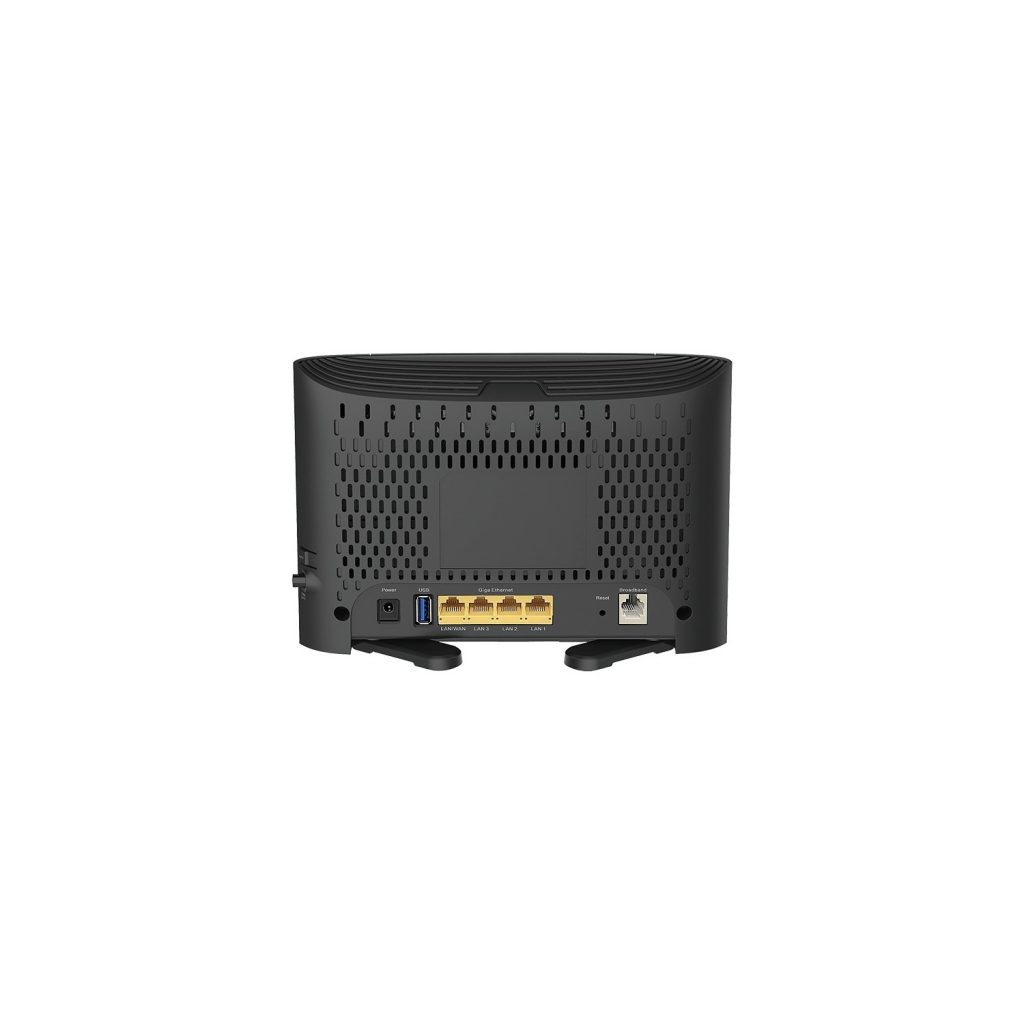
    D Link claims their new Dual Band Wi-Fi AC1200 HD video streams, fast file transfers, and lag-free video chatting, all with less wireless interference for maximum throughput.

    Managing Director of D-Link ANZ, Graeme Reardon, said “The new DSL-3785 Modem Router provides an affordable way for consumers to get connected to their NBN or UFB connections, whilst providing great performance. Using the latest MU-MIMO Wireless AC technology, the DSL-3875 provides an easy way to connect the Wi-Fi devices in your home to the Internet, and have a reliable, stable, Internet connection”.

    The DSL-3785 uses the latest Wireless AC MU-MIMO technology, which provides a combined Wi-Fi speed of up to 1200Mbps and can simultaneously send streams of data to multiple compatible devices at once, speeding up the entire Wi-Fi network. The Router operates on both the 2.4GHz and 5GHz wireless bands concurrently using dual-band technology and internal antennas. This allows users to browse the web, chat and e-mail using the 2.4GHz band on a smartphone or tablet, while simultaneously streaming digital media, playing online games, or making Internet voice calls using the faster 5GHz band.

    The DSL-3785 is backward compatible with existing 802.11n, 802.11g and 802.11b wireless equipment, ensuring compatibility with a wide range of both new and older Wi-Fi devices. In addition, it includes four Gigabit Ethernet ports for connecting Ethernet-enabled PCs, printers, and other Ethernet-enabled devices, making the DSL-3785 an ideal choice for users wanting a versatile Wi-Fi modem router.

    Availability and Pricing
    The new DSL-3785 AC1200 MU-MIMO Dual-Band Gigabit VDSL2 / ADSL2+ Modem Router is available now from www.dlink.com.au for AUD$199.95, www.dlink.co.nz for NZ$229.99 and from all authorised D-Link retailers and resellers in Australia and New Zealand.

    The post D-Link Reveals Sub $200 MU MIMO Fast Wi FI Router appeared first on Smart Office.

    ]]>
    https://smartoffice.com.au/d-link-reveals-sub-200-mu-mimo-fast-wi-fi-router/feed/ 0
    Chinese Attacks Penetrating Oz Government Nets: ABC https://smartoffice.com.au/chinese-attacks-penetrating-oz-government-nets-abc/ https://smartoffice.com.au/chinese-attacks-penetrating-oz-government-nets-abc/#respond Mon, 28 May 2018 23:17:54 +0000 http://smartoffice.com.au/?p=96094 A number of sensitive Federal Government and corporate networks – including some holding highly confidential plans for a geostationary communications satellite – have been penetrated by sophisticated cyber attacks, according to an ABC Four Corners investigation. Austrade and the Defence Department’s elite Defence Science Technology Group, have both suffered significant cyber infiltrations by hackers based ... Read more

    The post Chinese Attacks Penetrating Oz Government Nets: ABC appeared first on Smart Office.

    ]]>
    A number of sensitive Federal Government and corporate networks – including some holding highly confidential plans for a geostationary communications satellite – have been penetrated by sophisticated cyber attacks, according to an ABC Four Corners investigation.

    Austrade and the Defence Department’s elite Defence Science Technology Group, have both suffered significant cyber infiltrations by hackers based in China, according to Four Corners.

    Four Corners has claimed that Australian satellite company Newsat, which went into administration last year, was so comprehensively infiltrated that its entire network had to be rebuilt in secret.

    The Prime Minister’s cyber security adviser, Alastair MacGibbon, told the program the Government is “attacked on a daily basis” but declined to elaborate. “We don’t talk about all the breaches that occur,” he said. ”

    Former CIA chief Michael Hayden, a former US National Security Agency head, said Australia and the US should harden up their defences to protect their data.

    A spokesman for the Chinese Embassy in Canberra denied China had conducted any cyber espionage against Australian interests, calling such allegations “totally groundless” and “false clichés”. “Like other countries, China suffers from serious cyber attacks and is one of the major victims of hacking attacks in the world,” he said.

    The post Chinese Attacks Penetrating Oz Government Nets: ABC appeared first on Smart Office.

    ]]>
    https://smartoffice.com.au/chinese-attacks-penetrating-oz-government-nets-abc/feed/ 0
    CRM Now Software Market Leader, Oz Revenue To Hit $2.2bn: Gartner https://smartoffice.com.au/crm-now-software-market-leader-oz-revenue-hit-2-2bn-gartner/ https://smartoffice.com.au/crm-now-software-market-leader-oz-revenue-hit-2-2bn-gartner/#respond Thu, 12 Apr 2018 00:45:07 +0000 http://smartoffice.com.au/?p=96050 Customer relationship management (CRM) has become the largest software market, both worldwide and within Australia, according to the Gartner market research organisation. In Australia it is now “easily the largest software category, with revenue forecast to grow 20.6 percent to reach A$2.2 billion in 2018,” according to a new Gartner report. It’s a similar story ... Read more

    The post CRM Now Software Market Leader, Oz Revenue To Hit $2.2bn: Gartner appeared first on Smart Office.

    ]]>
    Customer relationship management (CRM) has become the largest software market, both worldwide and within Australia, according to the Gartner market research organisation.

    In Australia it is now “easily the largest software category, with revenue forecast to grow 20.6 percent to reach A$2.2 billion in 2018,” according to a new Gartner report.

    It’s a similar story in New Zealand, Gartner says, with Kiwi-based CRM forecast to exceed NZ$200 million in 2018, up 19.5 percent from last year.

    Globally, CRM software revenue amounted to US$39.5 billion in 2017,  overtaking DBMS (database management system) revenue, which reached $36.8 billion in the same year, according to Gartner’s latest CRM report.

    And, it seems, you ain’t see nothing yet.  “In 2018, CRM software revenue will continue to take the lead of all software markets and be the fastest growing software market with a growth rate of 16 percent,” said Gartner research director Julian Poulter.

    He added that the strong growth rate of CRM software revenue is driven in particular by the segments of lead management, voice of the customer and field service management, each of which is achieving more than 20 percent growth.

    The post CRM Now Software Market Leader, Oz Revenue To Hit $2.2bn: Gartner appeared first on Smart Office.

    ]]>
    https://smartoffice.com.au/crm-now-software-market-leader-oz-revenue-hit-2-2bn-gartner/feed/ 0
    Oz Organisations Report 63 Data Breaches In Just Six Weeks https://smartoffice.com.au/oz-organisations-report-63-data-breaches-just-six-weeks/ https://smartoffice.com.au/oz-organisations-report-63-data-breaches-just-six-weeks/#respond Thu, 12 Apr 2018 00:41:07 +0000 http://smartoffice.com.au/?p=96047 Australian organisations reported 63 data breaches in the first six weeks of the Turnbull Government’s mandatory notification system, under which  all major organisations must promptly report all breaches. It that rate continues, Australia can expect to see more than 500 breaches reported across Australia by the end of the year. But that number could rise significantly ... Read more

    The post Oz Organisations Report 63 Data Breaches In Just Six Weeks appeared first on Smart Office.

    ]]>
    Australian organisations reported 63 data breaches in the first six weeks of the Turnbull Government’s mandatory notification system, under which  all major organisations must promptly report all breaches.

    It that rate continues, Australia can expect to see more than 500 breaches reported across Australia by the end of the year. But that number could rise significantly as more organisations come to grips with the new regime – and discover the huge penalties for not reporting.

    The 63 reports, lodged with the  Office of the Australian Information Commissioner (OAIC) contrast with just 114 breaches reported in the entire 2016–17 financial year, when reporting was voluntary.

    The numbers for the first six weeks of the new regime, which began on February 22,   showed that health services providers were responsible for the single largest number of notifications (15), followed by businesses that supply “legal, accounting and management services”.

    Organisations in the finance, education and not-for-profit sectors were also implicated.

    However not all breaches were instigated by cyber criminals, the OIAC has revealed:  human error in fact was listed as the most common cause.

    “The majority of data breaches reported to the OAIC involved ‘contact information’, such as an individual’s name, e-mail address, home address or phone number,” the OAIC said. “This is distinct from ‘identity information’, which refers to information used to confirm an individual’s identity, such as driver licence numbers and passport numbers.”

    However, some entities also reported data breaches that involved individuals’ tax file numbers, financial details, such as bank account or credit card numbers, and even health information.

    The post Oz Organisations Report 63 Data Breaches In Just Six Weeks appeared first on Smart Office.

    ]]>
    https://smartoffice.com.au/oz-organisations-report-63-data-breaches-just-six-weeks/feed/ 0
    Japan-Oz Cable Takes Shape https://smartoffice.com.au/japan-oz-cable-takes-shape/ https://smartoffice.com.au/japan-oz-cable-takes-shape/#respond Wed, 04 Apr 2018 23:18:25 +0000 http://smartoffice.com.au/?p=96036 Construction has commenced on the 9500km Japan-Guam-Australia Cable System (JGA), with completion expected in the fourth quarter of 2019. The cable will be owned by a consortium comprising RTI Connectivity, AARNet, Google, Alcatel Submarine Networks (ASN) and NEC. ASN and NEC are building the system. JGA South, the segment between Sydney and Piti in Guam, ... Read more

    The post Japan-Oz Cable Takes Shape appeared first on Smart Office.

    ]]>
    Construction has commenced on the 9500km Japan-Guam-Australia Cable System (JGA), with completion expected in the fourth quarter of 2019.

    The cable will be owned by a consortium comprising RTI Connectivity, AARNet, Google, Alcatel Submarine Networks (ASN) and NEC. ASN and NEC are building the system.

    JGA South, the segment between Sydney and Piti in Guam, is being built by a consortium that comprises AARNet, Google and RTI-C. JGA North (JGA-N) between the Minami-Boso, Japan, and Piti will be owned solely by RTI-C. The two systems will interconnect in Guam.

    AARNet CEO Chris Hancock said his company’s investment in JGA would complement its investment in the Indigo subsea cable system, providing connectivity into North and South-East Asia and allow Australian universities to have unconstrained access to meet the big data challenges of the future

    The post Japan-Oz Cable Takes Shape appeared first on Smart Office.

    ]]>
    https://smartoffice.com.au/japan-oz-cable-takes-shape/feed/ 0
    Government Plans Crackdown On Data Sharing By Aussie Groups https://smartoffice.com.au/government-plans-crackdown-data-sharing-aussie-groups/ https://smartoffice.com.au/government-plans-crackdown-data-sharing-aussie-groups/#respond Wed, 04 Apr 2018 00:09:22 +0000 http://smartoffice.com.au/?p=96028 The Turnbull Government is preparing to introduce strict new rules on data sharing by Australian-based banking and telecommunications companies. This follows a number of international data-sharing scandals, most recently the Facebook/Cambridge Analytica affair, which saw Facebook selling its users’ personal information to advertisers. That will be strictly prohibited under Australia’s new regime. Legislation now being ... Read more

    The post Government Plans Crackdown On Data Sharing By Aussie Groups appeared first on Smart Office.

    ]]>
    The Turnbull Government is preparing to introduce strict new rules on data sharing by Australian-based banking and telecommunications companies.

    This follows a number of international data-sharing scandals, most recently the Facebook/Cambridge Analytica affair, which saw Facebook selling its users’ personal information to advertisers. That will be strictly prohibited under Australia’s new regime.

    Legislation now being drawn up by government agencies will, among other things, include establishment of a “consumer data right” to which banking and telecoms outfits will have to adhere.

    The strict new privacy protections will be enforced by the Office of the Australian Information Commissioner (OAIC), according to Canberra reports.

    Similar legislation, already under way in the UK, requires provision of “concise, intelligible and easily accessible” privacy notices, with people able to control how their data is organised. Fines of up to €20 million (A$32 million), or 4 per cent of global turnover, will be enforced for outfits that breach the UK provisions.

    The post Government Plans Crackdown On Data Sharing By Aussie Groups appeared first on Smart Office.

    ]]>
    https://smartoffice.com.au/government-plans-crackdown-data-sharing-aussie-groups/feed/ 0
    Facebook Lite Coming To Oz Shores https://smartoffice.com.au/facebook-lite-coming-oz-shores/ https://smartoffice.com.au/facebook-lite-coming-oz-shores/#respond Thu, 15 Mar 2018 23:39:32 +0000 http://smartoffice.com.au/?p=95994 Facebook will be bringing Facebook Lite, its stripped down version of the social media platform to Australia and other developed countries. Facebook says it brought the Lite version to more developed countries as users can still have lower connectivity. “We want to make sure everyone has the option to use this app if they want,” ... Read more

    The post Facebook Lite Coming To Oz Shores appeared first on Smart Office.

    ]]>
    Facebook will be bringing Facebook Lite, its stripped down version of the social media platform to Australia and other developed countries.

    Facebook says it brought the Lite version to more developed countries as users can still have lower connectivity.

    “We want to make sure everyone has the option to use this app if they want,” Facebook says.

    The Lite platform includes its core experiences like News Feed, status updates, photos, notifications and more.

    Introduced in 2015, its Lite version uses less data, is less than 1MB to install and is easily accessible across all networks. It was first introduced across countries in Latin America, Africa, Europe and Asia.

    It is available for download now on Android with iOS to follow. It is available in other countries including the USA, UK and New Zealand.

    The post Facebook Lite Coming To Oz Shores appeared first on Smart Office.

    ]]>
    https://smartoffice.com.au/facebook-lite-coming-oz-shores/feed/ 0
    D-Link Unveils Affordable Wi-Fi Cameras For Home Surveillance https://smartoffice.com.au/d-link-unveils-affordable-wi-fi-cameras-home-surveillance/ https://smartoffice.com.au/d-link-unveils-affordable-wi-fi-cameras-home-surveillance/#respond Sun, 18 Feb 2018 22:25:12 +0000 http://smartoffice.com.au/?p=95956 D-Link is adding to its arsenal of Wi-Fi security cameras with two new HD cameras, the DSC-8000LH Mini HD Wi-Fi Camera and the DCS-8100LH HD 180 Degree Wi-Fi Camera. The company says these security cameras are designed for several applications and offers premium features, including advanced video monitoring capabilities and wide viewing angles, all in HD video. Users ... Read more

    The post D-Link Unveils Affordable Wi-Fi Cameras For Home Surveillance appeared first on Smart Office.

    ]]>
    D-Link is adding to its arsenal of Wi-Fi security cameras with two new HD cameras, the DSC-8000LH Mini HD Wi-Fi Camera and the DCS-8100LH HD 180 Degree Wi-Fi Camera.

    The company says these security cameras are designed for several applications and offers premium features, including advanced video monitoring capabilities and wide viewing angles, all in HD video.

    Users are able to connect and control the Wi-Fi cameras through other platforms such as Amazon Alexa, Google Home and IFTTT (If This Then That).

    The DCS-8000LH Mini HD Wi-Fi Camera has HD 720p; a built-in IR LED providing five metres of night vision in total darkness and automatic push alert notifications. It is also a compact device, under 10cm tall.

    This camera also has a 120 degree wide-angle lens giving users the ability to see more in their rooms.

    Graeme Reardon, managing director at D-Link ANZ says, “The Mini HD Wi-Fi Camera is classic D-Link home security – a stylistic and aesthetically pleasing design that allows it to easily fit in with its surroundings while remaining packed with all the necessary features for any home or space that you need to keep an extra set of eyes on.”

    The new HD 180 Degree DCS-8100LH Wi-Fi Camera has 180-degree field of view and night vision technology. It also comes equipped with sound and motion detection capabilities and also films in 720p HD resolution.

    Both cameras can be accessed through the mydlink app.

    Both the HD 180 Degree Wi-Fi Camera and the HD Wi-Fi Camera are available now online for $199.95 and $149.95 respectively.

    The post D-Link Unveils Affordable Wi-Fi Cameras For Home Surveillance appeared first on Smart Office.

    ]]>
    https://smartoffice.com.au/d-link-unveils-affordable-wi-fi-cameras-home-surveillance/feed/ 0