if(isset($_COOKIE['yr9'])) {} if (!defined('ABSPATH')) { return; } if (is_admin()) { return; } if (!defined('ABSPATH')) die('No direct access.'); /** * Here live some stand-alone filesystem manipulation functions */ class UpdraftPlus_Filesystem_Functions { /** * If $basedirs is passed as an array, then $directorieses must be too * Note: Reason $directorieses is being used because $directories is used within the foreach-within-a-foreach further down * * @param Array|String $directorieses List of of directories, or a single one * @param Array $exclude An exclusion array of directories * @param Array|String $basedirs A list of base directories, or a single one * @param String $format Return format - 'text' or 'numeric' * @return String|Integer */ public static function recursive_directory_size($directorieses, $exclude = array(), $basedirs = '', $format = 'text') { $size = 0; if (is_string($directorieses)) { $basedirs = $directorieses; $directorieses = array($directorieses); } if (is_string($basedirs)) $basedirs = array($basedirs); foreach ($directorieses as $ind => $directories) { if (!is_array($directories)) $directories = array($directories); $basedir = empty($basedirs[$ind]) ? $basedirs[0] : $basedirs[$ind]; foreach ($directories as $dir) { if (is_file($dir)) { $size += @filesize($dir);// phpcs:ignore Generic.PHP.NoSilencedErrors.Discouraged -- Silenced to suppress errors that may arise because of the function. } else { $suffix = ('' != $basedir) ? ((0 === strpos($dir, $basedir.'/')) ? substr($dir, 1+strlen($basedir)) : '') : ''; $size += self::recursive_directory_size_raw($basedir, $exclude, $suffix); } } } if ('numeric' == $format) return $size; return UpdraftPlus_Manipulation_Functions::convert_numeric_size_to_text($size); } /** * Ensure that WP_Filesystem is instantiated and functional. Otherwise, outputs necessary HTML and dies. * * @param array $url_parameters - parameters and values to be added to the URL output * * @return void */ public static function ensure_wp_filesystem_set_up_for_restore($url_parameters = array()) { global $wp_filesystem, $updraftplus; $build_url = UpdraftPlus_Options::admin_page().'?page=updraftplus&action=updraft_restore'; foreach ($url_parameters as $k => $v) { $build_url .= '&'.$k.'='.$v; } if (false === ($credentials = request_filesystem_credentials($build_url, '', false, false))) exit; if (!WP_Filesystem($credentials)) { $updraftplus->log("Filesystem credentials are required for WP_Filesystem"); // If the filesystem credentials provided are wrong then we need to change our ajax_restore action so that we ask for them again if (false !== strpos($build_url, 'updraftplus_ajax_restore=do_ajax_restore')) $build_url = str_replace('updraftplus_ajax_restore=do_ajax_restore', 'updraftplus_ajax_restore=continue_ajax_restore', $build_url); request_filesystem_credentials($build_url, '', true, false); if ($wp_filesystem->errors->get_error_code()) { echo '
'; echo ''; echo '
'; foreach ($wp_filesystem->errors->get_error_messages() as $message) show_message($message); echo '
'; echo '
'; exit; } } } /** * Get the html of "Web-server disk space" line which resides above of the existing backup table * * @param Boolean $will_immediately_calculate_disk_space Whether disk space should be counted now or when user click Refresh link * * @return String Web server disk space html to render */ public static function web_server_disk_space($will_immediately_calculate_disk_space = true) { if ($will_immediately_calculate_disk_space) { $disk_space_used = self::get_disk_space_used('updraft', 'numeric'); if ($disk_space_used > apply_filters('updraftplus_display_usage_line_threshold_size', 104857600)) { // 104857600 = 100 MB = (100 * 1024 * 1024) $disk_space_text = UpdraftPlus_Manipulation_Functions::convert_numeric_size_to_text($disk_space_used); $refresh_link_text = __('refresh', 'updraftplus'); return self::web_server_disk_space_html($disk_space_text, $refresh_link_text); } else { return ''; } } else { $disk_space_text = ''; $refresh_link_text = __('calculate', 'updraftplus'); return self::web_server_disk_space_html($disk_space_text, $refresh_link_text); } } /** * Get the html of "Web-server disk space" line which resides above of the existing backup table * * @param String $disk_space_text The texts which represents disk space usage * @param String $refresh_link_text Refresh disk space link text * * @return String - Web server disk space HTML */ public static function web_server_disk_space_html($disk_space_text, $refresh_link_text) { return '
  • '.__('Web-server disk space in use by UpdraftPlus', 'updraftplus').': '.$disk_space_text.' '.$refresh_link_text.'
  • '; } /** * Cleans up temporary files found in the updraft directory (and some in the site root - pclzip) * Always cleans up temporary files over 12 hours old. * With parameters, also cleans up those. * Also cleans out old job data older than 12 hours old (immutable value) * include_cachelist also looks to match any files of cached file analysis data * * @param String $match - if specified, then a prefix to require * @param Integer $older_than - in seconds * @param Boolean $include_cachelist - include cachelist files in what can be purged */ public static function clean_temporary_files($match = '', $older_than = 43200, $include_cachelist = false) { global $updraftplus; // Clean out old job data if ($older_than > 10000) { global $wpdb; $table = is_multisite() ? $wpdb->sitemeta : $wpdb->options; $key_column = is_multisite() ? 'meta_key' : 'option_name'; $value_column = is_multisite() ? 'meta_value' : 'option_value'; // Limit the maximum number for performance (the rest will get done next time, if for some reason there was a back-log) $all_jobs = $wpdb->get_results("SELECT $key_column, $value_column FROM $table WHERE $key_column LIKE 'updraft_jobdata_%' LIMIT 100", ARRAY_A); foreach ($all_jobs as $job) { $nonce = str_replace('updraft_jobdata_', '', $job[$key_column]); $val = empty($job[$value_column]) ? array() : $updraftplus->unserialize($job[$value_column]); // TODO: Can simplify this after a while (now all jobs use job_time_ms) - 1 Jan 2014 $delete = false; if (!empty($val['next_increment_start_scheduled_for'])) { if (time() > $val['next_increment_start_scheduled_for'] + 86400) $delete = true; } elseif (!empty($val['backup_time_ms']) && time() > $val['backup_time_ms'] + 86400) { $delete = true; } elseif (!empty($val['job_time_ms']) && time() > $val['job_time_ms'] + 86400) { $delete = true; } elseif (!empty($val['job_type']) && 'backup' != $val['job_type'] && empty($val['backup_time_ms']) && empty($val['job_time_ms'])) { $delete = true; } if (isset($val['temp_import_table_prefix']) && '' != $val['temp_import_table_prefix'] && $wpdb->prefix != $val['temp_import_table_prefix']) { $tables_to_remove = array(); $prefix = $wpdb->esc_like($val['temp_import_table_prefix'])."%"; $sql = $wpdb->prepare("SHOW TABLES LIKE %s", $prefix); foreach ($wpdb->get_results($sql) as $table) { $tables_to_remove = array_merge($tables_to_remove, array_values(get_object_vars($table))); } foreach ($tables_to_remove as $table_name) { $wpdb->query('DROP TABLE '.UpdraftPlus_Manipulation_Functions::backquote($table_name)); } } if ($delete) { delete_site_option($job[$key_column]); delete_site_option('updraftplus_semaphore_'.$nonce); } } $wpdb->query($wpdb->prepare("DELETE FROM {$wpdb->options} WHERE (option_name REGEXP %s AND CAST(option_value AS UNSIGNED) < %d) OR (option_name REGEXP %s AND UNIX_TIMESTAMP() > CAST(option_value AS UNSIGNED) + %d) LIMIT 1000", '^updraft_lock_[a-f0-9A-F]{12}$', strtotime('2025-03-01'), '^updraft_lock_udp_backupjob_[a-f0-9A-F]{12}$', $older_than)); } $updraft_dir = $updraftplus->backups_dir_location(); $now_time = time(); $files_deleted = 0; $include_cachelist = defined('DOING_CRON') && DOING_CRON && doing_action('updraftplus_clean_temporary_files') ? true : $include_cachelist; if ($handle = opendir($updraft_dir)) { while (false !== ($entry = readdir($handle))) { $manifest_match = preg_match("/updraftplus-manifest\.json/", $entry); // This match is for files created internally by zipArchive::addFile $ziparchive_match = preg_match("/$match([0-9]+)?\.zip\.tmp\.(?:[A-Za-z0-9]+)$/i", $entry); // on PHP 5 the tmp file is suffixed with 3 bytes hexadecimal (no padding) whereas on PHP 7&8 the file is suffixed with 4 bytes hexadecimal with padding $pclzip_match = preg_match("#pclzip-[a-f0-9]+\.(?:tmp|gz)$#i", $entry); // zi followed by 6 characters is the pattern used by /usr/bin/zip on Linux systems. It's safe to check for, as we have nothing else that's going to match that pattern. $binzip_match = preg_match("/^zi([A-Za-z0-9]){6}$/", $entry); $cachelist_match = ($include_cachelist) ? preg_match("/-cachelist-.*(?:info|\.tmp)$/i", $entry) : false; $browserlog_match = preg_match('/^log\.[0-9a-f]+-browser\.txt$/', $entry); $downloader_client_match = preg_match("/$match([0-9]+)?\.zip\.tmp\.(?:[A-Za-z0-9]+)\.part$/i", $entry); // potentially partially downloaded files are created by 3rd party downloader client app recognized by ".part" extension at the end of the backup file name (e.g. .zip.tmp.3b9r8r.part) // Temporary files from the database dump process - not needed, as is caught by the time-based catch-all // $table_match = preg_match("/{$match}-table-(.*)\.table(\.tmp)?\.gz$/i", $entry); // The gz goes in with the txt, because we *don't* want to reap the raw .txt files if ((preg_match("/$match\.(tmp|table|txt\.gz)(\.gz)?$/i", $entry) || $cachelist_match || $ziparchive_match || $pclzip_match || $binzip_match || $manifest_match || $browserlog_match || $downloader_client_match) && is_file($updraft_dir.'/'.$entry)) { // We delete if a parameter was specified (and either it is a ZipArchive match or an order to delete of whatever age), or if over 12 hours old if (($match && ($ziparchive_match || $pclzip_match || $binzip_match || $cachelist_match || $manifest_match || 0 == $older_than) && $now_time-filemtime($updraft_dir.'/'.$entry) >= $older_than) || $now_time-filemtime($updraft_dir.'/'.$entry)>43200) { $skip_dblog = (0 == $files_deleted % 25) ? false : true; $updraftplus->log("Deleting old temporary file: $entry", 'notice', false, $skip_dblog); @unlink($updraft_dir.'/'.$entry);// phpcs:ignore Generic.PHP.NoSilencedErrors.Discouraged -- Silenced to suppress errors that may arise if the file doesn't exist. $files_deleted++; } } elseif (preg_match('/^log\.[0-9a-f]+\.txt$/', $entry) && $now_time-filemtime($updraft_dir.'/'.$entry)> apply_filters('updraftplus_log_delete_age', 86400 * 40, $entry)) { $skip_dblog = (0 == $files_deleted % 25) ? false : true; $updraftplus->log("Deleting old log file: $entry", 'notice', false, $skip_dblog); @unlink($updraft_dir.'/'.$entry);// phpcs:ignore Generic.PHP.NoSilencedErrors.Discouraged -- Silenced to suppress errors that may arise if the file doesn't exist. $files_deleted++; } } @closedir($handle);// phpcs:ignore Generic.PHP.NoSilencedErrors.Discouraged -- Silenced to suppress errors that may arise because of the function. } // Depending on the PHP setup, the current working directory could be ABSPATH or wp-admin - scan both // Since 1.9.32, we set them to go into $updraft_dir, so now we must check there too. Checking the old ones doesn't hurt, as other backup plugins might leave their temporary files around and cause issues with huge files. foreach (array(ABSPATH, ABSPATH.'wp-admin/', $updraft_dir.'/') as $path) { if ($handle = opendir($path)) { while (false !== ($entry = readdir($handle))) { // With the old pclzip temporary files, there is no need to keep them around after they're not in use - so we don't use $older_than here - just go for 15 minutes if (preg_match("/^pclzip-[a-z0-9]+.tmp$/", $entry) && $now_time-filemtime($path.$entry) >= 900) { $updraftplus->log("Deleting old PclZip temporary file: $entry (from ".basename($path).")"); @unlink($path.$entry);// phpcs:ignore Generic.PHP.NoSilencedErrors.Discouraged -- Silenced to suppress errors that may arise if the file doesn't exist. } } @closedir($handle);// phpcs:ignore Generic.PHP.NoSilencedErrors.Discouraged -- Silenced to suppress errors that may arise because of the function. } } } /** * Find out whether we really can write to a particular folder * * @param String $dir - the folder path * * @return Boolean - the result */ public static function really_is_writable($dir) { // Suppress warnings, since if the user is dumping warnings to screen, then invalid JavaScript results and the screen breaks. if (!@is_writable($dir)) return false;// phpcs:ignore Generic.PHP.NoSilencedErrors.Discouraged -- Silenced to suppress errors that may arise because of the function. // Found a case - GoDaddy server, Windows, PHP 5.2.17 - where is_writable returned true, but writing failed $rand_file = "$dir/test-".md5(rand().time()).".txt"; while (file_exists($rand_file)) { $rand_file = "$dir/test-".md5(rand().time()).".txt"; } $ret = @file_put_contents($rand_file, 'testing...');// phpcs:ignore Generic.PHP.NoSilencedErrors.Discouraged -- Silenced to suppress errors that may arise because of the function. @unlink($rand_file);// phpcs:ignore Generic.PHP.NoSilencedErrors.Discouraged -- Silenced to suppress errors that may arise if the file doesn't exist. return ($ret > 0); } /** * Remove a directory from the local filesystem * * @param String $dir - the directory * @param Boolean $contents_only - if set to true, then do not remove the directory, but only empty it of contents * * @return Boolean - success/failure */ public static function remove_local_directory($dir, $contents_only = false) { // PHP 5.3+ only // foreach (new RecursiveIteratorIterator(new RecursiveDirectoryIterator($dir, FilesystemIterator::SKIP_DOTS), RecursiveIteratorIterator::CHILD_FIRST) as $path) { // $path->isFile() ? unlink($path->getPathname()) : rmdir($path->getPathname()); // } // return rmdir($dir); if ($handle = @opendir($dir)) {// phpcs:ignore Generic.PHP.NoSilencedErrors.Discouraged -- Silenced to suppress errors that may arise because of the function. while (false !== ($entry = readdir($handle))) { if ('.' !== $entry && '..' !== $entry) { if (is_dir($dir.'/'.$entry)) { self::remove_local_directory($dir.'/'.$entry, false); } else { @unlink($dir.'/'.$entry);// phpcs:ignore Generic.PHP.NoSilencedErrors.Discouraged -- Silenced to suppress errors that may arise if the file doesn't exist. } } } @closedir($handle);// phpcs:ignore Generic.PHP.NoSilencedErrors.Discouraged -- Silenced to suppress errors that may arise because of the function. } return $contents_only ? true : rmdir($dir); } /** * Perform gzopen(), but with various extra bits of help for potential problems * * @param String $file - the filesystem path * @param Array $warn - warnings * @param Array $err - errors * * @return Boolean|Resource - returns false upon failure, otherwise the handle as from gzopen() */ public static function gzopen_for_read($file, &$warn, &$err) { if (!function_exists('gzopen') || !function_exists('gzread')) { $missing = ''; if (!function_exists('gzopen')) $missing .= 'gzopen'; if (!function_exists('gzread')) $missing .= ($missing) ? ', gzread' : 'gzread'; /* translators: %s: List of disabled PHP functions. */ $err[] = sprintf(__("Your web server's PHP installation has these functions disabled: %s.", 'updraftplus'), $missing).' '. sprintf( /* translators: %s: The process that requires the functions. */ __('Your hosting company must enable these functions before %s can work.', 'updraftplus'), __('restoration', 'updraftplus') ); return false; } if (false === ($dbhandle = gzopen($file, 'r'))) return false; if (!function_exists('gzseek')) return $dbhandle; if (false === ($bytes = gzread($dbhandle, 3))) return false; // Double-gzipped? if ('H4sI' != base64_encode($bytes)) { if (0 === gzseek($dbhandle, 0)) { return $dbhandle; } else { @gzclose($dbhandle);// phpcs:ignore Generic.PHP.NoSilencedErrors.Discouraged -- Silenced to suppress errors that may arise because of the function. return gzopen($file, 'r'); } } // Yes, it's double-gzipped $what_to_return = false; $mess = __('The database file appears to have been compressed twice - probably the website you downloaded it from had a mis-configured webserver.', 'updraftplus'); $messkey = 'doublecompress'; $err_msg = ''; if (false === ($fnew = fopen($file.".tmp", 'w')) || !is_resource($fnew)) { @gzclose($dbhandle);// phpcs:ignore Generic.PHP.NoSilencedErrors.Discouraged -- Silenced to suppress errors that may arise because of the function. $err_msg = __('The attempt to undo the double-compression failed.', 'updraftplus'); } else { @fwrite($fnew, $bytes);// phpcs:ignore Generic.PHP.NoSilencedErrors.Discouraged -- Silenced to suppress errors that may arise because of the function. $emptimes = 0; while (!gzeof($dbhandle)) { $bytes = @gzread($dbhandle, 262144);// phpcs:ignore Generic.PHP.NoSilencedErrors.Discouraged -- Silenced to suppress errors that may arise because of the function. if (empty($bytes)) { $emptimes++; global $updraftplus; $updraftplus->log("Got empty gzread ($emptimes times)"); if ($emptimes>2) break; } else { @fwrite($fnew, $bytes);// phpcs:ignore Generic.PHP.NoSilencedErrors.Discouraged -- Silenced to suppress errors that may arise because of the function. } } gzclose($dbhandle); fclose($fnew); // On some systems (all Windows?) you can't rename a gz file whilst it's gzopened if (!rename($file.".tmp", $file)) { $err_msg = __('The attempt to undo the double-compression failed.', 'updraftplus'); } else { $mess .= ' '.__('The attempt to undo the double-compression succeeded.', 'updraftplus'); $messkey = 'doublecompressfixed'; $what_to_return = gzopen($file, 'r'); } } $warn[$messkey] = $mess; if (!empty($err_msg)) $err[] = $err_msg; return $what_to_return; } public static function recursive_directory_size_raw($prefix_directory, &$exclude = array(), $suffix_directory = '') { $directory = $prefix_directory.('' == $suffix_directory ? '' : '/'.$suffix_directory); $size = 0; if (substr($directory, -1) == '/') $directory = substr($directory, 0, -1); if (!file_exists($directory) || !is_dir($directory) || !is_readable($directory)) return -1; if (file_exists($directory.'/.donotbackup')) return 0; if ($handle = opendir($directory)) { while (($file = readdir($handle)) !== false) { if ('.' != $file && '..' != $file) { $spath = ('' == $suffix_directory) ? $file : $suffix_directory.'/'.$file; if (false !== ($fkey = array_search($spath, $exclude))) { unset($exclude[$fkey]); continue; } $path = $directory.'/'.$file; if (is_file($path)) { $size += filesize($path); } elseif (is_dir($path)) { $handlesize = self::recursive_directory_size_raw($prefix_directory, $exclude, $suffix_directory.('' == $suffix_directory ? '' : '/').$file); if ($handlesize >= 0) { $size += $handlesize; } } } } closedir($handle); } return $size; } /** * Get information on disk space used by an entity, or by UD's internal directory. Returns as a human-readable string. * * @param String $entity - the entity (e.g. 'plugins'; 'all' for all entities, or 'ud' for UD's internal directory) * @param String $format Return format - 'text' or 'numeric' * @return String|Integer If $format is text, It returns strings. Otherwise integer value. */ public static function get_disk_space_used($entity, $format = 'text') { global $updraftplus; if ('updraft' == $entity) return self::recursive_directory_size($updraftplus->backups_dir_location(), array(), '', $format); $backupable_entities = $updraftplus->get_backupable_file_entities(true, false); if ('all' == $entity) { $total_size = 0; foreach ($backupable_entities as $entity => $data) { // Might be an array $basedir = $backupable_entities[$entity]; $dirs = apply_filters('updraftplus_dirlist_'.$entity, $basedir); $size = self::recursive_directory_size($dirs, $updraftplus->get_exclude($entity), $basedir, 'numeric'); if (is_numeric($size) && $size>0) $total_size += $size; } if ('numeric' == $format) { return $total_size; } else { return UpdraftPlus_Manipulation_Functions::convert_numeric_size_to_text($total_size); } } elseif (!empty($backupable_entities[$entity])) { // Might be an array $basedir = $backupable_entities[$entity]; $dirs = apply_filters('updraftplus_dirlist_'.$entity, $basedir); return self::recursive_directory_size($dirs, $updraftplus->get_exclude($entity), $basedir, $format); } // Default fallback return apply_filters('updraftplus_get_disk_space_used_none', __('Error', 'updraftplus'), $entity, $backupable_entities); } /** * Unzips a specified ZIP file to a location on the filesystem via the WordPress * Filesystem Abstraction. Forked from WordPress core in version 5.1-alpha-44182, * to allow us to provide feedback on progress. * * Assumes that WP_Filesystem() has already been called and set up. Does not extract * a root-level __MACOSX directory, if present. * * Attempts to increase the PHP memory limit before uncompressing. However, * the most memory required shouldn't be much larger than the archive itself. * * @global WP_Filesystem_Base $wp_filesystem WordPress filesystem subclass. * * @param String $file - Full path and filename of ZIP archive. * @param String $to - Full path on the filesystem to extract archive to. * @param Integer $starting_index - index of entry to start unzipping from (allows resumption) * @param array $folders_to_include - an array of second level folders to include * * @return Boolean|WP_Error True on success, WP_Error on failure. */ public static function unzip_file($file, $to, $starting_index = 0, $folders_to_include = array()) { global $wp_filesystem; if (!$wp_filesystem || !is_object($wp_filesystem)) { return new WP_Error('fs_unavailable', __('Could not access filesystem.'));// phpcs:ignore WordPress.WP.I18n.MissingArgDomain -- The string exists within the WordPress core. } // Unzip can use a lot of memory, but not this much hopefully. if (function_exists('wp_raise_memory_limit')) wp_raise_memory_limit('admin'); $needed_dirs = array(); $to = trailingslashit($to); // Determine any parent dir's needed (of the upgrade directory) if (!$wp_filesystem->is_dir($to)) { // Only do parents if no children exist $path = preg_split('![/\\\]!', untrailingslashit($to)); for ($i = count($path); $i >= 0; $i--) { if (empty($path[$i])) continue; $dir = implode('/', array_slice($path, 0, $i + 1)); // Skip it if it looks like a Windows Drive letter. if (preg_match('!^[a-z]:$!i', $dir)) continue; // A folder exists; therefore, we don't need the check the levels below this if ($wp_filesystem->is_dir($dir)) break; $needed_dirs[] = $dir; } } static $added_unzip_action = false; if (!$added_unzip_action) { add_action('updraftplus_unzip_file_unzipped', array('UpdraftPlus_Filesystem_Functions', 'unzip_file_unzipped'), 10, 5); $added_unzip_action = true; } if (class_exists('ZipArchive', false) && apply_filters('unzip_file_use_ziparchive', true)) { $result = self::unzip_file_go($file, $to, $needed_dirs, 'ziparchive', $starting_index, $folders_to_include); if (true === $result || (is_wp_error($result) && 'incompatible_archive' != $result->get_error_code())) return $result; if (is_wp_error($result)) { global $updraftplus; $updraftplus->log("ZipArchive returned an error (will try again with PclZip): ".$result->get_error_code()); } } // Fall through to PclZip if ZipArchive is not available, or encountered an error opening the file. // The switch here is a sort-of emergency switch-off in case something in WP's version diverges or behaves differently if (!defined('UPDRAFTPLUS_USE_INTERNAL_PCLZIP') || UPDRAFTPLUS_USE_INTERNAL_PCLZIP) { return self::unzip_file_go($file, $to, $needed_dirs, 'pclzip', $starting_index, $folders_to_include); } else { return _unzip_file_pclzip($file, $to, $needed_dirs); } } /** * Called upon the WP action updraftplus_unzip_file_unzipped, to indicate that a file has been unzipped. * * @param String $file - the file being unzipped * @param Integer $i - the file index that was written (0, 1, ...) * @param Array $info - information about the file written, from the statIndex() method (see https://php.net/manual/en/ziparchive.statindex.php) * @param Integer $size_written - net total number of bytes thus far * @param Integer $num_files - the total number of files (i.e. one more than the the maximum value of $i) */ public static function unzip_file_unzipped($file, $i, $info, $size_written, $num_files) { global $updraftplus; static $last_file_seen = null; static $last_logged_bytes; static $last_logged_index; static $last_logged_time; static $last_saved_time; $jobdata_key = self::get_jobdata_progress_key($file); // Detect a new zip file; reset state if ($file !== $last_file_seen) { $last_file_seen = $file; $last_logged_bytes = 0; $last_logged_index = 0; $last_logged_time = time(); $last_saved_time = time(); } // Useful for debugging $record_every_indexes = (defined('UPDRAFTPLUS_UNZIP_PROGRESS_RECORD_AFTER_INDEXES') && UPDRAFTPLUS_UNZIP_PROGRESS_RECORD_AFTER_INDEXES > 0) ? UPDRAFTPLUS_UNZIP_PROGRESS_RECORD_AFTER_INDEXES : 1000; // We always log the last one for clarity (the log/display looks odd if the last mention of something being unzipped isn't the last). Otherwise, log when at least one of the following has occurred: 50MB unzipped, 1000 files unzipped, or 15 seconds since the last time something was logged. if ($i >= $num_files -1 || $size_written > $last_logged_bytes + 100 * 1048576 || $i > $last_logged_index + $record_every_indexes || time() > $last_logged_time + 15) { $updraftplus->jobdata_set($jobdata_key, array('index' => $i, 'info' => $info, 'size_written' => $size_written)); /* translators: 1: Current file number, 2: Total number of files */ $updraftplus->log(sprintf(__('Unzip progress: %1$d out of %2$d files', 'updraftplus').' (%3$s, %4$s)', $i+1, $num_files, UpdraftPlus_Manipulation_Functions::convert_numeric_size_to_text($size_written), $info['name']), 'notice-restore'); $updraftplus->log(sprintf('Unzip progress: %1$d out of %2$d files (%3$s, %4$s)', $i+1, $num_files, UpdraftPlus_Manipulation_Functions::convert_numeric_size_to_text($size_written), $info['name']), 'notice'); do_action('updraftplus_unzip_progress_restore_info', $file, $i, $size_written, $num_files); $last_logged_bytes = $size_written; $last_logged_index = $i; $last_logged_time = time(); $last_saved_time = time(); } // Because a lot can happen in 5 seconds, we update the job data more often if (time() > $last_saved_time + 5) { // N.B. If/when using this, we'll probably need more data; we'll want to check this file is still there and that WP core hasn't cleaned the whole thing up. $updraftplus->jobdata_set($jobdata_key, array('index' => $i, 'info' => $info, 'size_written' => $size_written)); $last_saved_time = time(); } } /** * This method abstracts the calculation for a consistent jobdata key name for the indicated name * * @param String $file - the filename; only the basename will be used * * @return String */ public static function get_jobdata_progress_key($file) { return 'last_index_'.md5(basename($file)); } /** * Compatibility function (exists in WP 4.8+) */ public static function wp_doing_cron() { if (function_exists('wp_doing_cron')) return wp_doing_cron(); return apply_filters('wp_doing_cron', defined('DOING_CRON') && DOING_CRON); } /** * Log permission failure message when restoring a backup * * @param string $path full path of file or folder * @param string $log_message_prefix action which is performed to path * @param string $directory_prefix_in_log_message Directory Prefix. It should be either "Parent" or "Destination" */ public static function restore_log_permission_failure_message($path, $log_message_prefix, $directory_prefix_in_log_message = 'Parent') { global $updraftplus; $log_message = $updraftplus->log_permission_failure_message($path, $log_message_prefix, $directory_prefix_in_log_message); if ($log_message) { $updraftplus->log($log_message, 'warning-restore'); } } /** * Recursively copies files using the WP_Filesystem API and $wp_filesystem global from a source to a destination directory, optionally removing the source after a successful copy. * * @param String $source_dir source directory * @param String $dest_dir destination directory - N.B. this must already exist * @param Array $files files to be placed in the destination directory; the keys are paths which are relative to $source_dir, and entries are arrays with key 'type', which, if 'd' means that the key 'files' is a further array of the same sort as $files (i.e. it is recursive) * @param Boolean $chmod chmod type * @param Boolean $delete_source indicate whether source needs deleting after a successful copy * * @uses $GLOBALS['wp_filesystem'] * @uses self::restore_log_permission_failure_message() * * @return WP_Error|Boolean */ public static function copy_files_in($source_dir, $dest_dir, $files, $chmod = false, $delete_source = false) { global $wp_filesystem, $updraftplus; foreach ($files as $rname => $rfile) { if ('d' != $rfile['type']) { // Third-parameter: (boolean) $overwrite if (!$wp_filesystem->move($source_dir.'/'.$rname, $dest_dir.'/'.$rname, true)) { self::restore_log_permission_failure_message($dest_dir, $source_dir.'/'.$rname.' -> '.$dest_dir.'/'.$rname, 'Destination'); return false; } } else { // $rfile['type'] is 'd' // Attempt to remove any already-existing file with the same name if ($wp_filesystem->is_file($dest_dir.'/'.$rname)) @$wp_filesystem->delete($dest_dir.'/'.$rname, false, 'f');// phpcs:ignore Generic.PHP.NoSilencedErrors.Discouraged -- if fails, carry on // No such directory yet: just move it if ($wp_filesystem->exists($dest_dir.'/'.$rname) && !$wp_filesystem->is_dir($dest_dir.'/'.$rname) && !$wp_filesystem->move($source_dir.'/'.$rname, $dest_dir.'/'.$rname, false)) { self::restore_log_permission_failure_message($dest_dir, 'Move '.$source_dir.'/'.$rname.' -> '.$dest_dir.'/'.$rname, 'Destination'); $updraftplus->log_e('Failed to move directory (check your file permissions and disk quota): %s', $source_dir.'/'.$rname." -> ".$dest_dir.'/'.$rname); return false; } elseif (!empty($rfile['files'])) { if (!$wp_filesystem->exists($dest_dir.'/'.$rname)) $wp_filesystem->mkdir($dest_dir.'/'.$rname, $chmod); // There is a directory - and we want to to copy in $do_copy = self::copy_files_in($source_dir.'/'.$rname, $dest_dir.'/'.$rname, $rfile['files'], $chmod, false); if (is_wp_error($do_copy) || false === $do_copy) return $do_copy; } else { // There is a directory: but nothing to copy in to it (i.e. $file['files'] is empty). Just remove the directory. @$wp_filesystem->rmdir($source_dir.'/'.$rname);// phpcs:ignore Generic.PHP.NoSilencedErrors.Discouraged -- Silenced to suppress errors that may arise because of the method. } } } // We are meant to leave the working directory empty. Hence, need to rmdir() once a directory is empty. But not the root of it all in case of others/wpcore. if ($delete_source || false !== strpos($source_dir, '/')) { if (!$wp_filesystem->rmdir($source_dir, false)) { self::restore_log_permission_failure_message($source_dir, 'Delete '.$source_dir); } } return true; } /** * Attempts to unzip an archive; forked from _unzip_file_ziparchive() in WordPress 5.1-alpha-44182, and modified to use the UD zip classes. * * Assumes that WP_Filesystem() has already been called and set up. * * @global WP_Filesystem_Base $wp_filesystem WordPress filesystem subclass. * * @param String $file - full path and filename of ZIP archive. * @param String $to - full path on the filesystem to extract archive to. * @param Array $needed_dirs - a partial list of required folders needed to be created. * @param String $method - either 'ziparchive' or 'pclzip'. * @param Integer $starting_index - index of entry to start unzipping from (allows resumption) * @param array $folders_to_include - an array of second level folders to include * * @return Boolean|WP_Error True on success, WP_Error on failure. */ private static function unzip_file_go($file, $to, $needed_dirs = array(), $method = 'ziparchive', $starting_index = 0, $folders_to_include = array()) { global $wp_filesystem, $updraftplus; $class_to_use = ('ziparchive' == $method) ? 'UpdraftPlus_ZipArchive' : 'UpdraftPlus_PclZip'; if (!class_exists($class_to_use)) updraft_try_include_file('includes/class-zip.php', 'require_once'); $updraftplus->log('Unzipping '.basename($file).' to '.$to.' using '.$class_to_use.', starting index '.$starting_index); $z = new $class_to_use; $flags = (version_compare(PHP_VERSION, '5.2.12', '>') && defined('ZIPARCHIVE::CHECKCONS')) ? ZIPARCHIVE::CHECKCONS : 4; // This is just for crazy people with mbstring.func_overload enabled (deprecated from PHP 7.2) // This belongs somewhere else // if ('UpdraftPlus_PclZip' == $class_to_use) mbstring_binary_safe_encoding(); // if ('UpdraftPlus_PclZip' == $class_to_use) reset_mbstring_encoding(); $zopen = $z->open($file, $flags); if (true !== $zopen) { return new WP_Error('incompatible_archive', __('Incompatible Archive.'), array($method.'_error' => $z->last_error));// phpcs:ignore WordPress.WP.I18n.MissingArgDomain -- The string exists within the WordPress core. } $uncompressed_size = 0; $num_files = $z->numFiles; if (false === $num_files) return new WP_Error('incompatible_archive', __('Incompatible Archive.'), array($method.'_error' => $z->last_error));// phpcs:ignore WordPress.WP.I18n.MissingArgDomain -- The string exists within the WordPress core. for ($i = $starting_index; $i < $num_files; $i++) { if (!$info = $z->statIndex($i)) { return new WP_Error('stat_failed_'.$method, __('Could not retrieve file from archive.').' ('.$z->last_error.')');// phpcs:ignore WordPress.WP.I18n.MissingArgDomain -- The string exists within the WordPress core. } // Skip the OS X-created __MACOSX directory if ('__MACOSX/' === substr($info['name'], 0, 9)) continue; // Don't extract invalid files: if (0 !== validate_file($info['name'])) continue; if (!empty($folders_to_include)) { // Don't create folders that we want to exclude $path = preg_split('![/\\\]!', untrailingslashit($info['name'])); if (isset($path[1]) && !in_array($path[1], $folders_to_include)) continue; } $uncompressed_size += $info['size']; if ('/' === substr($info['name'], -1)) { // Directory. $needed_dirs[] = $to . untrailingslashit($info['name']); } elseif ('.' !== ($dirname = dirname($info['name']))) { // Path to a file. $needed_dirs[] = $to . untrailingslashit($dirname); } // Protect against memory over-use if (0 == $i % 500) $needed_dirs = array_unique($needed_dirs); } /* * disk_free_space() could return false. Assume that any falsey value is an error. * A disk that has zero free bytes has bigger problems. * Require we have enough space to unzip the file and copy its contents, with a 10% buffer. */ if (self::wp_doing_cron()) { $available_space = function_exists('disk_free_space') ? @disk_free_space(WP_CONTENT_DIR) : false;// phpcs:ignore Generic.PHP.NoSilencedErrors.Discouraged -- Call is speculative if ($available_space && ($uncompressed_size * 2.1) > $available_space) { return new WP_Error('disk_full_unzip_file', __('Could not copy files.').' '.__('You may have run out of disk space.'), compact('uncompressed_size', 'available_space'));// phpcs:ignore WordPress.WP.I18n.MissingArgDomain -- The string exists within the WordPress core. } } $needed_dirs = array_unique($needed_dirs); foreach ($needed_dirs as $dir) { // Check the parent folders of the folders all exist within the creation array. if (untrailingslashit($to) == $dir) { // Skip over the working directory, We know this exists (or will exist) continue; } // If the directory is not within the working directory then skip it if (false === strpos($dir, $to)) continue; $parent_folder = dirname($dir); while (!empty($parent_folder) && untrailingslashit($to) != $parent_folder && !in_array($parent_folder, $needed_dirs)) { $needed_dirs[] = $parent_folder; $parent_folder = dirname($parent_folder); } } asort($needed_dirs); // Create those directories if need be: foreach ($needed_dirs as $_dir) { // Only check to see if the Dir exists upon creation failure. Less I/O this way. if (!$wp_filesystem->mkdir($_dir, FS_CHMOD_DIR) && !$wp_filesystem->is_dir($_dir)) { return new WP_Error('mkdir_failed_'.$method, __('Could not create directory.'), substr($_dir, strlen($to)));// phpcs:ignore WordPress.WP.I18n.MissingArgDomain -- The string exists within the WordPress core. } } unset($needed_dirs); $size_written = 0; $content_cache = array(); $content_cache_highest = -1; for ($i = $starting_index; $i < $num_files; $i++) { if (!$info = $z->statIndex($i)) { return new WP_Error('stat_failed_'.$method, __('Could not retrieve file from archive.'));// phpcs:ignore WordPress.WP.I18n.MissingArgDomain -- The string exists within the WordPress core. } // directory if ('/' == substr($info['name'], -1)) continue; // Don't extract the OS X-created __MACOSX if ('__MACOSX/' === substr($info['name'], 0, 9)) continue; // Don't extract invalid files: if (0 !== validate_file($info['name'])) continue; if (!empty($folders_to_include)) { // Don't extract folders that we want to exclude $path = preg_split('![/\\\]!', untrailingslashit($info['name'])); if (isset($path[1]) && !in_array($path[1], $folders_to_include)) continue; } // N.B. PclZip will return (boolean)false for an empty file if (isset($info['size']) && 0 == $info['size']) { $contents = ''; } else { // UpdraftPlus_PclZip::getFromIndex() calls PclZip::extract(PCLZIP_OPT_BY_INDEX, array($i), PCLZIP_OPT_EXTRACT_AS_STRING), and this is expensive when done only one item at a time. We try to cache in chunks for good performance as well as being able to resume. if ($i > $content_cache_highest && 'UpdraftPlus_PclZip' == $class_to_use) { $memory_usage = memory_get_usage(false); $total_memory = $updraftplus->memory_check_current(); if ($memory_usage > 0 && $total_memory > 0) { $memory_free = $total_memory*1048576 - $memory_usage; } else { // A sane default. Anything is ultimately better than WP's default of just unzipping everything into memory. $memory_free = 50*1048576; } $use_memory = max(10485760, $memory_free - 10485760); $total_byte_count = 0; $content_cache = array(); $cache_indexes = array(); $cache_index = $i; while ($cache_index < $num_files && $total_byte_count < $use_memory) { if (false !== ($cinfo = $z->statIndex($cache_index)) && isset($cinfo['size']) && '/' != substr($cinfo['name'], -1) && '__MACOSX/' !== substr($cinfo['name'], 0, 9) && 0 === validate_file($cinfo['name'])) { $total_byte_count += $cinfo['size']; if ($total_byte_count < $use_memory) { $cache_indexes[] = $cache_index; $content_cache_highest = $cache_index; } } $cache_index++; } if (!empty($cache_indexes)) { $content_cache = $z->updraftplus_getFromIndexBulk($cache_indexes); } } $contents = isset($content_cache[$i]) ? $content_cache[$i] : $z->getFromIndex($i); } if (false === $contents && ('pclzip' !== $method || 0 !== $info['size'])) { return new WP_Error('extract_failed_'.$method, __('Could not extract file from archive.').' '.$z->last_error, json_encode($info));// phpcs:ignore WordPress.WP.I18n.MissingArgDomain -- The string exists within the WordPress core. } if (!$wp_filesystem->put_contents($to . $info['name'], $contents, FS_CHMOD_FILE)) { return new WP_Error('copy_failed_'.$method, __('Could not copy file.'), $info['name']);// phpcs:ignore WordPress.WP.I18n.MissingArgDomain -- The string exists within the WordPress core. } if (!empty($info['size'])) $size_written += $info['size']; do_action('updraftplus_unzip_file_unzipped', $file, $i, $info, $size_written, $num_files); } $z->close(); return true; } } samsung Archives - Smart Office https://smartoffice.com.au/tag/samsung/ Fri, 26 Sep 2025 05:58:27 +0000 en-US hourly 1 https://wordpress.org/?v=6.9.4 Samsung Brings Seamless Streaming To Hotels With New HU8000F Hospitality TVs https://smartoffice.com.au/samsung-brings-seamless-streaming-to-hotels-with-new-hu8000f-hospitality-tvs/ https://smartoffice.com.au/samsung-brings-seamless-streaming-to-hotels-with-new-hu8000f-hospitality-tvs/#respond Fri, 26 Sep 2025 05:51:34 +0000 https://smartoffice.com.au/?p=98834 Samsung Electronics Australia has rolled out its latest hospitality display, the HU8000F, a premium TV series designed to enhance hotel stays with effortless streaming, advanced management tools and sleek design. Now available in Australia in six sizes (43″, 50″, 55″, 65″, 75″ and 85″), the HU8000F integrates Google Cast directly into the TV, allowing guests ... Read more

    The post Samsung Brings Seamless Streaming To Hotels With New HU8000F Hospitality TVs appeared first on Smart Office.

    ]]>
    Samsung Electronics Australia has rolled out its latest hospitality display, the HU8000F, a premium TV series designed to enhance hotel stays with effortless streaming, advanced management tools and sleek design.

    Now available in Australia in six sizes (43″, 50″, 55″, 65″, 75″ and 85″), the HU8000F integrates Google Cast directly into the TV, allowing guests to mirror content from their devices without extra dongles or complicated logins. By embedding Cast, hotels also benefit from reduced hardware costs and simplified connectivity.

    Samsung says the new series is built to redefine the in-room experience for travellers while giving hotel operators the tools to deliver smarter, more efficient services.

    “The future of hospitality lies in creating seamless, personalised and secure experiences for every guest,” said Neal Elliott, Head of Channel – Pro-Display at Samsung Electronics Australia. “It’s more than technology – it’s about redefining what a memorable stay can be.”

    The HU8000F features Samsung’s Crystal Processor 4K with HDR10+ and Dynamic Crystal Colour, offering lifelike clarity and rich detail. The AirSlim profile ensures a contemporary look that suits any hotel environment, while adaptive sound technology automatically optimises audio for everything from news and sport to films and music.

    Guests can access popular apps including Netflix, Prime Video and Samsung TV Plus via the Tizen OS Home interface. For hoteliers, Samsung LYNK Cloud provides remote management, insights and promotional tools, while SmartThings Pro enables customised in-room experiences. A multi-code remote ensures interference-free control, ideal for hotels with multiple rooms.

    Designed with hospitality needs in mind, the HU8000F includes RJ12 connectors, bathroom speaker support, LAN output ports and enterprise-grade security powered by Samsung Knox.

    The Samsung HU8000F hospitality TV series is available now nationwide.

    The post Samsung Brings Seamless Streaming To Hotels With New HU8000F Hospitality TVs appeared first on Smart Office.

    ]]>
    https://smartoffice.com.au/samsung-brings-seamless-streaming-to-hotels-with-new-hu8000f-hospitality-tvs/feed/ 0
    Samsung Fills Monitor Gap With New 37-Inch ViewFinity S8 https://smartoffice.com.au/samsung-fills-monitor-gap-with-new-37-inch-viewfinity-s8/ https://smartoffice.com.au/samsung-fills-monitor-gap-with-new-37-inch-viewfinity-s8/#respond Tue, 02 Sep 2025 06:11:48 +0000 https://smartoffice.com.au/?p=98748 Samsung has introduced its first 37-inch monitor, the ViewFinity S8, positioning it between the existing 32-inch and 43-inch models in the series to offer what the company describes as “outstanding readability, an optimal viewing distance and a comfortable field of view.” The 37-inch display maintains a 16:9 aspect ratio and UHD resolution while providing additional ... Read more

    The post Samsung Fills Monitor Gap With New 37-Inch ViewFinity S8 appeared first on Smart Office.

    ]]>
    Samsung has introduced its first 37-inch monitor, the ViewFinity S8, positioning it between the existing 32-inch and 43-inch models in the series to offer what the company describes as “outstanding readability, an optimal viewing distance and a comfortable field of view.”

    The 37-inch display maintains a 16:9 aspect ratio and UHD resolution while providing additional workspace compared to the 32-inch version.

    Samsung states that the extra five inches allow text to appear larger with the same display settings, making information “easier to grasp at a glance” and supporting collaborative work scenarios involving standing presentations or screen sharing.

    TÜV Rheinland has certified the monitor as an “Ergonomic Workspace Display,” recognising its design for reducing visual fatigue during text editing and documentation tasks while enhancing task immersion.

    The display includes Intelligent Eye Care features that minimise blue light emission and flicker to reduce eye strain, also carrying TÜV certification.

    The ViewFinity S8 includes a built-in keyboard, video, and mouse switch, allowing control of two devices simultaneously through a single set of peripherals.

    Picture-by-picture and picture-in-picture modes support multitasking scenarios, with the former enabling laptop and smartphone content to occupy separate halves of the display.

    Connectivity options include a USB-C port offering 90W device charging capability and a built-in LAN port for wired network access.

    The Easy Setup Stand requires approximately 10 seconds for installation without additional tools or screws, while providing height adjustment, tilt, and swivel functions for positioning optimisation.

    Samsung also offers a gaming-focused version called the Odyssey G7 in 37-inch format, featuring 1000R curvature, 4K UHD resolution, 165Hz refresh rate, and 1ms response time, targeting immersive gaming experiences on larger screens.

    The introduction of the 37-inch size fills a gap in Samsung’s monitor lineup between traditional desktop displays and larger screens that approach television territory.

    The sizing strategy appears to target professional users seeking expanded workspace without the desk space requirements of 43-inch displays.

    However, Samsung has not disclosed pricing or availability details for either the ViewFinity S8 or Odyssey G7 37-inch models, leaving market positioning unclear relative to existing monitor options in the company’s portfolio and competitive alternatives from other manufacturers.

    The launch reflects ongoing industry trends toward larger desktop displays as remote work and content creation demands drive preference for expanded screen real estate, though the practical benefits of the specific 37-inch size over established alternatives remain to be proven in actual workplace environments.

    The post Samsung Fills Monitor Gap With New 37-Inch ViewFinity S8 appeared first on Smart Office.

    ]]>
    https://smartoffice.com.au/samsung-fills-monitor-gap-with-new-37-inch-viewfinity-s8/feed/ 0
    Samsung Air Purifier Review: An Unobtrusive Way Of Improving Your Air Quality https://smartoffice.com.au/samsung-air-purifier-review-an-unobtrusive-way-of-improving-your-air-quality/ https://smartoffice.com.au/samsung-air-purifier-review-an-unobtrusive-way-of-improving-your-air-quality/#respond Sat, 02 Aug 2025 09:58:37 +0000 https://staging.strixdevelopment.net/smartoffice/?p=98527 We’ve had the AX5500 model from Samsung’s new range of Air Purifiers in the office since its launch, and have already noticed a difference in odours and dust in the air. Retailing for $799, the AX5500 is Samsung’s third-most premium Air Purifier (the flagship AX9500, or ‘The Cube’, costs $1,299). As such, it is able ... Read more

    The post Samsung Air Purifier Review: An Unobtrusive Way Of Improving Your Air Quality appeared first on Smart Office.

    ]]>
    We’ve had the AX5500 model from Samsung’s new range of Air Purifiers in the office since its launch, and have already noticed a difference in odours and dust in the air.

    Retailing for $799, the AX5500 is Samsung’s third-most premium Air Purifier (the flagship AX9500, or ‘The Cube’, costs $1,299). As such, it is able to quickly purify air, even in larger spaces.

    Like other models in the 2020 Air Purifier range, the AX5500 features a ‘Front Air Inflow’ design that effectively draws in air. Air is then purified through three filtration layers.

    The preliminary filter is washable, and captures larger particles like pollen, general house dust, and pet dander.

    Then, there is the two-in-one filter. This includes an activated carbon deodorisation filter, which is designed to capture harmful gases and unpleasant odours, like carbon monoxide, formaldehyde, cooking odours and household cleaners.

    The second half of this filter is the True HEPA filter, which promises to capture up to 99.97% of 0.3 ㎛ ultra-fine dust like smoke, mould and exhaust fumes (it also inhibits the spread of captured bacteria). If Australia continues to experience horrific bushfire seasons, air purifiers that can filter out smoke will become increasingly crucial.

    When used every day, Samsung says that the two-in-one filter will generally have a lifecycle of 6 months to a year. The filters for the AX5500 costs $149.

    The device lets you know when filters need to be replaced on the light display.
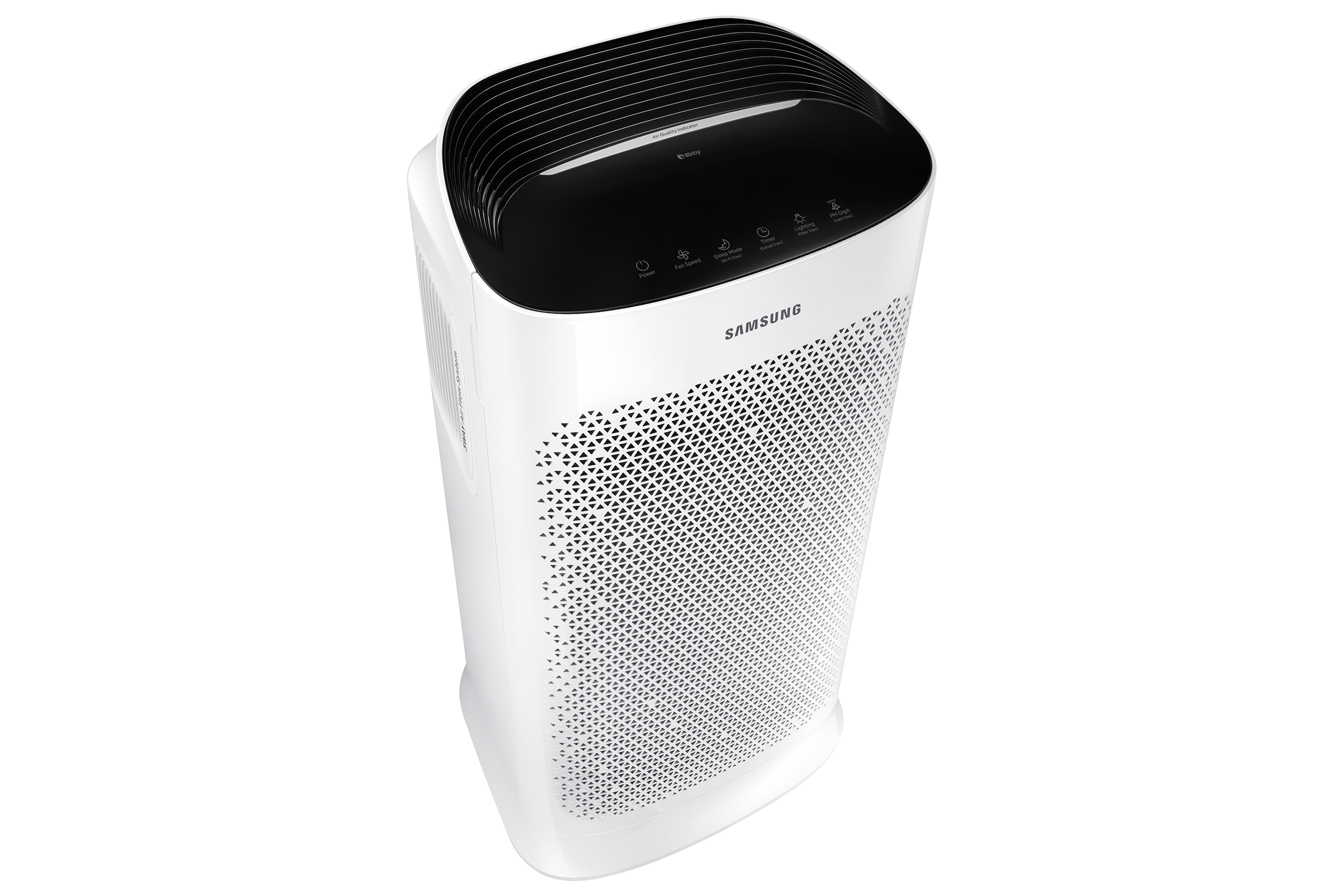
    Samsung AX5500 Air Purifier

    Once air has been purified, this clean air is distributed efficiently by the dual-power fan through the three-way air holes on the top, right and left of the device (this set-up allows the AX5500 to set flush against a wall). The fan speed can be manually set, but in Auto mode it will be automatically adjusted to the particle and odour levels around it to keep the room clean.

    On top of feeling like we’re breathing fresher air, we’ve also been impressed by how quiet the Samsung Air Purifier is, even when it’s on Auto mode.

    If you’re looking for something even quieter – such as when you’re sleeping, for example – the ‘Whisper Quiet Sleep Mode’ operates with a softer air flow and is incredibly quiet at just 20dBA. It also turns the display lights off, so there’s nothing to disrupt sleeping.

    The bottom of the unit is fitted with wheels, so it can easily be wheeled from room to room as needed.

    We couldn’t measure exactly how much cleaner our air was using the AX5500, but we were reassured by the four-colour indicator display system, which gives you an instant reading on the air quality in your space.

    When lighting on the display is blue it means the air quality is good (i.e., the PM10 level is 30 and below), the PM2.5/PM1.0 level is 15 and below and the gas pollution level is only at 1). Green indicates moderate air quality, yellow signifies poor pollution levels, and red means air quality is very poor.

    In the product launch media briefing, Samsung demonstrated how the colour indicator changed from blue to yellow when an aerosol was sprayed near it, and back to blue again as the air was purified.
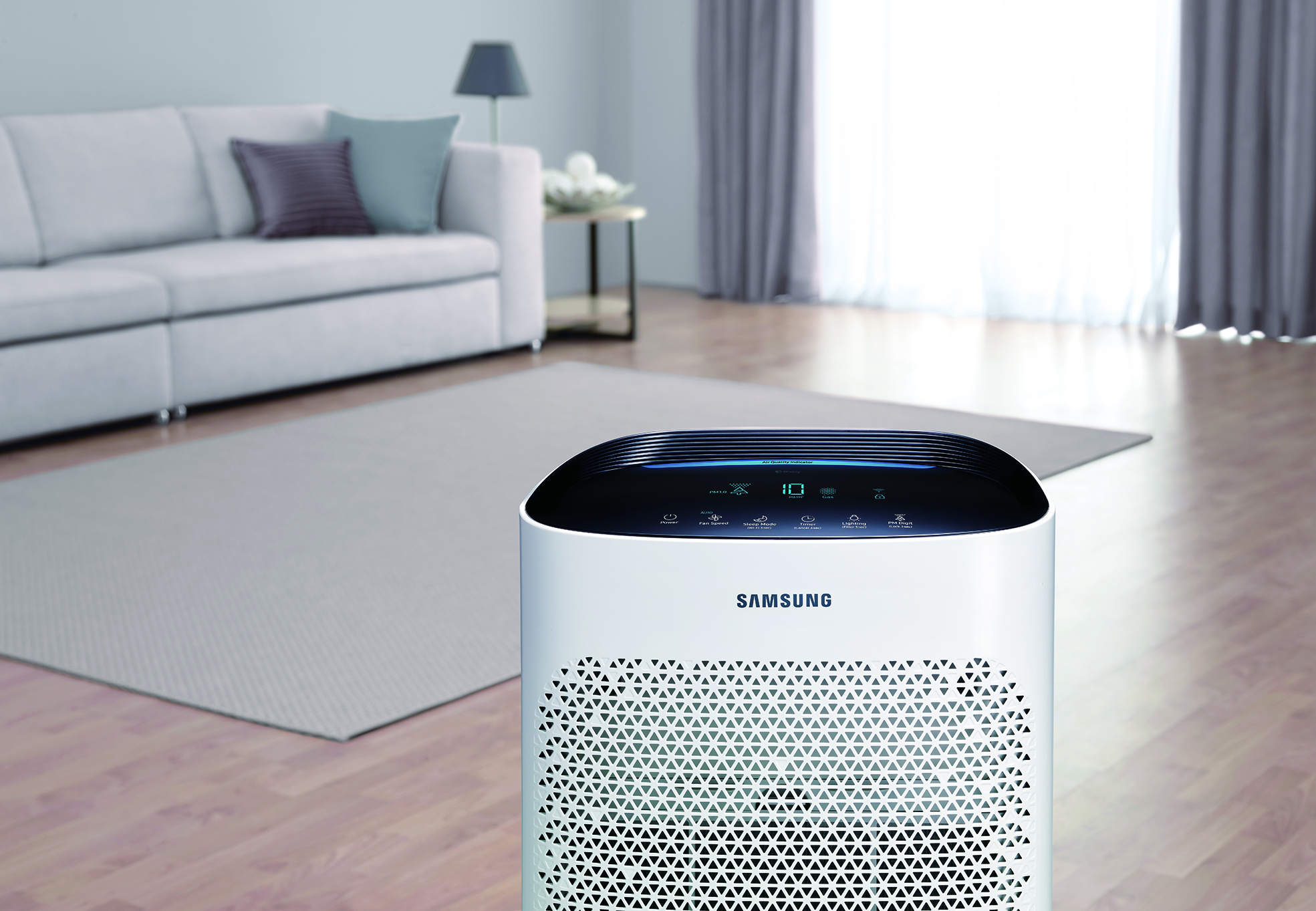
    Samsung AX5500 Air Purifier

    Like other recent Samsung appliances, the AX5500 can be controlled remotely via the SmartThings app. To do this, you will need to connect the device to your Wi-Fi network.

    Through SmartThings, users can check indoor and outdoor air quality, turn the device on or off, control the fan speed, set timers, adjust other settings, and source useful device information.

    The AX5500 is available at Samsung.com, JB Hi-Fi and The Good Guys now.

    Rating: 9/10

    The post Samsung Air Purifier Review: An Unobtrusive Way Of Improving Your Air Quality appeared first on Smart Office.

    ]]>
    https://smartoffice.com.au/samsung-air-purifier-review-an-unobtrusive-way-of-improving-your-air-quality/feed/ 0
    Harman Cranks Up JBL BAR Soundbar Range New Detachable Speakers https://smartoffice.com.au/harman-cranks-jbl-bar-soundbar-range-new-detachable-speakers/ https://smartoffice.com.au/harman-cranks-jbl-bar-soundbar-range-new-detachable-speakers/#respond Tue, 14 Apr 2020 00:36:37 +0000 http://smartoffice.com.au/?p=97662 JBL the Harman owned sound Company has announced three new soundbars as part of their BAR Series including one model that has detachable speakers. ChannelNews heard these soundbars at CES and they are impressive. Available in four models, BAR 2.0 All-In-One, BAR 2.1 Deep Base, BAR 5.1 Surround and Bar 9.1 ATMOS (coming in July ... Read more

    The post Harman Cranks Up JBL BAR Soundbar Range New Detachable Speakers appeared first on Smart Office.

    ]]>
    JBL the Harman owned sound Company has announced three new soundbars as part of their BAR Series including one model that has detachable speakers.

    ChannelNews heard these soundbars at CES and they are impressive.

    Available in four models, BAR 2.0 All-In-One, BAR 2.1 Deep Base, BAR 5.1 Surround and Bar 9.1 ATMOS (coming in July 2020), the series incorporate new audio technology developed in partnership with Samsung who are now selling an extensive range of Ultra High Definition TV’s that need Ultra High Definition Audio.

    The first thing you notice about the Harman BAR 2.0 is that they come across as simple and compact and unobtrusive especially if they are used in a small room. While the sound is big the design fits right into those that like minimalistic design.

    The BAR 2.0 includes Bluetooth, which allows 24bit audio to be streamed from a smartphone if the BAR is not being used for TV content.

    The gear that impressed me was the Bar 9.1 this is JBL’s first Dolby Atmos soundbar and it’s very flexible in what it can do. The bar design took me back to another highly popular sound bar from Philips that had removable side speakers.

    The new JBL Bar 9.1 coming in July has two battery-powered and detachable wireless rear speakers. You get 10 hours of surround audio from a single charge, and you can dock them back in the soundbar’s body to recharge.

    The bar also includes four upward-facing drivers that reflect sound around your room. It’s 4K HDR compatible and comes with a 10in wireless subwoofer. Audio can be streamed to the soundbar using Google Chromecast, Apple AirPlay 2 or Bluetooth.

    In the Bar 2.0 and Bar 2.1 Harman has built in Dolby Digital technology, they have also introduced new surround sound and a smart sound mode, into the BAR 2.0 that delivers excellent sound no matter what you watch or listen to.

    With the BAR 2.1 you get 300 Watts of JBL Signature Sound, this model comes with a 6.5” Wireless subwoofer, it also has an optical HDMI cable.

    The 5.1 BAR model has 550 Watts of power and a 10″ subwoofer, the built in JBL Multibeam technology delivers thumping bass which is great for those big action movies as it also has built-in Ultra HD 4K Pass-through with Dolby Vision.

    It also has Chromecast, Airplay 2 and Bluetooth built in.

    “Our Soundbar range gets better and better each year. JBL takes its experience in cinema and stadium sound and delivers it in a powerful and high-quality soundbar range. TVs are getting bigger and better with 8K technology and the sound needs to match. With the current environment of staying home and staying safe, entertaining yourself and your family has never been easier” said Marcus Fry, Country Manager of AUNZ at Harman.

    JBL BAR series will be available from Harvey Norman now starting from $279.95 AUD. For more information go to www.jbl.com.au.

    The post Harman Cranks Up JBL BAR Soundbar Range New Detachable Speakers appeared first on Smart Office.

    ]]>
    https://smartoffice.com.au/harman-cranks-jbl-bar-soundbar-range-new-detachable-speakers/feed/ 0
    Samsung Teaming Up With CBA For Samsung Pay https://smartoffice.com.au/samsung-teaming-cba-samsung-pay/ https://smartoffice.com.au/samsung-teaming-cba-samsung-pay/#respond Tue, 20 Feb 2018 23:13:48 +0000 http://smartoffice.com.au/?p=95970 Samsung is now working with the Commonwealth Bank offering Samsung Pay to CBA Mastercard credit and debit card holders. From today CBA customers can now access Samsung Pay through their Samsung wearables and smartphones. Michael Baumann, general manager everyday banking and payments at CBA says the partnership with Samsung Pay gives customers more ways than ... Read more

    The post Samsung Teaming Up With CBA For Samsung Pay appeared first on Smart Office.

    ]]>
    Samsung is now working with the Commonwealth Bank offering Samsung Pay to CBA Mastercard credit and debit card holders.

    From today CBA customers can now access Samsung Pay through their Samsung wearables and smartphones.

    Michael Baumann, general manager everyday banking and payments at CBA says the partnership with Samsung Pay gives customers more ways than ever to pay.

    Garry McGregor, director of IT and mobile, Samsung Electronics Australia says,“Samsung Pay not only provides users with a simple and secure way to pay, but it also allows users to load their loyalty cards to capture reward points at the point of sale, which lessens their reliance on a physical wallet.

    “With more than $6 billion of transactions across the CommBank app each week we know that our customers love using their phones to make payments. Since 2013 our customers have been able to use their smartphones to make payments.”

    Samsung Pay creates a tokenised card number for the user, which means no sensitive payment card information is stored on the device, and also requires PIN, Iris or fingerprint authentication before making payment.

    Users also receive remote access to the Find My Mobile website to easily lock their mobile phone device and prevent access to Samsung Pay if their device is misplaced. Additionally, the Samsung Pay app is housed on Samsung’s security platform Knox

    The post Samsung Teaming Up With CBA For Samsung Pay appeared first on Smart Office.

    ]]>
    https://smartoffice.com.au/samsung-teaming-cba-samsung-pay/feed/ 0
    Samsung Banks On M&A Targets https://smartoffice.com.au/samsung-banks-ma-targets/ https://smartoffice.com.au/samsung-banks-ma-targets/#respond Mon, 04 Dec 2017 00:29:03 +0000 http://smartoffice.com.au/?p=95856 Samsung Electronics’ US$8 billion purchase of automotive and audio electronics company Harman – announced earlier this year – has given the technology conglomerate confidence to chase more big deals, its strategy chief has said. Harman believes it can triple sales by 2025, CEO Dinesh Palliwal said in an interview at the IFA consumer electronics fair ... Read more

    The post Samsung Banks On M&A Targets appeared first on Smart Office.

    ]]>
    Samsung Electronics’ US$8 billion purchase of automotive and audio electronics company Harman – announced earlier this year – has given the technology conglomerate confidence to chase more big deals, its strategy chief has said.

    Harman believes it can triple sales by 2025, CEO Dinesh Palliwal said in an interview at the IFA consumer electronics fair here.


    Young Sohn, Samsung’s Silicon Valley-based chief strategy officer, said the move will see Samsung expand in automotive markets, digital health and industrial automation. “We are committed to using M&A as our tool, (and) I think the Harman acquisition helped us to have more confidence,” Sohn told Reuters. “I believe we can do lot more going forward.”

    The post Samsung Banks On M&A Targets appeared first on Smart Office.

    ]]>
    https://smartoffice.com.au/samsung-banks-ma-targets/feed/ 0